Automatic translation
This article has been translated automatically using computer technology. While we strive for accuracy, some wording or details may differ from those in the original article.
This translation was not manually reviewed. For important facts, quotations or legally sensitive information, please consult the German original. Individual selections, images, embedded media or technical terms may have been translated differently or incompletely.

2021 Iron and Steel Collective Bargaining Round Steel Collective Bargaining Negotiations Ahead of a Decision

Collective bargaining in the steel industry is entering a decisive phase. Today, IG Metall and employers are negotiating in Düsseldorf. The biggest sticking point remains the pay issue: So far, employers have offered a one-time payment of 350 euros for both 2021 and 2022. IG Metall wants more and permanent raises.

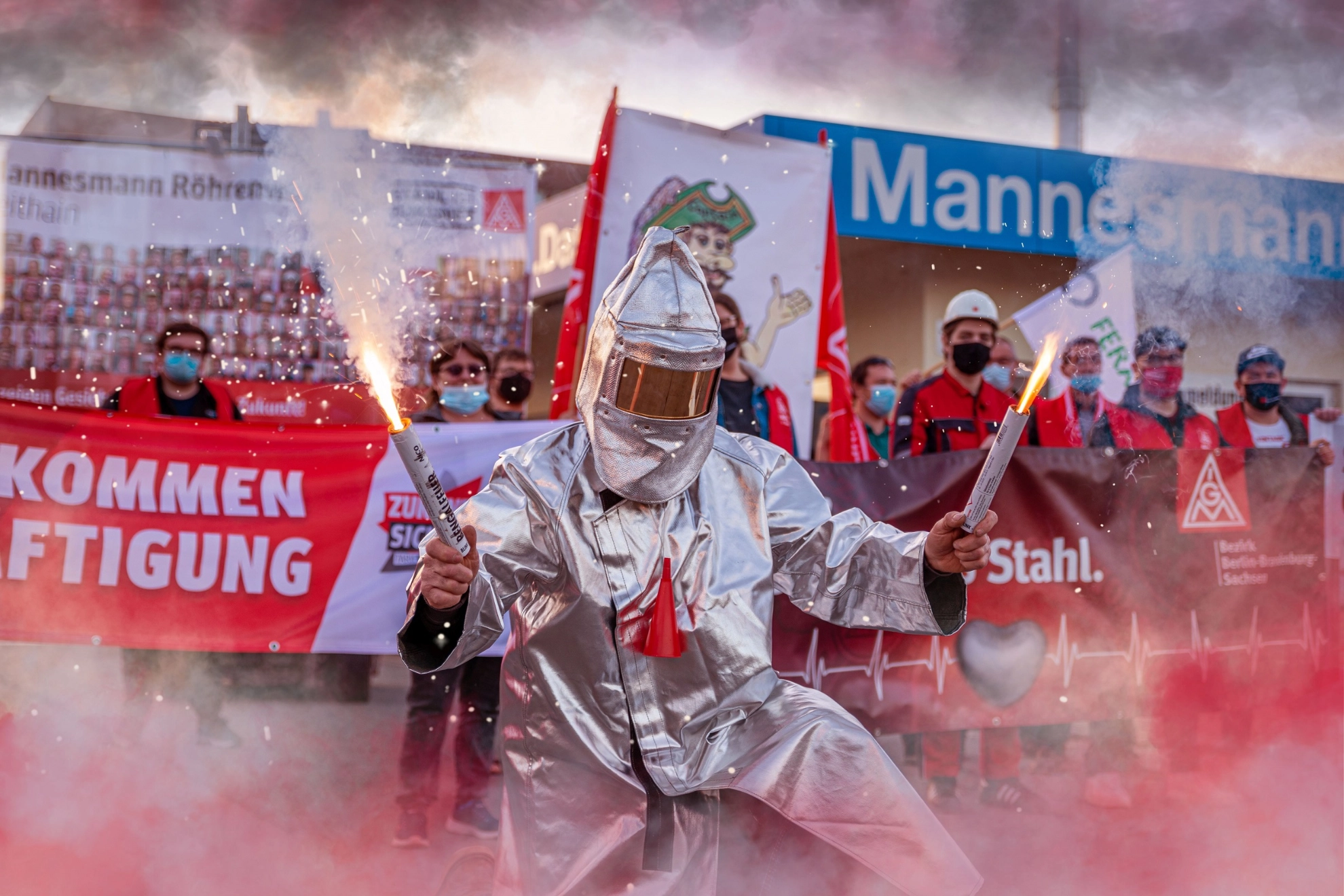
Warnstreik Mannesmann Röhren Zeithain

26 March 2021 26 March 2021


Today, IG Metall and employers are meeting in Düsseldorf to try to reach a solution in the collective bargaining negotiations for the Northwest Iron and Steel Industry. During the last round of negotiations in mid-March, employers offered a one-time COVID-19 bonus of 350 euros to be paid on June 30, 2021, as well as another one-time payment of 350 euros in February 2022. This payment is also to be convertible into time off to help secure jobs. However, the employers are not offering a permanent increase in wages. The agreement is to run for 17 months.

Get the latest updates on your smartphone via push notifications with our IG Metall app

“What the steel employers offered last week was too little, and the term was too long,” explains Knut Giesler, district director of IG Metall NRW and chief negotiator. At today’s negotiations, he says, a pay increase must be offered that will be permanently incorporated into the pay structure. “We also need this to be able to finance measures to secure jobs where necessary. The steel industry, in particular, faces major challenges that will not be resolved by next year.”


Negotiations in Eastern Germany on Tuesday

Next Tuesday, IG Metall will then hold negotiations in the East German steel industry. There, employers presented the same offer last week. That’s not enough for the workers on the shop floor. The order book is full, and there’s barely enough time to keep up with the workload. The workers expect this to be reflected financially—not just as a one-time payment, but as a permanent adjustment to the pay scale.

“It’s time for employers to make a move,” demands Birgit Dietze, regional director of IG Metall Berlin-Brandenburg-Saxony. Dietze emphasized that order books at many steel companies are full and that steel prices have reached record levels. “For the current calendar year—despite all the differences within the industry—the outlook is very positive. If we reach an agreement with too long a term, the steel companies will be back to full production and our colleagues will come away empty-handed. That’s not acceptable.”


(Photo: IG Metall)

IG Metall is demanding a 4 percent increase, which can be used both to boost wages and apprenticeship stipends and to fund measures to secure jobs.

Still, steel employers have offered to extend the collective bargaining agreements on job security, partial retirement, and contract work, and to fulfill a commitment to engage in talks regarding dual-track students—as demanded by IG Metall. They also proposed initiating talks on a collective bargaining agreement for transformation.

Separate negotiations are still underway in the Saarland steel industry, where the collective bargaining agreements do not expire until the end of May.
New on igmetall.de
Aktionstag bei Mercedes Benz, Daimler, in Sindelfingen gegen die Angriffe auf Beschäftigten in der Automobilindustrie.
Resistance to Attempts at Drastic Cuts Auto industry workers issue a warning
Sie wollen doch nur dein Bestes
Redistribution Making Germany more equitable: We need this tax reform now
Der Streik bei Kelvion in Nobitz-Wilchwitz begann am 4. August 2026. Die Geschäftsleitung will nach Sarstedt/Niedersachsen verlagern - obwohl die Produktion in Wilchwitz profitabel und bis ins nächste Jahr ausgelastet ist.
"It’s worth fighting for!" Kelvion workers strike for a social collective bargaining agreement
Ruhrpott Rebellion am 07.07.2026
Welfare State September 26: Nationwide Day of Action for Social Policy
Beschäftigter arbeitet an einem Getriebe in einer Fabrik
Working Hours Why working longer doesn’t help—and actually does more harm than good
Ein männlicher Land- & Baumaschinenmechatroniker prüft einen Traktor mit einem Tablet
2026 Collective Bargaining Agreement for the Metalworking and Agricultural Engineering Sectors Greater Flexibility in the Metalworking and Agricultural Engineering Sectors in Lower Saxony and Bremen
Elektronikerin prüft die Spannung an einem Schaltschrank.
2026 Collective Bargaining Round for the Electrical Trades Wage Increase in the Electrical Trades in Berlin-Brandenburg
Benjamin Heine ist Mitarbeiter der BMA in Braunschweig
2026 Collective Bargaining Round for Metal Fabrication and Precision Engineering Higher Wages in the Metal Fabrication and Precision Engineering Sectors in Southwest Germany
Metall-Arbeiter beim Schleifen
2026 Collective Bargaining Round for the Metalworking Trade Employees in the Berlin-Brandenburg metalworking sector will receive higher pay
Beschäftigte von Thyssenkrupp demonstrieren in Essen am 23. Mai 2024 gegen das Vorgehen der Geschäftsführung beim geplanten Teilverkauf des Unternehmens.
Defend the welfare state All dates for nationwide actions against cuts to social services
IGM Aktion VW Wolfsburg
On September 21, things will get loud Nationwide Day of Action: Auto Industry Workers Fight Back Against Mass Layoffs
Auszubildender in einer Schreinerei
Apprenticeship Wages Questions and Answers About Apprenticeship Wages

Subscribe to the newsletter