Automatic translation
This article has been translated automatically using computer technology. While we strive for accuracy, some wording or details may differ from those in the original article.
This translation was not manually reviewed. For important facts, quotations or legally sensitive information, please consult the German original. Individual selections, images, embedded media or technical terms may have been translated differently or incompletely.

Current ICT Pay Analysis Over 15 Percent More for ICT Employees Under a Collective Bargaining Agreement

ICT workers covered by a collective bargaining agreement earn, on average, more than 15 percent more than those in companies without such an agreement. At the same time, their average working hours are shorter. This is shown by IG Metall’s new ICT pay analysis, where ICT workers can also check and compare their own pay.

Ein Team von Entwicklern sitzt vor den Rechnern und arbeitet

13 May 2025 13 May 2025


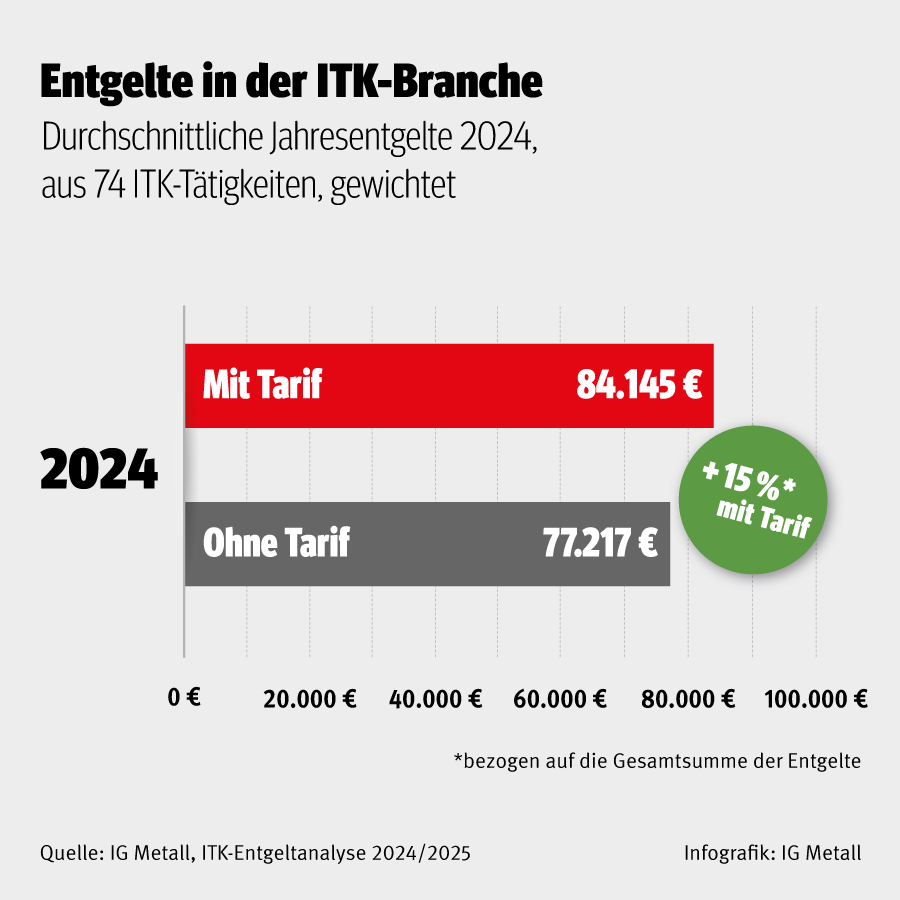
Whether or not a collective bargaining agreement is in place makes a noticeable difference even in the information technology and telecommunications (ICT) sector. ICT employees covered by a collective bargaining agreement earn, on average, 15 percent more than their colleagues who are not covered by such an agreement. This is shown by IG Metall’s latest ICT Compensation Analysis 2024/25. The annual survey of wages in the ICT sector revealed average income growth of 3.9 percent across all sectors as of December 31, 2024.

For the analysis, over 37,000 salary data points were collected from 94 companies. The results clearly showed that companies bound by collective bargaining agreements perform better year-over-year than those not bound by such agreements. The positive effect of collective bargaining agreements is particularly evident in the job family of software engineers. At hierarchical level 3—Senior Software Specialist—the average income of employees covered by collective bargaining agreements is nearly 14 percent higher than that of employees not covered by such agreements. That amounts to a difference of 10,500 euros.

“The survey results confirm that employees in companies bound by collective bargaining agreements are better paid. Given the shortage of skilled workers in IT professions, IT professionals will base their job and career decisions even more heavily on whether their employer is bound by a collective bargaining agreement,” explains Christiane Benner, First Chair of IG Metall. “Our initiative increases transparency for employees regarding earnings in the IT sector.”


Infografik Entgelte in der ITK-Branche 2024


Shorter Work Hours Under Collective Bargaining Agreements

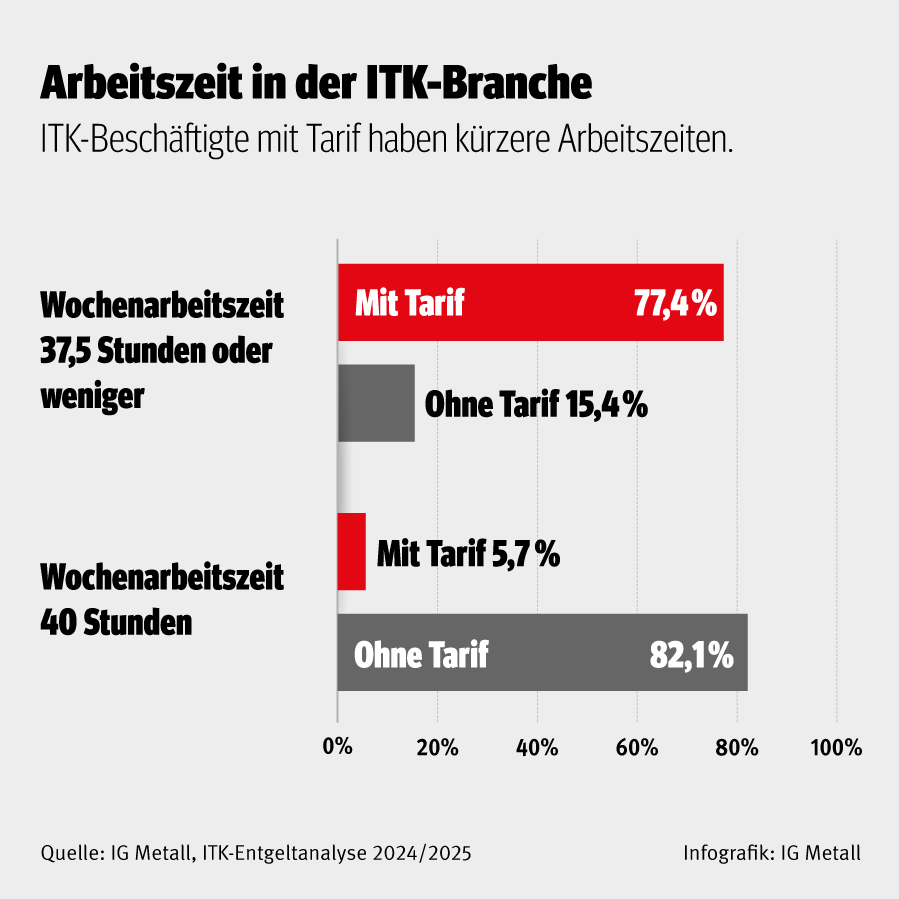
In its annual ICT compensation analysis, IG Metall also surveys the average weekly working hours: More than three-quarters of employees covered by a collective bargaining agreement work 37.5 hours or fewer. In contrast, 82 percent of employees not covered by a collective bargaining agreement work 40 hours per week. Despite the shorter working hours, employees covered by a collective bargaining agreement earn a higher annual salary.


Grafik Arbeitszeit in der ITK-Branche 2024


Check and compare your pay

The results of the 26th survey areavailable online atitk-entgeltanalyse.igmetall.de . For works council members, union representatives, and other active members in the workplace, additional background information and analyses are available—if you’re interested, please contact us by email atitk@igmetall.de 


Our collective bargaining tables provide further information on pay in the ITC sector

New on igmetall.de
Landkarte mitmarkern für Geschäftsstellen
IG Metall on Site
Advice, Service, Assistance

Any questions? Contact your local IG Metall office for more information.

Ein lachender Mann mit IG Metall-Kappe in einer Menschenmenge.
IG Metall App
News straight to your smartphone

News on current topics, guides, pay scale tables, and more—download the IG Metall app for Android or iOS!

Subscribe to the newsletter