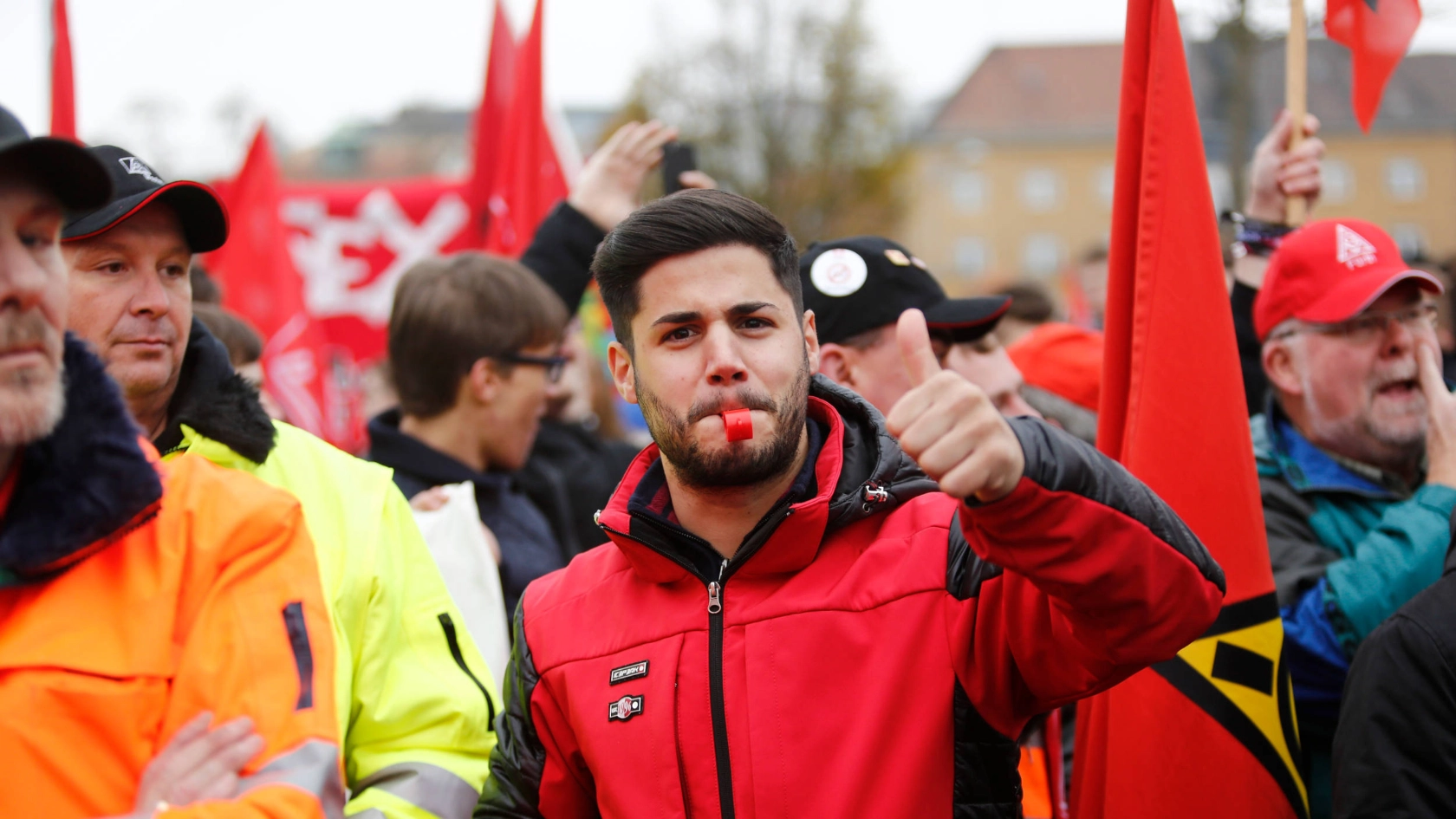
We wanted to secure jobs, shape the future, and stabilize incomes. With the collective bargaining agreement in the metal and electrical industries, we’ve succeeded in doing just that. Over a million metalworkers fought for this through warning strikes.
Notable new features include longer-term models for reducing working hours, rules for future collective bargaining agreements, and a new annual special payment—the “transformation allowance” or “transformation component.”
A COVID-19 bonus of 500 euros will be paid out as early as June, with 300 euros for apprentices.
The outcome stands for solutions based on solidarity. In the midst of a global pandemic and the resulting economic crisis, job security for workers was the top priority.
Under the collective bargaining agreement, working hours can be collectively reduced within a company for up to 36 months—preferably in the form of a 4-day workweek with 32 hours. Layoffs for operational reasons are prohibited during this period.
Discussions Even Before the Crisis
To secure and shape the future of work, we have established framework provisions for future collective bargaining agreements: Going forward, works councils and IG Metall can call on employers to engage in discussions about the future.
In future collective bargaining agreements, we aim to agree on how the company will successfully position itself for the future and what measures are necessary to achieve this. The new collective bargaining provisions call for discussions on the company’s vision, skills development, change management, and the development of the company’s location and workforce.
The New Transformation Fund
Regarding financial support, we demanded a funding level in the collective bargaining negotiations that companies can also use to secure jobs.
Following the COVID-19 bonus of 500 euros in June 2021, employees will receive a “transformation allowance” (known as the “transformation module” in Baden-Württemberg) equal to 18.4 percent of their monthly pay in February 2022. In February 2023, the transformation payment—known as “T-Geld” or “Trafo module” for short—will then increase to 27.6 percent.
From that point on, the transformation allowance will be permanent, serving as a new special payment. Employees will then receive the T-allowance every February.
In companies facing a crisis, the transformation allowance can alternatively be used to reduce working hours—and thus secure jobs. In combination with other special payments and employer contributions, working hours can be reduced to 32 hours per week—while employees are still paid for a full 34 hours.
Collective Bargaining Agreement Also Applies to Dual-Track Students
Employers wanted to cut back on training. We prevented that. We secured apprenticeship positions and guaranteed job placement upon completion.
In addition, we’ve succeeded in extending our collective bargaining agreements to cover an increasing number of dual-track students. In Baden-Württemberg alone, this brings 10,000 dual-track students at the Dual University (DHBW) under the collective bargaining agreement. IG Metall and employers are now negotiating to include additional dual-track students—such as those in the practice-integrated model—in the collective bargaining agreement.