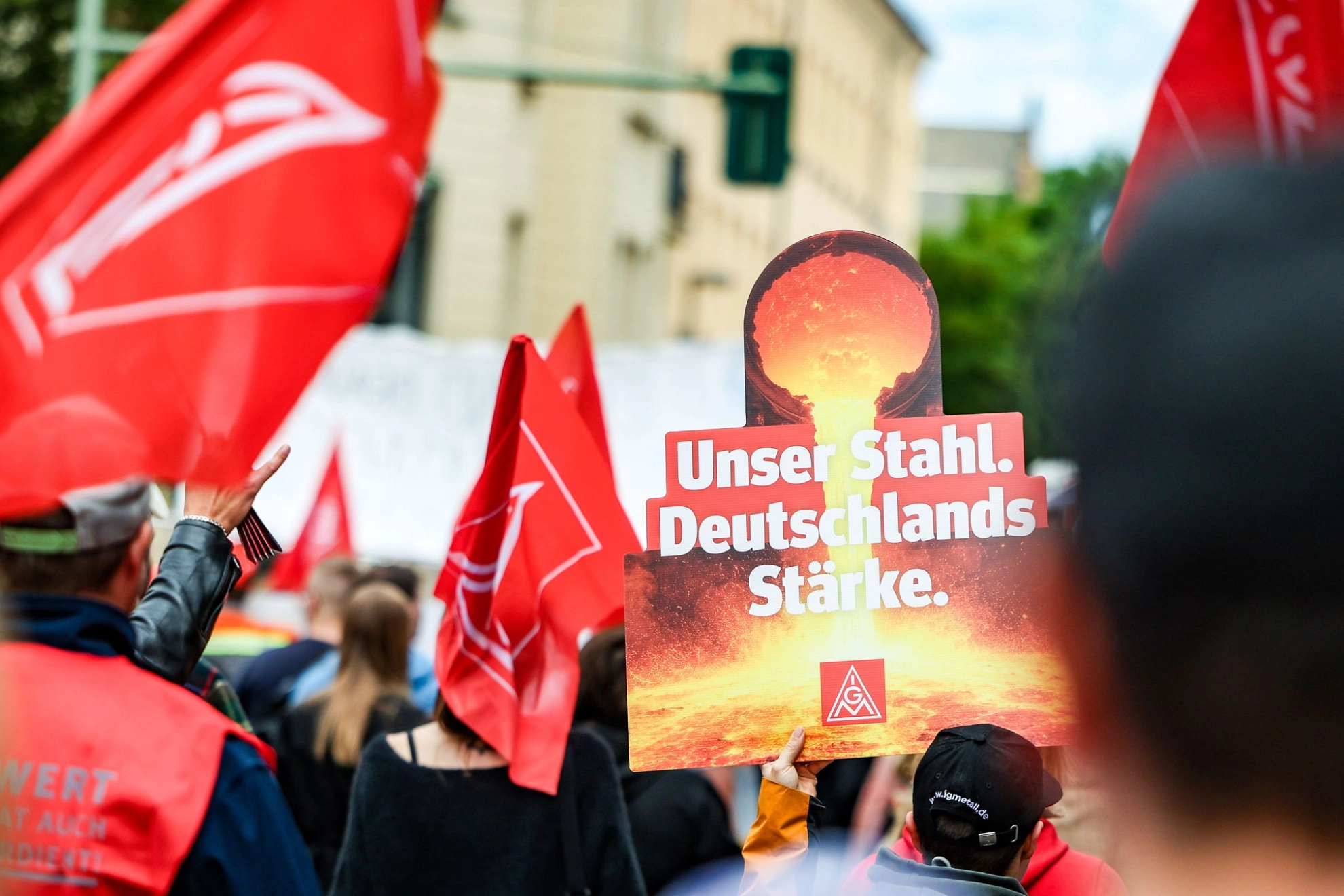
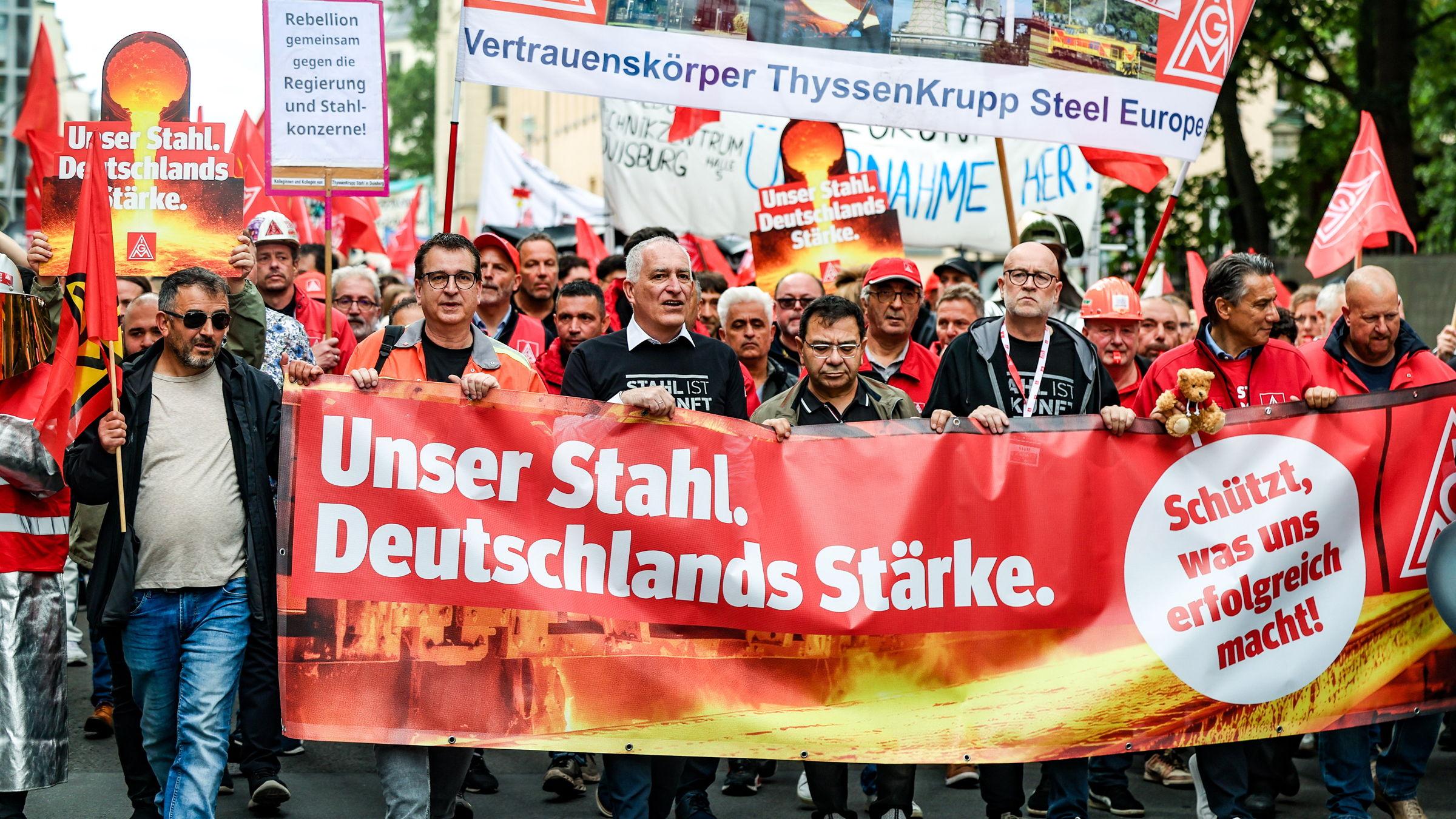
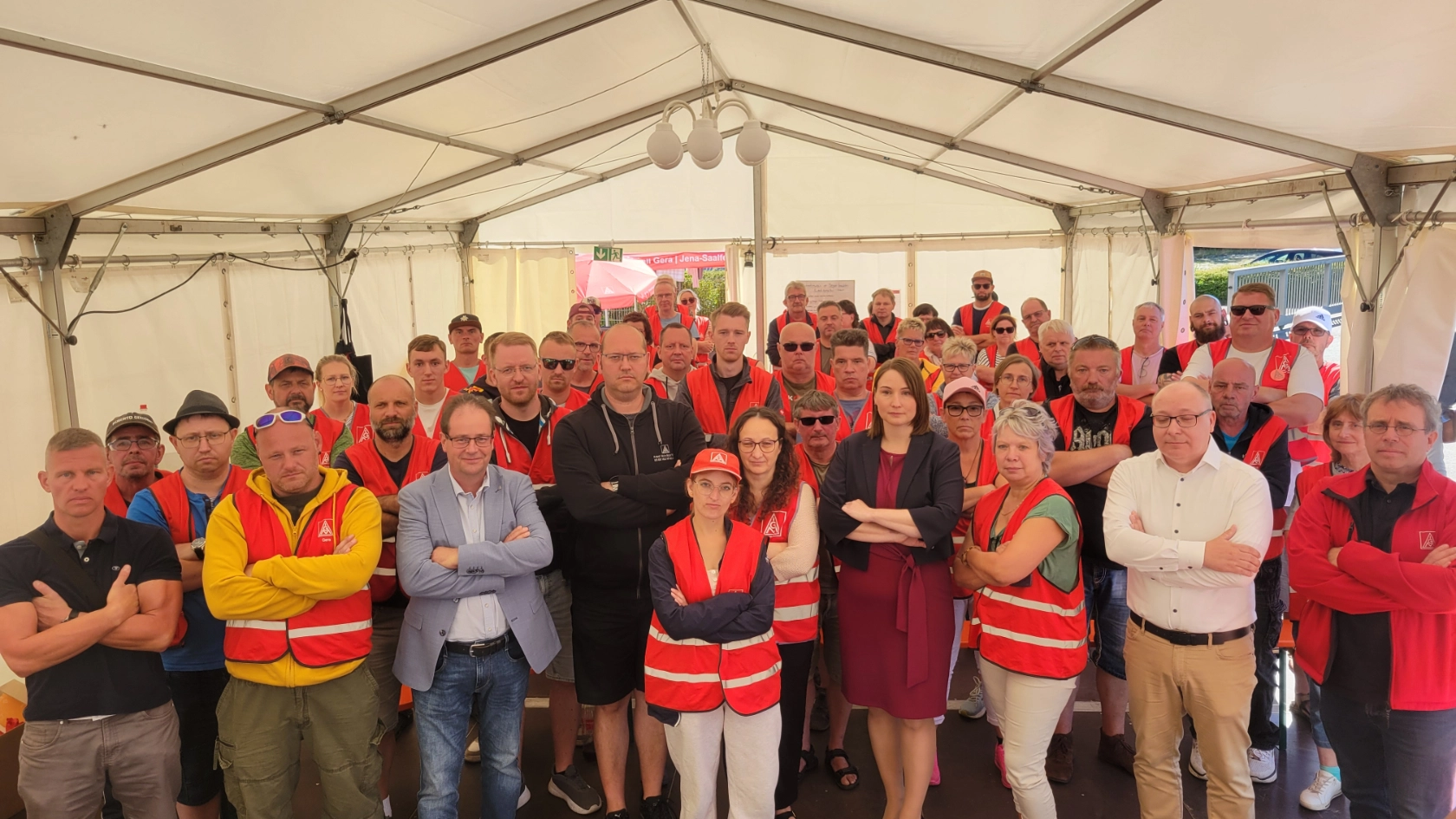
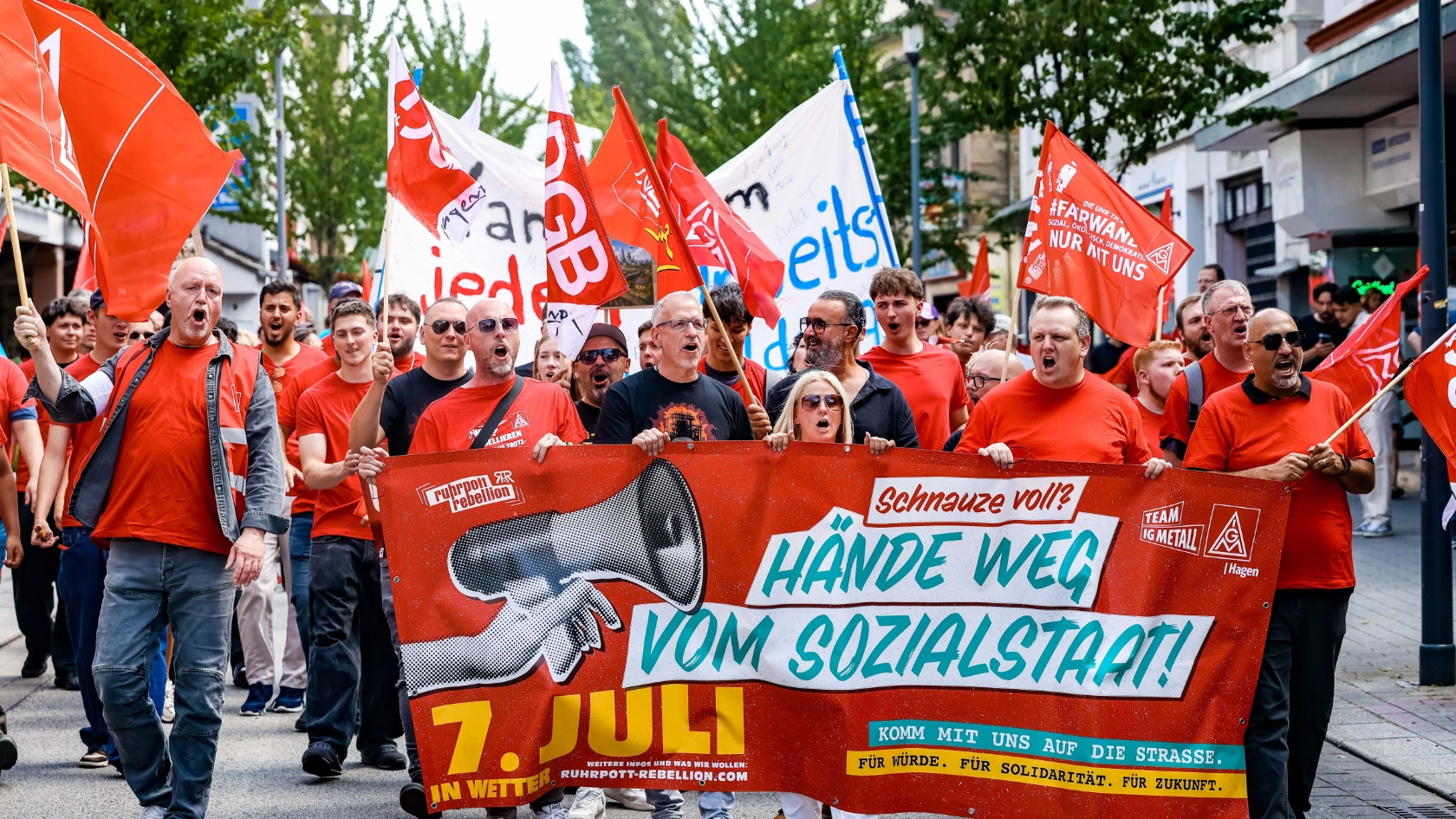
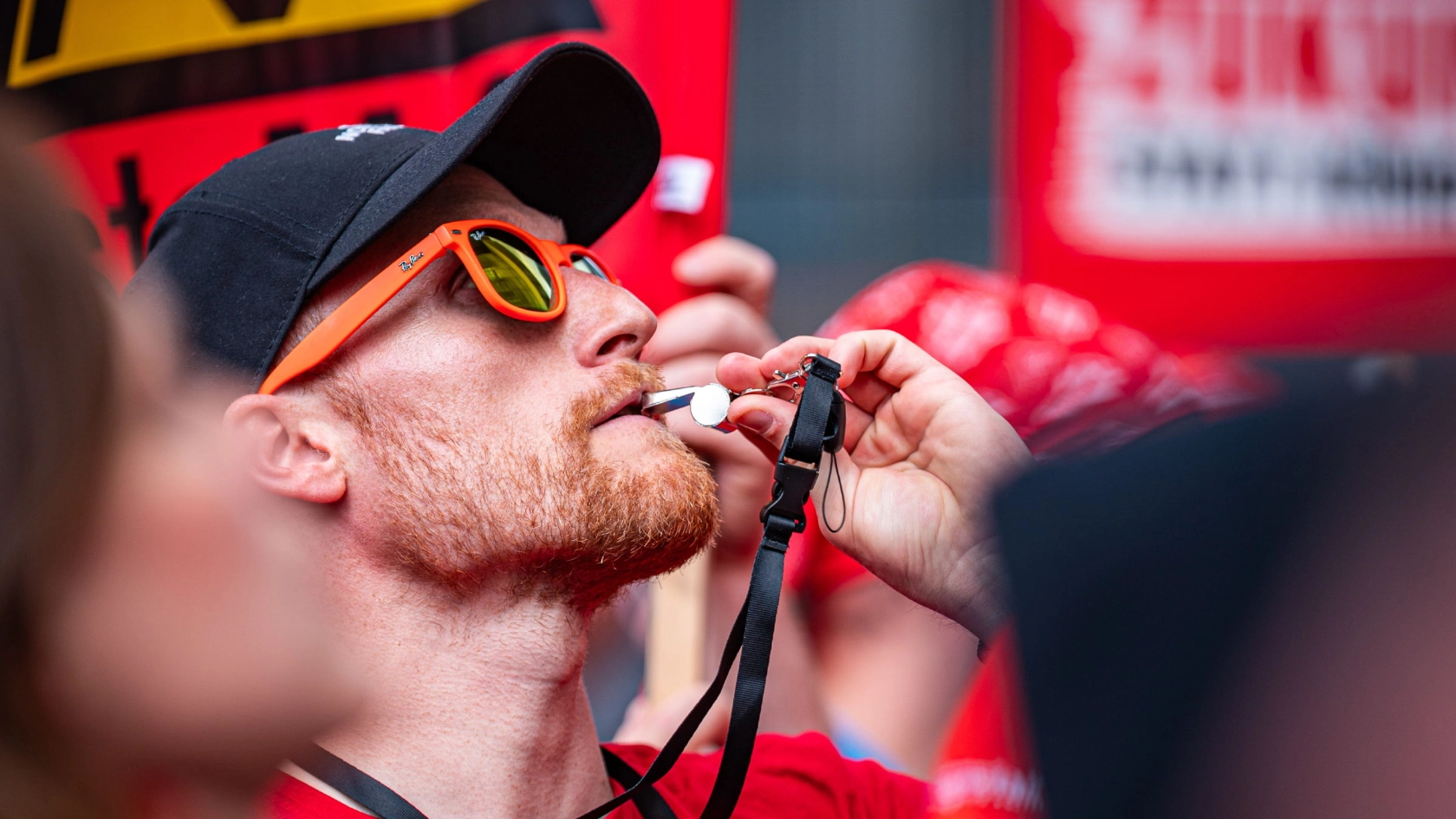
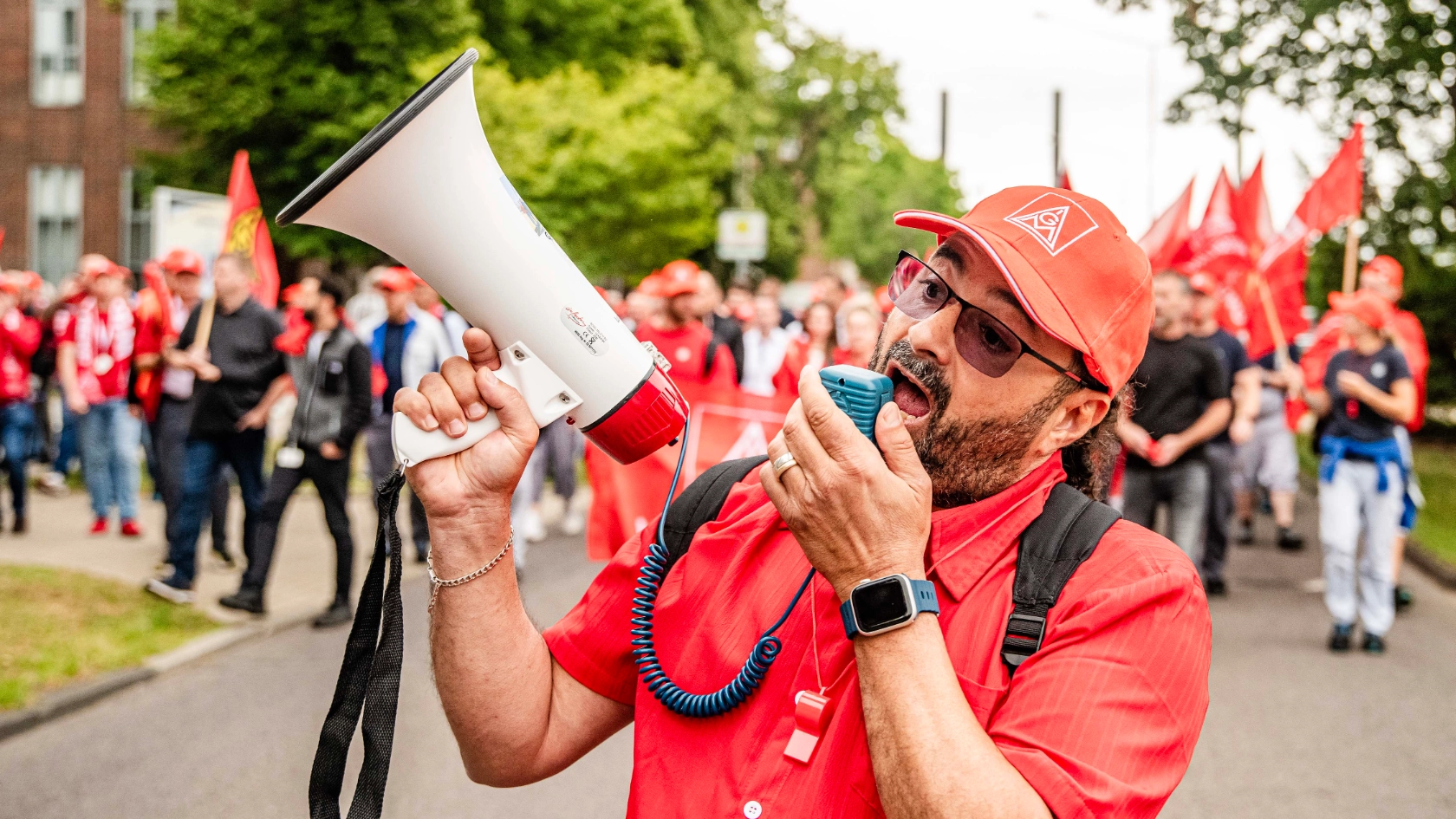
Protesters from the “Box Stop Steel Industry” demonstration march through Berlin.
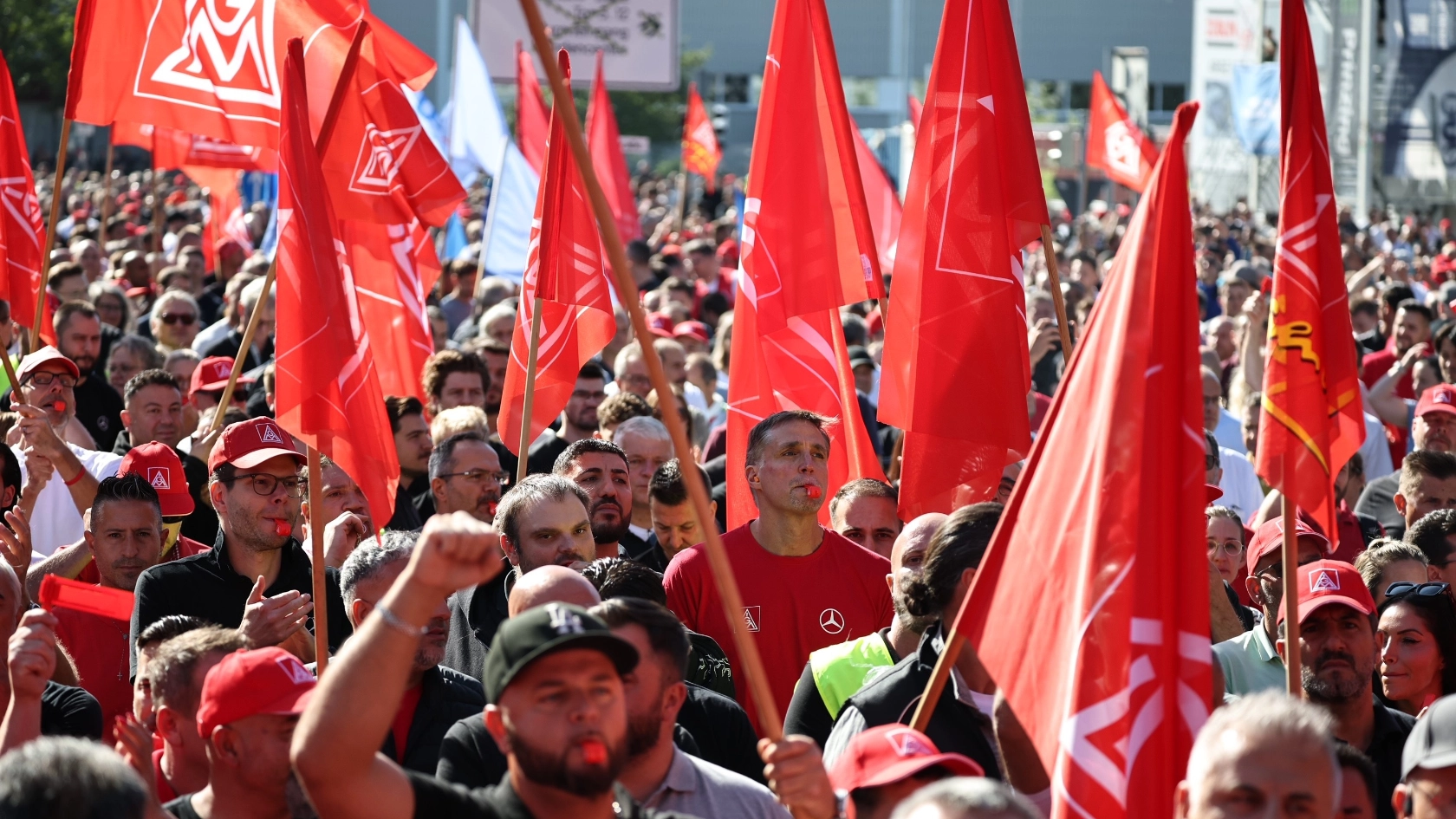
The demonstrators’ whistles, megaphones, and blood-curdling chants of “Steel is the future” rouse the last sleepers on this Friday morning and are meant, above all, to wake up the political establishment. And so it begins. The procession sets off, winding its way through the city. The destination: the Federal Ministry of Economics. This is where the metalworkers—the employees of the steel industry—intend to present their key demands. And those demands are: Lower energy prices! Strengthen industry! No room for dumped steel!
At the same time, around 8,500 steel industry workers in Saarland are taking to the streets to support the fight for the future of the steel industry from there. “Today we’re not standing here as individual companies; today we’re standing here as one steel family, fighting together for our future,” shouts Tekin Nasikkol, chairman of the general works council at thyssenkrupp Steel, into the microphone at the rally in front of the Federal Ministry of Economics. He emphasizes: “Without steel, there are no wind turbines, no power grids, no bridges. Without steel, there is no industrial nation. And Germany must remain an industrial nation!”
The Future of the Steel Industry Depends on Policy
The German steel industry is under considerable pressure to transform and compete. Thousands of jobs, key industrial value chains, and entire regions are at stake. For this reason, IG Metall organized the demonstration and rally in Berlin, which send a clear political message: The transformation of the steel industry must be implemented decisively, reliably, and with social safeguards.
“We are fighting together for the future of the steel industry. We produce green steel, and our steel mills are becoming climate-neutral as far as possible. But policymakers must create the framework conditions. And policymakers are moving at a snail’s pace,” emphasizes Jürgen Kerner, Second Chairman of IG Metall. IG Metall has already achieved some progress and secured certain concessions from policymakers at the last steel summit in November 2025. But that’s not enough yet. Jürgen Kerner makes it clear: “The glass is half full. But half full is not a solution. That’s why policymakers must deliver now.” IG Metall is calling on policymakers to find solutions in four areas.
The steel industry needs competitive electricity prices
Anyone who wants to produce steel competitively needs competitive electricity prices. The metalworkers made that clear in Berlin. IG Metall has been fighting for competitive electricity prices for energy-intensive industries for five years now. Now, Federal Minister of Economics Katherina Reiche has proposed an industrial electricity price. But it’s very different from what IG Metall had demanded. It is tied to numerous conditions, can only be applied to half of electricity consumption, and is valid for only three years. Taxes and levies are added on top of that. These measures are not enough to keep pace with international competition. “We need an industrial electricity price of 5 cents per kilowatt-hour—including all taxes and levies,” says Jürgen Kerner.
Comprehensive Protection Against Cheap Imports
To cut off funding for Russia’s war economy, the EU banned imports of many Russian products following Russia’s attack on Ukraine. There are also steel sanctions, but IG Metall and the demonstrators in Berlin—who are calling for a more consistent import ban—believe there are far too many exceptions. Every year, 3.6 million metric tons of Russian slabs are still being shipped to the EU, mostly via third countries. This continues to support the Russian war economy. Furthermore, it perpetuates distortions of competition in the European market.
Cheap imports of subsidized steel from China also threaten the German steel industry. At the urging of IG Metall, the EU is strengthening trade defense measures. New regulations will take effect in July: These will cut the duty-free import quota into the European Union in half and impose a punitive tariff of 50 on steel imports exceeding that quota—twice as much as before. That’s a good step, but the demonstrators and IG Metall are also demanding that loopholes be closed in this area. The demonstrators’ signs get right to the point: “Our steel. Germany’s strength. Protect what makes us successful!”
Better Use of Domestic Steel in Public Contracts
The European Commission aims to increase demand for low-carbon technologies and products manufactured in Europe while simultaneously strengthening key industries in Europe. To this end, it has presented the Industrial Accelerator Act. It’s a good initiative, but in its current form, the EU’s proposal offers little benefit to the steel industry. On the positive side: Steel is classified as a strategic sector in Europe. Also positive: Starting in 2029, 25 percent of the steel used in public works projects—such as bridge construction—must be climate-friendly. This could help steel producers with their transition. The problem, however, is that imports of subsidized Chinese steel are also included in this requirement. This can and will put European producers at a disadvantage. IG Metall is therefore calling for stronger protection for European steel and clear rules on origin. The federal government and the Ministry of Economics must advocate for this, as the metalworkers made clear at the demonstration in Berlin.
In general, IG Metall is calling for “European content” regulations in public procurement. When the government spends taxpayer money—for example, to build bridges or purchase trams for public transit systems—that money should go toward domestic products. After all, this is simply a better use of funds: Domestic companies and their employees then pay their taxes here, which in turn generates new public revenue.
Transformation Requires Planning Certainty
The EU is currently debating whether to adjust its emissions trading system. So far, it works like this: Anyone who emits CO2 must present CO2 allowances to cover those emissions. The EU is continuously reducing the number of allowances, causing their price to rise. This is intended to incentivize European companies to transition their production to climate-friendly methods. Now, the European Commission is considering slowing down or temporarily suspending this reduction. This is dividing the steel industry—for some, it’s good; for others, it’s bad.
The problem with reversing course is that companies like Saarstahl or Salzgitter AG, which have made massive strides toward green steel production, would be penalized for their progress in transformation. This is because green steel production is more expensive, and their new business model would no longer be competitive—and would not work—if the increases in CO2 prices were suspended. At the same time, there are many steel manufacturers that have not yet been able to embark on the path of transformation because they lack the necessary framework conditions and resources.
IG Metall is therefore calling on policymakers to act prudently. Jürgen Kerner emphasizes: “We need planning certainty for the first movers—that is, the companies that have used taxpayer money to begin producing green steel—so that their business models remain viable. And we must find a solution that ensures we don’t suffocate the companies that want to transition but are facing difficulties.”
Steel Is More Than Just a Material
“When we talk about steel, we’re not talking about just any material. We’re talking about the foundation of our industry,” emphasizes Jürgen Kerner, explaining: “Without steel, there is no mechanical engineering. Without steel, there is no infrastructure. Without steel, there is no energy transition. We are part of the solution. Not the problem. Steel is the future! And that is exactly why we need a clear commitment: to the industry. To the region. To the workers. We need investment. In infrastructure. In energy. In innovation. And we need reliable framework conditions. Not for two years. But for ten, fifteen years. Because only then will companies invest. Only then will jobs be created. Only then will the future take shape.”
“Steel Is the Future” Campaign