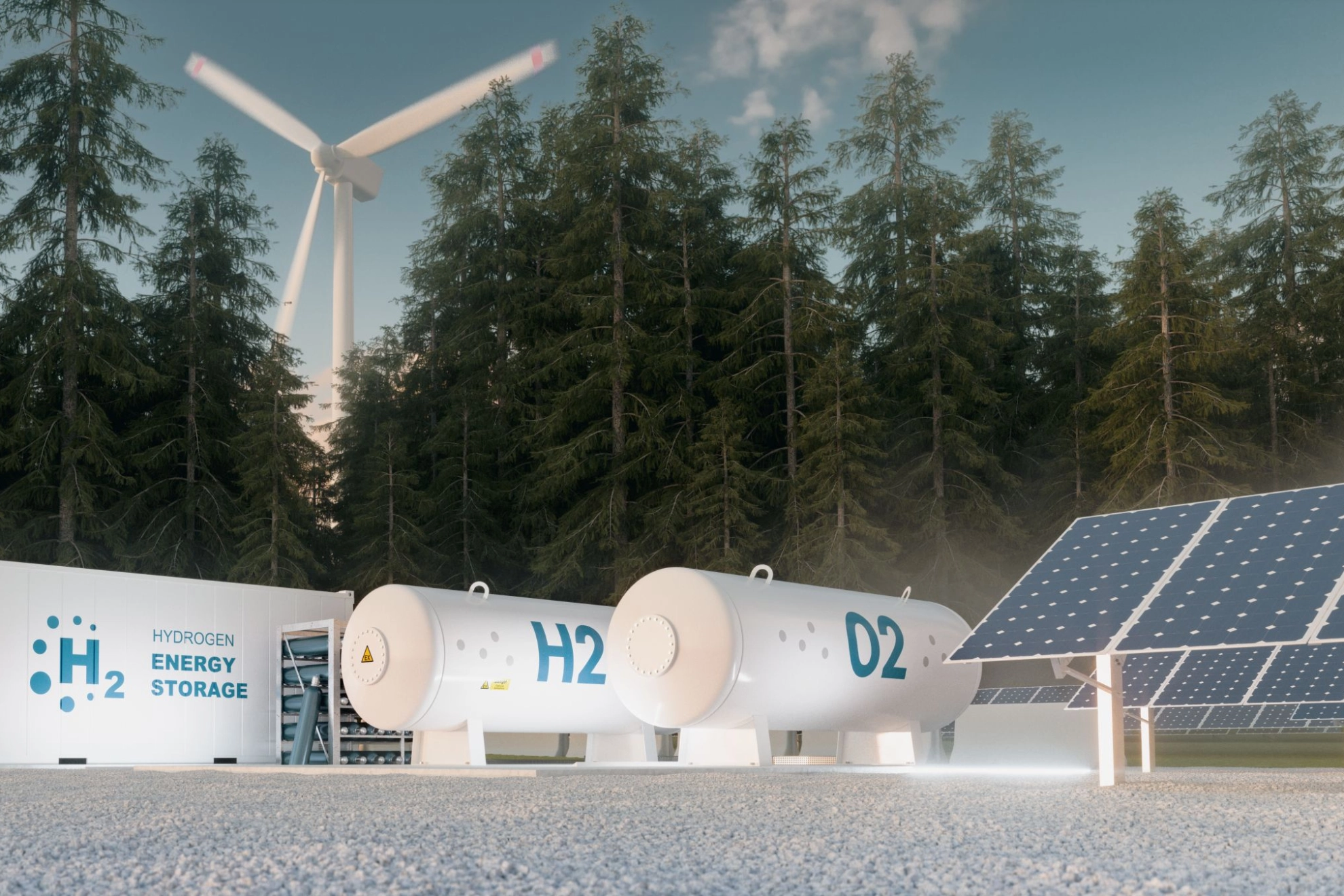
Industry, mobility, electricity and heat generation—all of these must be completely climate-neutral in just over 20 years. Fossil fuels such as coal, oil, and gas will disappear and be replaced by renewable energy sources. But the raw material of the future won’t just be wind or solar—hydrogen will also play a crucial role. The first element on the periodic table is used especially in areas where achieving climate neutrality becomes particularly challenging.
What hydrogen can and cannot do, where it comes from, and how it is used—we have the answers.
How can hydrogen replace oil or gas?
Hydrogen is an energy carrier. This energy can be “released,” for example, through a fuel cell. Here’s how it works: Hydrogen (H) is combined with oxygen (O); the elements react to form water (H₂O)—producing electricity and heat in the process. Hydrogen can be used to power trains, excavators, airplanes, and trucks, as well as ships, or to provide heat—or both—for industrial processes. The key point here is that while coal, oil, or gas always produce CO₂ at the end of the reaction, hydrogen produces only water. So, if we replace fossil fuels with hydrogen, industry, transportation, and heating can become climate-neutral.
Where does the use of hydrogen make the most sense first?
The answer to that question can be summed up in three words: in the steel industry! But let’s start from the beginning: There are many potential applications for hydrogen—it’s just that this “fuel of the future” is still in short supply. While demand is already very high, supply is only slowly gaining momentum. The result: the price is high. And that’s likely to remain the case for the time being. The bottom line is: “As a society, we have to spend a lot of money,” says Matthias Deutsch, program director for hydrogen at the think tank Agora Energiewende, which advises the German federal government. He therefore recommends that we use hydrogen only where there are no other alternatives. For Deutsch, these are: steel, chemicals, and a few other industrial sectors. When it comes to heavy-duty vehicles, that’s still up for debate, according to Deutsch. But of course, the price will also determine where it’s used.
How can hydrogen be used to produce green steel?
There’s a reason why climate experts want to channel scarce hydrogen into the steel industry first: “Steel accounts for 30 percent of industrial CO2 emissions. That makes it our biggest lever. And this lever can be shifted toward climate neutrality,” explains Tekin Nasikkol, chairman of the works council at Thyssenkrupp Steel. Technologically, this is possible. Instead of being produced in a blast furnace using coking coal, steel would then be produced in a direct reduction plant using hydrogen. But there’s still one catch: “We finally need the appropriate framework conditions from policymakers,” says Nasikkol, a steelworker.
The Duisburg native is not alone in this demand. “We can make the technological transition quickly, but the federal government and the EU must provide support,” adds Hasan Cakir, chairman of the works council at Salzgitter Flachstahl. To become climate-neutral, there are three things the domestic steel industry needs from policymakers: First, financial support for building the new facilities. Second: financial support to cover the resulting increase in operating costs. That’s because producing climate-neutral steel using hydrogen is significantly more expensive. Third: infrastructure that ensures the supply of hydrogen to steel mills. Thyssenkrupp Steel works council member Nasikkol illustrates the scale of the quantities involved: “For our steel production, we need twice as much hydrogen as the gasometer in Oberhausen can hold—and that’s per hour!”
Is there already green steel from Germany?
Yes, there is already green steel from Germany that has been produced using hydrogen. But so far, only in very small quantities. The first pilot plants for this have already been built or are in the planning stages. In Salzgitter, for example, a small-scale direct reduction plant is already in operation. In Duisburg, a large plant is now being built at a cost of 2 billion euros, which is scheduled to begin production in 2026. This is made possible by financial support from policymakers, which IG Metall has fought to secure.
But this is only the beginning. “We can’t stop at just a few pilot projects,” warns Jürgen Kerner, chief treasurer and executive board member of IG Metall. Kerner emphasizes: “We have 15 blast furnaces. Ultimately, we’ll have to convert them all.” To preserve the sites, IG Metall is advocating for local content regulations for green steel. Furthermore, “Companies should only receive government subsidies if they guarantee jobs,” emphasizes Tekin Nasikkol, chairman of the works council at Thyssenkrupp Steel. IG Metall is also putting pressure on policymakers to ensure this.
What Role Does Hydrogen Play on the Road?
Since hydrogen is in very short supply and all newly registered cars in the EU must be climate-neutral starting in 2035, battery-electric driving is likely the only realistic option for private transportation for the time being. Nevertheless, there are areas where hydrogen can make sense even for four-wheeled vehicles: high performance over an extended period—that’s what makes its use appealing. On the roads and in cities, this primarily applies to construction vehicles and heavy machinery, for which hydrogen is a viable option.
Georg Töpfer, project coordinator for advanced development at the engine manufacturer Deutz, sees the advantage of hydrogen in that diesel engines can be adapted to the new fuel relatively easily. However, he questions whether there will still be suppliers in the future to provide the necessary parts for its operation. That is one reason why Töpfer and the metalworkers at Deutz take an open-technology approach to their development work: biodiesel, multi-fuels, hydrogen, or synthetic fuels. They explore all options and advise their customers on which solution is best for their specific applications.
And what about trucks and buses?
Most truck manufacturers are primarily focusing on battery-electric vehicles. In heavy-duty road transport, hydrogen is likely to play more of a niche role. Fuel cell vehicles and vehicles powered by hydrogen-based e-fuels will become particularly relevant, for example, in areas where there is no suitable fast-charging infrastructure. The issue of power and range—which a few years ago was cited as an argument against batteries and in favor of hydrogen—is becoming less and less decisive as batteries continue to improve. Even today, more and more electric buses are being used in urban public transit systems. Markus Wansch, Chairman of the Works Council at MAN Truck & Bus Nuremberg, illustrates the point: “I used to be able to drive five screws into the wall with my cordless screwdriver before it ran out of power; today, I can drive more than 50. In the future, the price per kilometer driven will be the decisive factor,” explains Wansch. And that price is significantly lower for battery-electric vehicles than for hydrogen-powered ones.
Will airplanes fly on hydrogen in the future?
When it comes to aviation, the issue of fuel has not yet been fully resolved. One solution is sustainable fuels. In technical jargon, they’re called “Sustainable Aviation Fuel” or “SAF” for short. The first plant for producing this climate-neutral kerosene was opened in the Emsland region. Hydrogen serves as the basis for this process. Another solution for making air travel climate-neutral is the direct use of hydrogen in aircraft, though this would require an entirely new aircraft design. In any case, it’s clear that air travel must also become climate-neutral—and manufacturers of commercial aircraft are well aware of this. But there is still debate over how to achieve this. While Airbus is firmly committed to hydrogen-powered flight and is pushing ahead aggressively in this area, Thomas Stocker, deputy chairman of the works council at turbine manufacturer MTU, is pouring cold water on the idea. “Airlines will only buy hydrogen-powered aircraft once the necessary infrastructure is in place at all airports.” For Stocker, hydrogen is not the be-all and end-all. Studies show that the release of water—a byproduct of hydrogen “combustion”—into the atmosphere is not optimal. For the engineer, this means there is still a great deal of research and work to be done. With an eye on international competition, he urges swift action: “The later we start implementing this, the greater the chance that we’ll fall behind.”
Where do hydrogen-powered trains run?
Electric rail travel has already become the norm. Diesel locomotives are hardly being ordered anymore, confirms Norbert Moy, a development engineer and works council member at Siemens Mobility. But what if the overhead lines end? Even then, the journey continues electrically. Some locomotives carry a battery for such situations. Hydrogen only becomes an attractive option when the distance without overhead lines is longer than just the final few meters. In that case, the battery isn’t efficient. Hydrogen trains are already in operation in Germany. The first ones were built by the metalworkers at Alstom. But Moy and the metalworkers at Siemens Mobility now also offer hydrogen trains. Moy estimates that these could find a market particularly in the U.S., where only a very small portion of the rail lines has been electrified so far.
Where does the hydrogen come from?
Hydrogen is the most abundant chemical element in the universe. On Earth, it is primarily found in combination with oxygen (“O”) as water (H₂O). To obtain pure hydrogen—that is, H or H₂—water must be broken down into H₂ and O using energy. This process is called electrolysis. The necessary electrolysis plants are manufactured by companies such as Siemens Energy, MAN Energy Solutions, and Thyssenkrupp Industrial Solutions. However, it’s important to note that the energy required for the decomposition should come from renewable sources. Only then is the use of hydrogen truly climate-neutral.
Does Germany produce enough hydrogen?
No. So far, hydrogen in Germany is available only in very small quantities and at high prices. This is because hydrogen production is very energy-intensive. It is usually much more efficient to use electricity directly rather than first converting it into hydrogen and then extracting it from the hydrogen again. All things considered, an electric car consumes significantly less electricity per kilometer driven than a hydrogen car. Nevertheless, there are areas where climate neutrality won’t be possible without hydrogen: In steel production, hydrogen can replace coke as a reducing agent, thereby making steel production climate neutral; and in aviation, battery power is not a viable alternative. The steel industry will need 1.8 million metric tons of hydrogen annually to produce steel in a climate-neutral manner. To generate the amount of electricity required for hydrogen production, approximately 12,000 new wind turbines will be needed.
Will Germany import hydrogen?
Yes. Experts at Agora Energiewende estimate that 80 percent of hydrogen will be imported. Germany is already in the process of negotiating partnerships with countries where, for example, there is more and more reliable sunshine. But hydrogen production must also take place here at home. One positive development is that, under pressure from IG Metall, policymakers have already doubled the planned expansion of electrolysis capacity from 5 GW to 10 GW by 2030. However, in light of rising global demand for hydrogen and the need to achieve greater energy independence, IG Metall is insisting that the planned expansion be increased once again—to 15 GW by 2030.
To get the technology up and running, it’s absolutely essential to have it right here on the ground. That’s the only way new products related to hydrogen production and use will be developed in this country and jobs will be secured. Jürgen Kerner, chief treasurer of IG Metall and responsible for hydrogen policy, warns: “These applications must move beyond the laboratory stage; otherwise, the new jobs will be created elsewhere.” Kerner says it’s time to put an end to “play money” and “hobby projects” and start working seriously on building the hydrogen economy.
How should hydrogen be transported?
For short distances, pipelines could be the solution. Metalworkers at wind turbine manufacturer Siemens Gamesa are proposing to install wind turbines in the North Sea that are directly combined with an electrolyzer. Instead of electricity via cable, hydrogen would then be delivered directly to the coast via pipeline to supply local businesses. A first pilot plant is already in place off the coast of Denmark. Such projects are often hindered by a lack of political commitment, explains works council member Maike Rübke. The metalworker sees a clear need for improvement in this area.
Over longer distances, however, transporting hydrogen via pipeline becomes very expensive. Cargo ships are also out of the question here. Transporting hydrogen this way would be extremely costly even over shorter distances. Maren Jonczyk, a metalworker, and her colleagues at Thyssenkrupp Industrial Solutions—who build electrolysers for hydrogen production—have a solution: Using a Liquid Organic Hydrogen Carrier (LOHC) or by combining it with nitrogen to form ammonia, the hydrogen is liquefied, making it easier to store and transport. The bottom line is that this would drastically reduce the costs of transport by ship, as well as for long pipeline routes.
What IG Metall is calling for from policymakers
IG Metall has been advocating with policymakers for quite some time now for the future opportunities that hydrogen holds. “To achieve climate neutrality, we don’t need deindustrialization; rather, we must stake our claim in the fields of the future,” explains Daniela Jansen, who is putting this issue on the agenda for policymakers and companies on behalf of IG Metall. To ensure this succeeds, we have set forth eight demands:
- Increase electrolysis capacity to 15 GW by 2030.
- Set targets for the expansion of green hydrogen and support the expansion of domestic hydrogen production.
- Promote lead markets for the ramp-up of hydrogen.
- Expand renewable energy.
- Expand the infrastructure for pipelines and networks.
- Do not neglect education and training.
- Involve employees in innovation processes.
- Protect more expensive hydrogen production through appropriate policy instruments.