What is the FDP’s “stock-based pension”?
Until now, pensions have been financed through a so-called pay-as-you-go system. This means that the contributions you pay today are paid out to current pension recipients. When you yourself retire later, others will in turn finance your pension. The younger generation pays for the older one—a give-and-take arrangement.
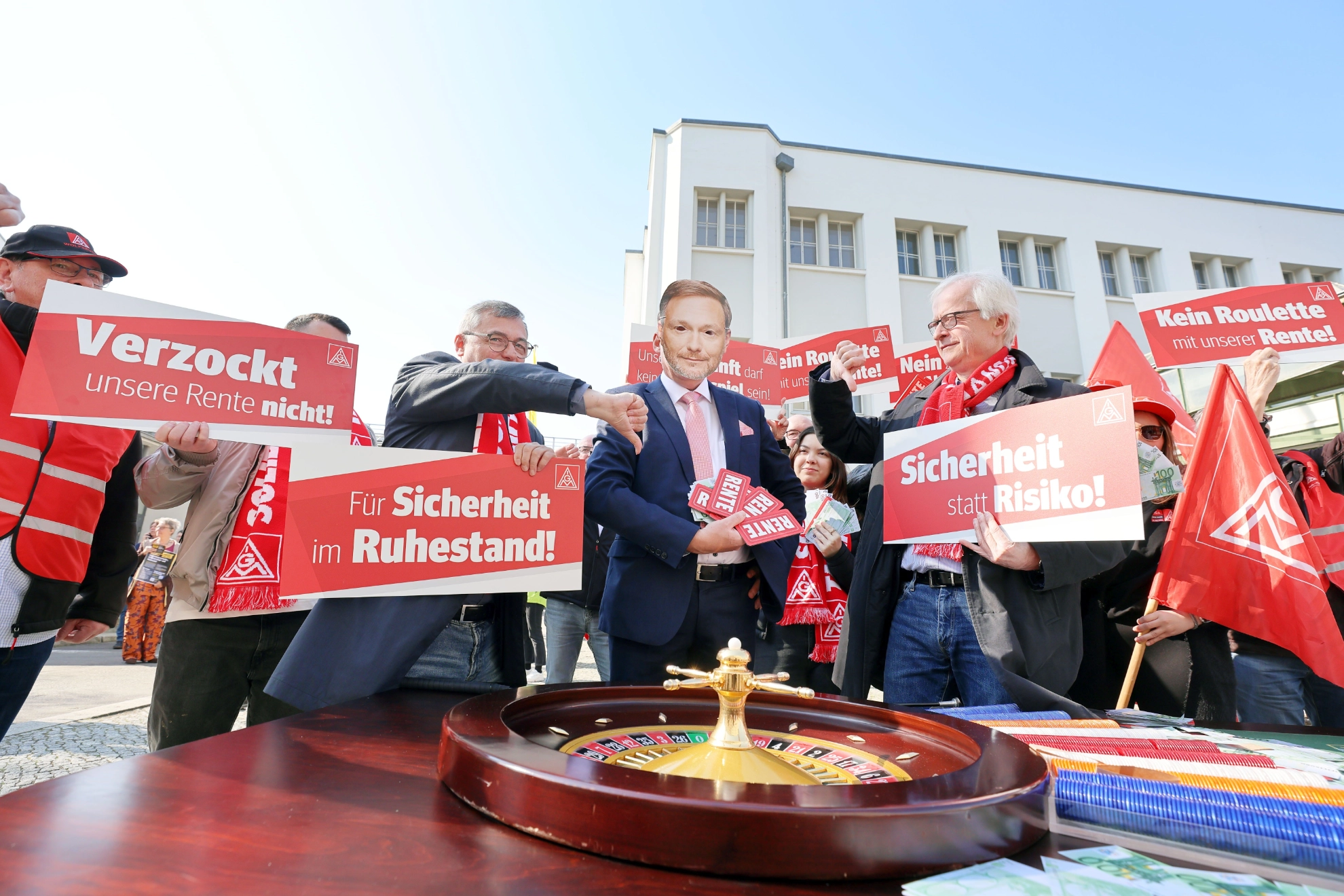
The FDP and the Federal Minister of Finance are pursuing their vision of a “stock-based pension,” in which, over the long term, a portion of the contributions from the pension fund would be invested in the financial markets, and pension payments would be linked to investment returns. The FDP emphasizes the opportunities for high-yield investments but fails to mention the glaring problems associated with such a systemic shift in retirement security:
- The FDP’s stock-based pension represents a departure from the solidarity-based pay-as-you-go system.
- It creates a hole in the pension fund. Additional expenditures must be covered by extra tax revenue. Whether and when these funds will be repaid depends on the return on the investments.
- Future retirees bear the risk of losses from fluctuating financial markets.
What is the federal government planning?
In the coalition agreement, the SPD, the Greens, and the FDP agreed to reform the pension system. Concrete negotiations are currently underway regarding the so-called Pension Package II. This package is also intended to implement a key demand of IG Metall: the long-term stabilization of the pension level at 48 percent. In addition, according to the coalition’s plans, pensions are to be partially financed by stock market gains in the future: To this end, Finance Minister Christian Lindner plans to introduce what is known as “Generation Capital.”
By “Generational Capital,” the government means a state-run fund through which it will purchase stocks and bonds on the stock market. The government’s hope is that, starting in the mid-2030s, profits from this fund could bolster the statutory pension. The specific goal is to reduce the contribution rate that employees and employers pay into the pension insurance system. It is thus a form of funded retirement savings within the statutory pension insurance system. The capital stock is intended to supplement the pay-as-you-go pension system on the revenue side.
What is IG Metall calling for?
IG Metall firmly opposes the introduction of a stock-based pension.
Instead of riskily investing pension contributions, IG Metall calls for a fundamental restructuring of the retirement security system and solidarity-based financing of pensions. “To make the statutory pension system future-proof, we need reforms based on solidarity, not financial market experiments. The introduction of a solidarity-based insurance system for the working population, higher tax subsidies, and moderately rising contributions are the key levers for achieving this,” says Hans-Jürgen Urban, executive board member of IG Metall.
Behind the scenes, negotiations are still underway regarding the specific implementation of “generational capital.” Regardless of how it is structured, one thing is clear to IG Metall: No contributions from the pension insurance system may flow into the fund, and it must be ensured that fluctuations in the financial markets do not lead to fluctuating pensions. Under no circumstances should “Generational Capital” become a precursor to a stock-based pension as envisioned by the FDP.
In its proposals for the sustainable financing of old-age security, IG Metall relies not on the stock markets but on the solidarity-based system. A strengthened statutory pension system, into which all working people contribute, must be at the center of the government’s old-age security policy. This is the only way to ensure fair and sustainable financing and adequate benefits for everyone.
Poll: Little Trust in Christian Lindner’s Pension Policy
A survey commissioned by IG Metall and conducted among more than a thousand eligible voters has revealed that two-thirds (67 percent) reject Federal Finance Minister and FDP leader Christian Lindner’s goal of investing a portion of pension contributions in the financial markets in the future as part of a “stock pension” scheme. Even a large proportion of FDP voters are skeptical: 42 percent reject this systemic change to finance pension entitlements.
61 percent of FDP supporters even say that, in principle, they have little trust in Christian Lindner when it comes to pension policy. Among all eligible voters, distrust of the Federal Minister of Finance stands at 74 percent.
You can find detailed information on the IG Metall survey here (PDF).
Further information on the stock-based pension is available in IG Metall’s Social Policy Information.