You can set your watch by it: Whenever the government is short on cash, the business community demands cuts to social programs. Because—alas, alas!—the welfare state has become far too expensive. This is often claimed, but it is nonetheless false.
Compared to other industrialized nations, Germany does not spend a particularly large amount on social programs. Nor has spending grown excessively in recent years.
This is shown by an analysis from the Institute for Macroeconomics and Economic Research (IMK). Economists Sebastian Dullien and Katja Rietzler evaluated data from the Organization for Economic Cooperation and Development (OECD) and the European Commission for this study.
Their conclusion: “Anyone who speaks of an unchecked expansion of the welfare state, or of the state generally becoming increasingly bloated, is spreading a myth that is not supported by facts,” says Sebastian Dullien, research director at the IMK.
Misleading Figures
The claim of a “bloated state” is often based on the fact that government or social spending is reaching “new records.” But according to the economic researcher, nominal monetary amounts are not very meaningful.
The analysis states: Prices and incomes rise every year, so it is only logical that new “records” in revenue and spending are constantly being set. “When, for example, workers’ incomes rise, it is perfectly normal for pension payments to rise as well—since these are intended to secure a certain portion of income,” the researchers write.
Other indicators are far more meaningful: for example, the growth of social spending relative to economic output, or relative to spending in other comparable countries. Dullien and Rietzler examined such metrics using the most recent data available.
The results of the data analysis in detail:
Growth in social spending:
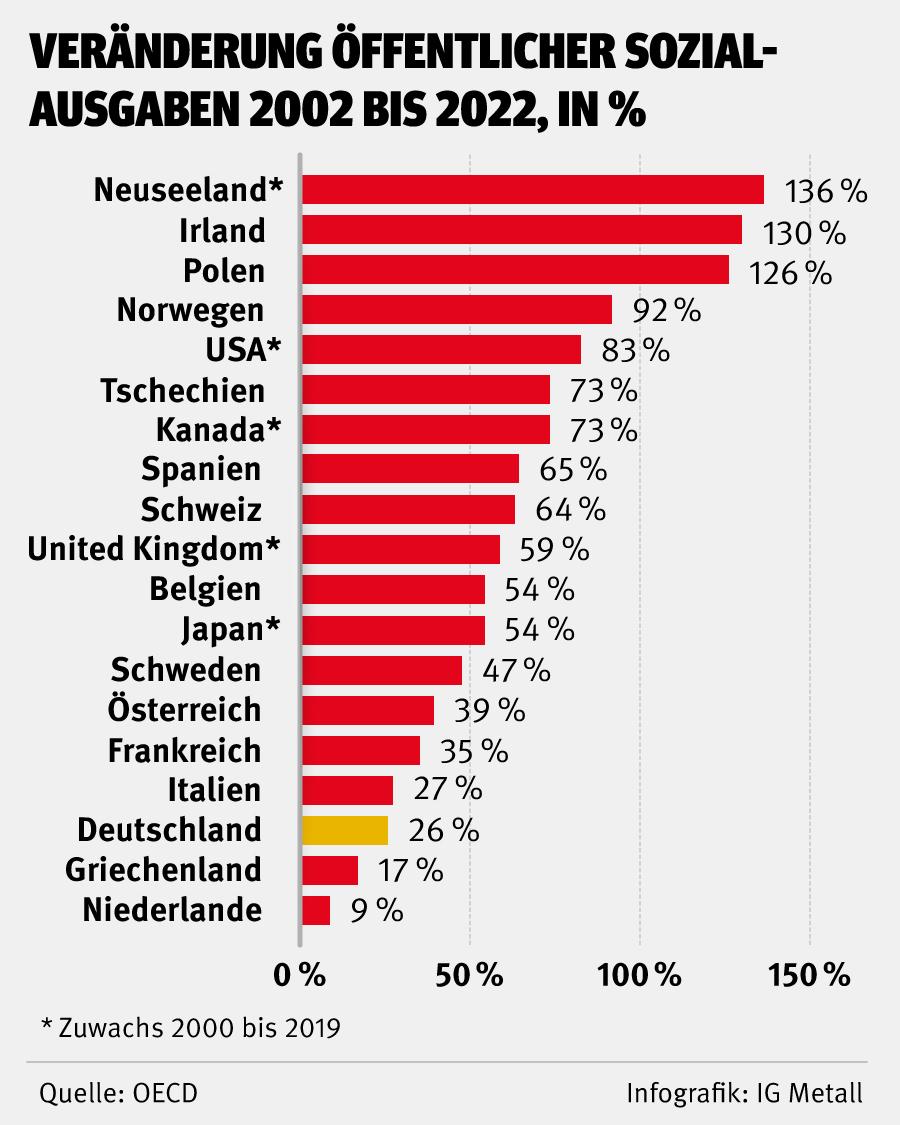
Compared with other industrialized nations, the growth in public social spending in Germany has been unremarkable for decades: Among OECD countries, Germany lags far behind—with an increase of 26 percent between 2002 and 2022.
Countries such as Ireland (up 130 percent), Poland (up 126 percent), and Norway (up 92 percent) are far ahead. The U.S. is also well ahead of Germany, with an increase of 83 percent.
Social spending compared to economic output (GDP):
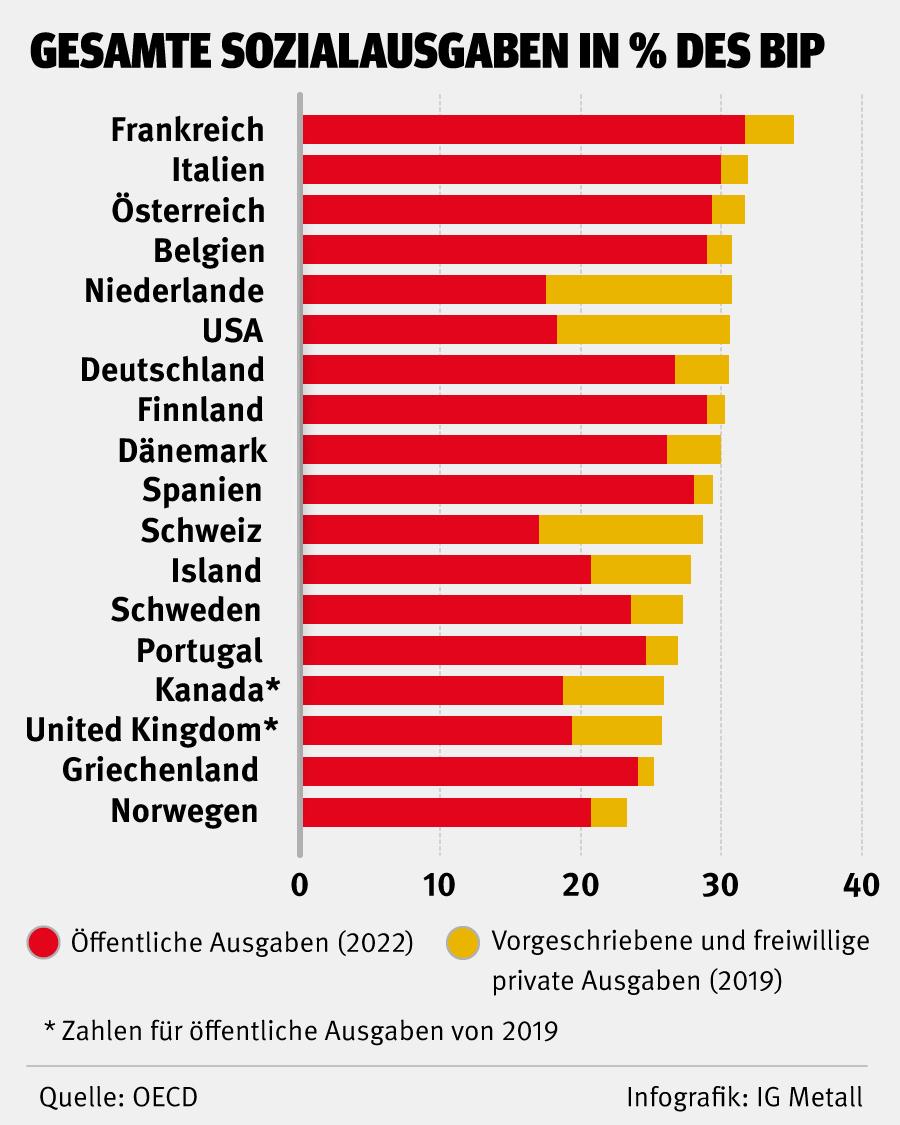
Compared to economic output, government social spending in Germany is unremarkable. A comparison with other industrialized nations shows that Germany ranks in the upper middle range here, by no means at the top.
The U.S., the Netherlands, and Switzerland appear to be significantly lower—though only at first glance, as the IMK data check reveals. This is because private health insurance is largely mandatory in these three countries. When public, government-mandated, and voluntary social spending are combined, the U.S. and the Netherlands actually rank slightly ahead of Germany.
Total government spending:
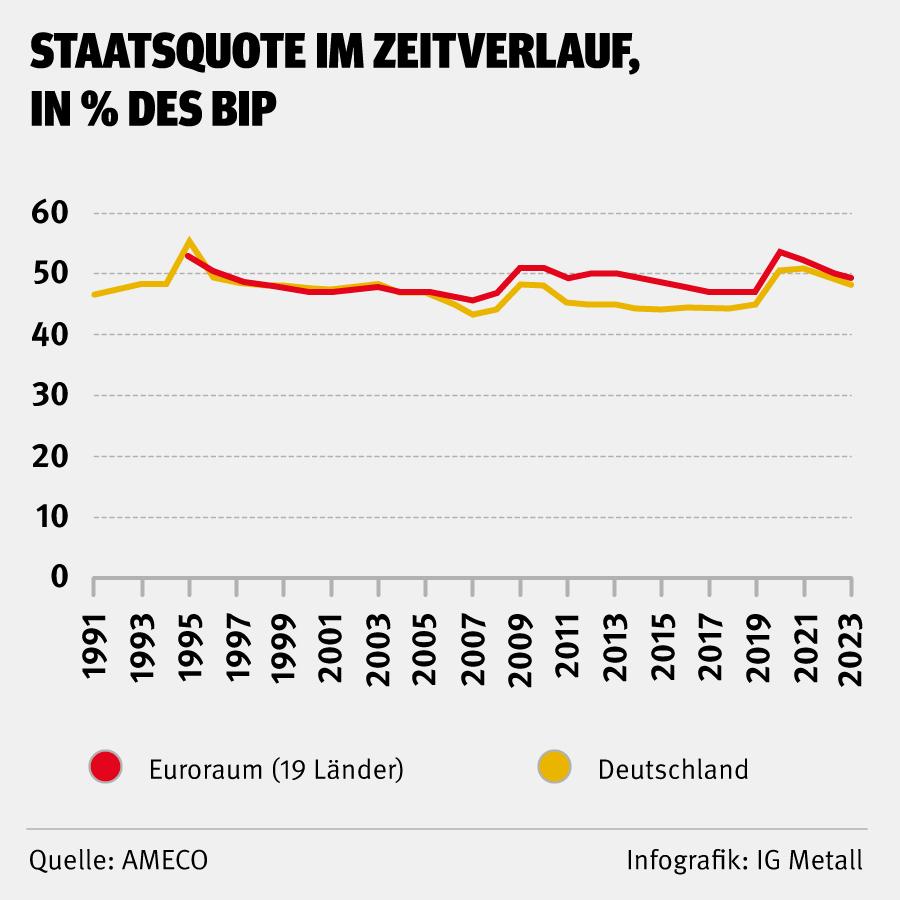
How large is Germany’s total government spending relative to its economic output? According to the IMK analysis, Germany is also in the middle of the pack here. At 48.2 percent of GDP, the so-called public spending ratio in Germany is actually slightly lower than the average for EU countries.
Over the past 30 years, this figure has remained largely constant. So there is certainly no evidence of a ceaselessly expanding government.
Many people already have to get by on a small pension. And since the basic income covers the minimum cost of living, there is nothing left to cut.
If the government needs more money, other ideas are needed: for example, a fair contribution from top earners and the wealthy.