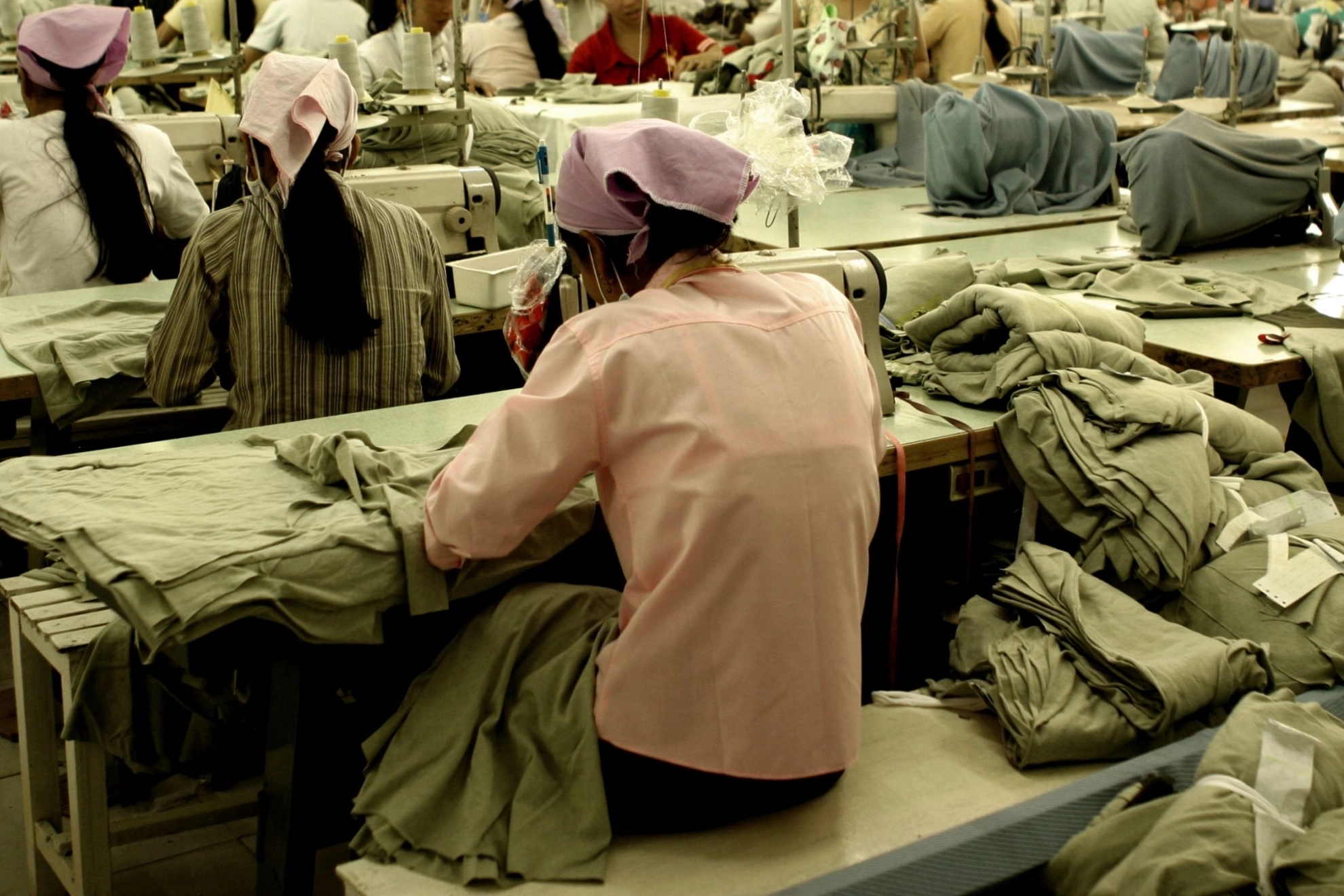
Anyone looking to buy locally produced clothing today will have a hard time finding any. It used to be different. Back when Bielefeld was still known as the “linen city.” Edith Echterdiek is someone who witnessed how sewing machines filled the factory buildings in Bielefeld with a loud clatter before 95 percent of production was relocated to so-called “low-wage countries.” The 85-year-old has witnessed the evolution of the clothing industry since the 1950s.
Back then, the future works council chairwoman began her apprenticeship at a men’s clothing manufacturer. “They paid me 35 pfennigs an hour back then,” says Edith. There was still plenty of work for seamstresses and seamsmen in the region at the time, but the working conditions took their toll on them. Fast-paced, repetitive tasks, poor posture, and plenty of dust and noise often made the 48-hour workweek a torment. “It took 39 minutes to finish sewing a shirt. For us, that meant repeating the same hand movement 1,000 times a day,” says Edith.
Offshoring Across Europe
The Textile and Apparel Union (GTB) at the time secured many improvements in collective bargaining agreements for the workers. “The GTB secured paid short breaks for the seamstresses and seamsmen, so that, thanks to the organized breaks, they never had to work for more than an hour and a half at a time,” says Peter Donath, author of the book *Wir machen Stoff* and, until 1974, head of the Labor Policy Division on the IG Metall executive board. “The works councils’ right to have a say in existing jobs and workplace improvements also led to very concrete benefits for the workers,” says Annette Szegfü, co-author of the book and union secretary in the collective bargaining department of IG Metall.
But none of that helped; the operations were relocated anyway. “From one day to the next, there were suddenly boxes everywhere in our company labeled ‘Hong Kong.’ We knew immediately what was in store for us,” says Edith. The only explanation from management was that the order situation was no longer sufficient. Although there was little sign of this in the fully utilized sewing shop, production was gradually relocated abroad. As a result, Edith and her colleagues had to look for new jobs. That was in the 1970s.
A shift toward Hong Kong, Macau, South Korea, and Taiwan was now taking hold across Europe. In these East Asian countries, production for the apparel industry was ramped up at an enormous pace—without fair wages or good working conditions. “Whenever a country showed some social progress, whenever the unions there grew stronger, they’d pack up the sewing machines and move on to another country,” says Annette. Peter confirms this: “A textile entrepreneur from the Ruhr region, Klaus Steilmann, always said that if we could teach penguins to sew, we’d even move production to the South Pole.”
Over a Million Jobs Disappear
Probably the greatest effort to prevent the exodus of apparel production was the World Textile Agreement—which the GTB strongly advocated for with the German federal government. This international agreement restricted free trade by imposing quotas on imports of textiles and apparel into Europe and the U.S. The first agreement of this kind was concluded in 1973; the last one expired in 2004. Although the shift had already begun in the 1950s, it gained significant momentum in the 1970s: 200,000 jobs were lost at that time. Subsequently, this trend fluctuated, but in the 1990s, a dynamic set in that seemed irreversible.
“So many jobs were lost back then that the GTB said: We no longer have the pool of members to organize that many people. The GTB executive board members were also concerned that the inevitably shrinking membership would no longer allow for a collective bargaining policy that provided sufficient protection for workers across the board,” says Peter. As a result, the union decided in 1996 to give up its independence. Since 1998, workers in the textile sector have been organized under IG Metall. Today, of the 1,000,000 workers who once worked in the former Federal Republic of Germany and the 300,000 in the GDR, only 100,000 remain employed in the textile and apparel industry.
“The gradual exodus of the apparel industry is also a story of the exploitation of women,” says Annette, because worldwide, it is predominantly female workers who serve as seamstresses in the apparel industry—today as in the past. “Much of what we’ve been fighting for since the 1980s doesn’t apply in the countries where most of the production takes place today,” says Edith—“maternity leave, childcare, and sick days for children.” Even though clothing production largely takes place under poor conditions, the debates of recent years about fast fashion, buying locally, and climate-friendly production at least offer hope that this won’t remain the case.
More about the history of the Textile and Apparel Union can be found in the book by Peter and Annette, *Wir machen Stoff – Die Gewerkschaft Textil-Bekleidung 1949–1998* (We Make a Difference – The Textile and Apparel Union 1949–1998), published by Transcript Verlag in Bielefeld.