Automatic translation
This article has been translated automatically using computer technology. While we strive for accuracy, some wording or details may differ from those in the original article.
This translation was not manually reviewed. For important facts, quotations or legally sensitive information, please consult the German original. Individual selections, images, embedded media or technical terms may have been translated differently or incompletely.

Germany as an Industrial Hub We’re fighting for our industry—compromise reached at Musashi

Our industry is cutting jobs, relocating, and closing plants—often for just one or two percent more profit, without a plan or clear prospects. Workers are fighting alongside IG Metall for their future. At the auto supplier Musashi, an agreement was reached in collective bargaining mediation shortly before the strike was set to begin.

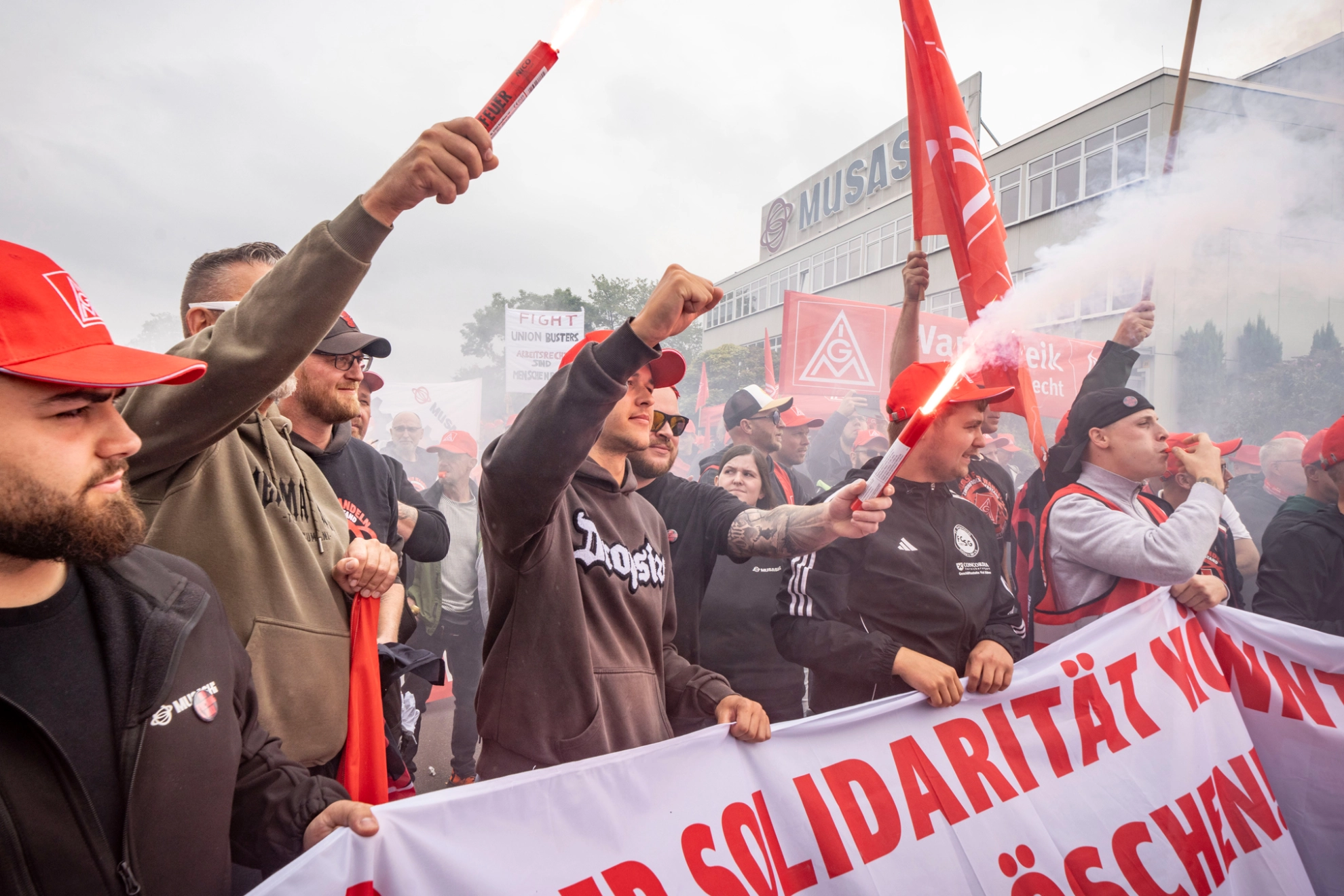
Musashi-Beschäftigte beim Warnstreik vor der Deutschlandzentrale in Bad Sobernheim

26 September 2025 26 September 2025 |
Updated on 10 December 2025 10 December 2025


Our factories and plants are burning. Everywhere, industrial companies are cutting jobs, relocating, and closing down. 10,000 jobs are lost every month. Particularly hard hit: the automotive and supplier industries. Over 50,000 jobs have been lost here in the last 12 months alone. 

Many industrial companies want to make employees pay for the current crisis and the transformation—even though it was the managers who failed for years to invest in the future. Now they can’t think of anything better than layoffs, relocations, and closures.

They blame politicians—and the high cost of doing business in Germany, they say. Yet labor costs in the metal and electrical industries account for just 17.7 percent of revenue (2024). And dividends continue to rise: For the 2024 fiscal year, the 160 companies listed on the DAX, MDAX, and SDAX paid out 63 billion euros to their shareholders; the 40 DAX-listed companies alone paid out nearly 54 billion—the third record in a row.
 

Employers must commit to the region as an industrial hub 

Yes: It is high time for policymakers to act. For months, IG Metall has been holding talks with the federal government. There was a steel summit, an auto dialogue—and finally, results: protective tariffs against steel dumping are expected soon. More flexible CO2 regulations for cars are under discussion. In Brussels, we’re making progress on “local content”: The European steel industry is to be given preference in public procurement. And starting January 1, we’ll finally have the reduced industrial electricity rate that IG Metall has been demanding for years. 

Politicians are getting things moving. Now it’s finally up to employers to step up: Instead of cutting jobs, they must commit to Germany as an industrial hub, invest, and take responsibility together with us as social partners, demands Christiane Benner, First Chair of IG Metall. “We finally need a clear commitment from companies to Germany as an industrial hub and an end to job cuts.”

In the workplaces, employees and IG Metall are standing up to these cuts and fighting against the mass layoffs to secure the future of their locations and jobs.


“Attack is the best form of defense”: A united struggle at all Musashi locations

They were unable to stop the closure of two plants. But the Musashi workers—over 80 percent of whom are members of IG Metall—stood together at all locations: layoffs were reduced, severance packages doubled, and jobs in Germany secured. 

“We, who are losing our jobs, fought for the future of those who are staying. And those who are staying fought for higher severance packages for us,” says Heiko Liebscher, a works council member at Musashi Machining in Leinefelde (Thuringia), which is set to close by March 2027.

Shortly before the strike was set to begin at all German locations of the automotive supplier Musashi—for which over 90 percent had voted in favor in the strike ballot—a negotiated settlement was finally reached in arbitration, following three months of struggle, endless negotiations, demonstrations, and warning strikes.

It’s a bitter pill to swallow: Two plants—Hannoversch Münden (Lower Saxony) and the machining plant in Leinefelde—will close by March 2027. But originally, management also wanted to shut down the other plant (forging) in Leinefelde. Through their joint struggle, they have nearly halved the planned job cuts at the Lüchow site (Lower Saxony) (70 jobs lost instead of 130), delayed the closures by one year, and doubled the severance packages offered, with up to 6,500 euros extra for IG Metall members. In addition, they secured job security for the remaining workers: The operations from the plants that are closing will be transferred to the remaining German sites, such as in the Nahe Valley in Rhineland-Palatinate, which have received a guarantee to that effect. IG Metall members there—over 80 percent of the workforce—have protection against termination until 2028.

There is also applause at the members’ meeting in Hannoversch Münden, despite the closure. They were closely involved and helped make the decision. That was the best that could be achieved. Under German law, the employer—who controls the purse strings—alone decides on plant closures. Works councils and IG Metall can only make them more expensive and more difficult to carry out.

Management even threatened to file for bankruptcy at all German locations and tried to have the strike banned by the courts. To no avail. The pressure that IG Metall built up through the threat of a strike and its network eventually became too great. Customers, such as VW and Daimler Truck, threatened to file lawsuits for damages due to missed deliveries. The works councils there spoke with their managers. Buses to the strike at Musashi had already been ordered. The Spanish unions prevented the deployment of strike breakers. And the Japanese unions established contact with Musashi’s corporate leadership in Japan, which finally put up an additional 20 million euros.


Management threatens bankruptcy and tries to divide them—but they stand together

Flashback: In June 2025, the management of Musashi Germany announced that it intended to completely close two locations and halve the size of another. “They didn’t say a word to us about the cutbacks,” criticizes Paul Alexander, a works council member in Hannoversch Münden, who had been working with management on plans for the future as part of the Transformation Steering Committee. Nor was any information provided to the supervisory board.

The cutbacks are supposedly intended to affect only the Hann. Münden, Leinefelde, and Lüchow sites. Managers tell employees along the Nahe River, in Bad Sobernheim, Bockenau, and Grolsheim: “You’ll actually benefit—at the expense of the others” (albeit without any guarantees). IG Metall, union representatives, and works council members are fighting back with video messages and countless discussions on the shop floor. 

In the end, 87.4 percent of workers along the Nahe River also voted in favor of the strike. They even waived their share of the severance pay intended for the others. “In return, we’ll give them the parts. We achieved this solely through our solidarity,” says Karl Koch, chairman of the works council in Hann. Münden, who helped negotiate the deal and will retire in 2027 alongside the others after 39 years. “We’re leaving—but we’re walking away as victors, with our heads held high.”
Jungheinrich Wants to Close Lüneburg – Strike for a Collective Bargaining Agreement

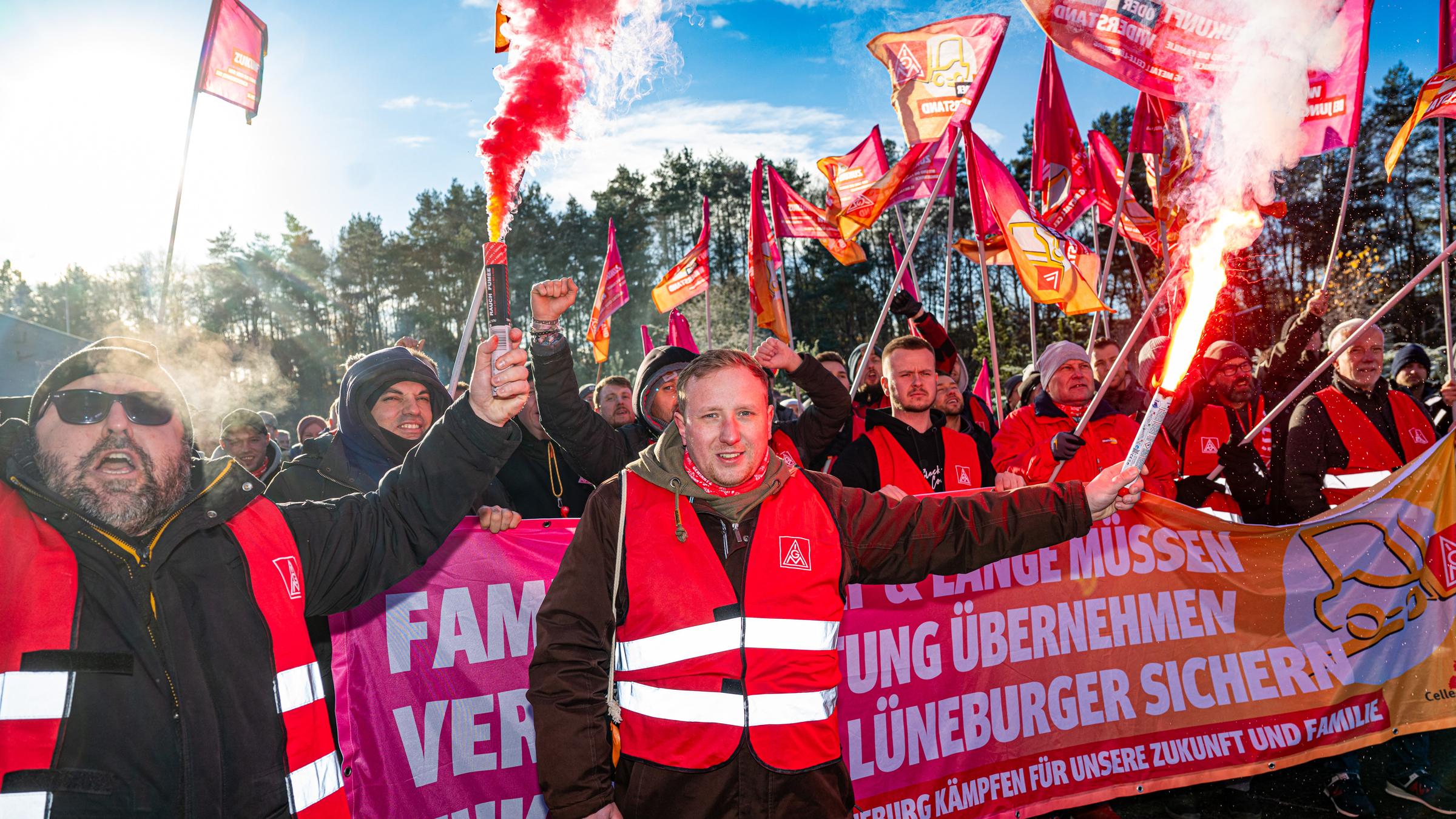
Employees at Jungheinrich in Lüneburg have been on strike since November 20. Despite record profits, management wants to close the plant—and refuses to negotiate with IG Metall. Following protests and warning strikes, 90 percent of the employees voted in favor of a strike in a shop-floor ballot.

In July, the management of forklift manufacturer Jungheinrich announced its plans to close the plant by 2027 at a works meeting. “That came completely out of the blue,” criticizes Steffen Schwarz, a works council member and member of the supervisory board. “We then kicked them out of the works meeting.”

380 employees are affected by the closure plans in Lüneburg—though management reportedly plans to close only the production facility, which employs 300 people. In total, Jungheinrich intends to cut 1,000 jobs across the company. There had been no indication of any of this in recent months. Management had even set a goal of doubling revenue by 2030—in just five years.

What particularly angers the works council and electrician Steffen Schwarz is that the closure plans were announced to them by a manager who has only been with the company for two years. Ever since Steffen Schwarz was hired permanently 27 years ago as a temporary worker with the help of the works council, Lüneburg has consistently generated profits for the corporation. And now this. 

“The plant in Lüneburg is in the black, successfully manufactures specialty and small-batch products—and is still slated for closure—just so that the return on investment in the executive suites improves by a few decimal places,” criticizes Lennard Aldag, chief representative of IG Metall Celle-Lüneburg. “We demand the conclusion of a social collective bargaining agreement. The employees are ready to fight for their future. The employees want a future, not liquidation. Jungheinrich is playing with people’s livelihoods as if they were mere numbers in an Excel spreadsheet. We won’t stand for that—we’re fighting for every job!”


Streik bei Jungheinrich in Lüneburg im November 2025

Strike at Jungheinrich in Lüneburg in November 2025


“A company exists to serve people”—Future or Resistance

From the perspective of the employees and IG Metall, Jungheinrich management’s actions break a taboo. More than 70 years ago, company founder Friedrich Jungheinrich always said: “A company is not an end in itself. It must serve people.”

Furthermore, from the employees’ perspective, the relocation plans simply cannot work—and certainly not the separation of design and assembly. They build custom solutions tailored to customers’ needs: forklifts with wider forks, with a pin, a ram, or a gripping claw, with a customized cockpit. This can’t be done by following a manual. It requires craftsmanship and improvisation, a great deal of expertise, experience, and cooperation.

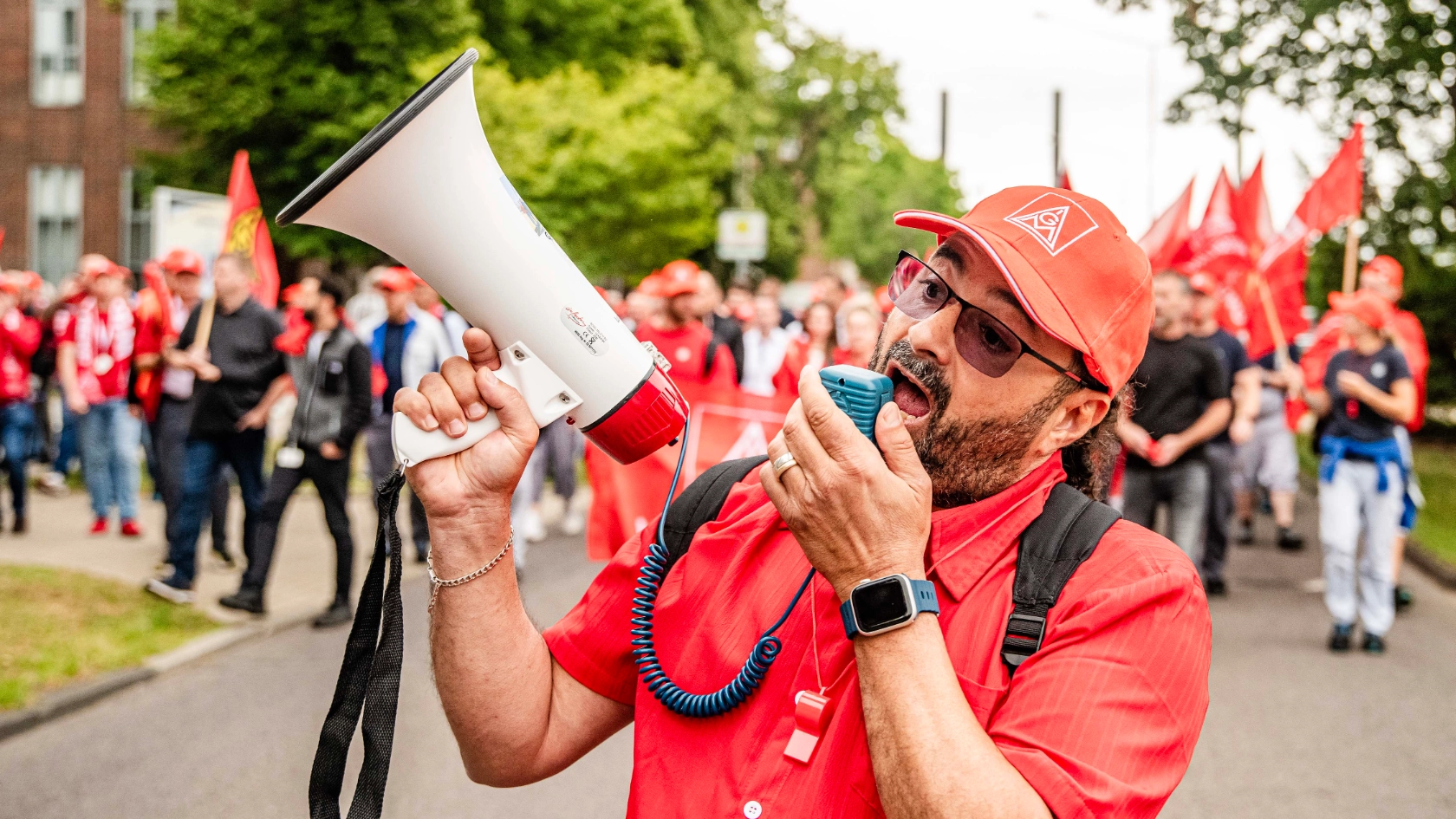
“We go to the assembly line every day to work out solutions together. Design here and build somewhere else? That doesn’t work in custom manufacturing. It’s suicide,” says Yusuf Cengiz. The engineer and head of the IG Metall shop stewards, like works council chairman Sven Nolte, joined the company years ago through an engineering service provider. Now he leads their strike demonstrations with a megaphone. 
“Our on-off strike strategy is working. Logistics are sinking into chaos, and customers are calling in furious,” reports Florian Rebstock of IG Metall Celle-Lüneburg, who is leading the strike. “Now is the time for the Wolf and Lange families to send their board to the negotiating table. That’s the only way they can save the special construction division—it only works in Lüneburg.”


Bosch: 22,000 Job Cuts

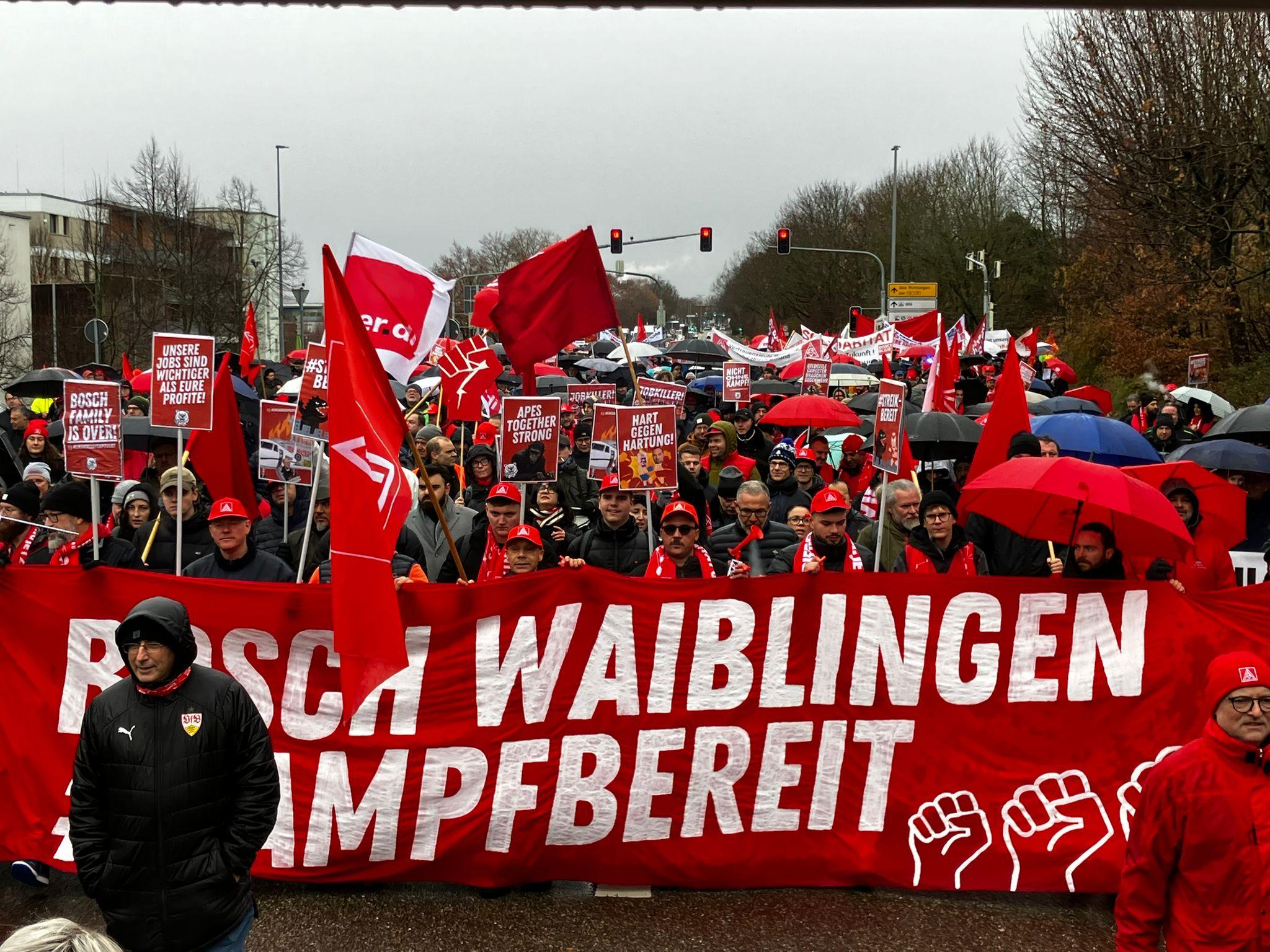
Even companies that once prided themselves on their social responsibility, such as Bosch, are cutting back: 22,000 jobs are set to be eliminated there by 2030. Many locations are to be downsized—in some cases by half—and the plant in Waiblingen is to be closed entirely. As of press time, talks are currently underway. And at all Bosch locations, employees are demonstrating for their future. They are fighting together. Hundreds of Bosch employees from other locations across Germany also joined the demonstration in Waiblingen, for example. They are demanding investment in their German locations. And they want management not to simply cut jobs, but to finally sit down with them to develop prospects for the future, new products, and new business models. 


Demo gegen Schließungspläne bei Bosch in Waiblingen

2,000 employees demonstrated against the closure plans at Bosch in Waiblingen.


“Instead of negotiating visions for the future at the sites as agreed, thousands of people are now once again expected to leave the company,” criticizes Frank Sell, chairman of the General Works Council for Bosch’s Mobility business sector. “There is no question that the situation in the German and European automotive and supplier industries is very tense. However, we firmly reject workforce reductions on this historic scale—without simultaneous commitments to secure our locations in Germany!”

Beschäftigte stehen zu einem großen Herz zusammen
Become a member
Become part of a strong community

From legal protection in labor and social law matters to fair wages and salaries—we take personal and reliable care of our members.

New on igmetall.de
Aktionstag bei Mercedes Benz, Daimler, in Sindelfingen gegen die Angriffe auf Beschäftigten in der Automobilindustrie.
Resistance to Attempts at Drastic Cuts Auto industry workers issue a warning
Sie wollen doch nur dein Bestes
Redistribution Making Germany more equitable: We need this tax reform now
Der Streik bei Kelvion in Nobitz-Wilchwitz begann am 4. August 2026. Die Geschäftsleitung will nach Sarstedt/Niedersachsen verlagern - obwohl die Produktion in Wilchwitz profitabel und bis ins nächste Jahr ausgelastet ist.
"It’s worth fighting for!" Kelvion workers strike for a social collective bargaining agreement
Ruhrpott Rebellion am 07.07.2026
Welfare State September 26: Nationwide Day of Action for Social Policy
Beschäftigter arbeitet an einem Getriebe in einer Fabrik
Working Hours Why working longer doesn’t help—and actually does more harm than good
Ein männlicher Land- & Baumaschinenmechatroniker prüft einen Traktor mit einem Tablet
2026 Collective Bargaining Agreement for the Metalworking and Agricultural Engineering Sectors Greater Flexibility in the Metalworking and Agricultural Engineering Sectors in Lower Saxony and Bremen
Elektronikerin prüft die Spannung an einem Schaltschrank.
2026 Collective Bargaining Round for the Electrical Trades Wage Increase in the Electrical Trades in Berlin-Brandenburg
Benjamin Heine ist Mitarbeiter der BMA in Braunschweig
2026 Collective Bargaining Round for Metal Fabrication and Precision Engineering Higher Wages in the Metal Fabrication and Precision Engineering Sectors in Southwest Germany
Metall-Arbeiter beim Schleifen
2026 Collective Bargaining Round for the Metalworking Trade Employees in the Berlin-Brandenburg metalworking sector will receive higher pay
Beschäftigte von Thyssenkrupp demonstrieren in Essen am 23. Mai 2024 gegen das Vorgehen der Geschäftsführung beim geplanten Teilverkauf des Unternehmens.
Defend the welfare state All dates for nationwide actions against cuts to social services
IGM Aktion VW Wolfsburg
On September 21, things will get loud Nationwide Day of Action: Auto Industry Workers Fight Back Against Mass Layoffs
Auszubildender in einer Schreinerei
Apprenticeship Wages Questions and Answers About Apprenticeship Wages

Subscribe to the newsletter