At the Rolladen Sauter craft business in Lahnau (Central Hesse), where Reinhard Zachmann has worked for over six years, there had been no employee representation until now. But with the acquisition by a craft industry conglomerate a few years ago, the atmosphere at Sauter suddenly changed. Cost-cutting measures were suddenly implemented. The conflict over the
turn of the year 2020/21 was the trigger. The employer not only cut the bonus payment but also tied it to how often an employee had been sick during the year. As a result, some employees received only 250 euros in Christmas bonus, while others received 1,500 euros. A glaring case of unequal treatment.
Reinhard Zachmann and many members of the workforce refused to accept this injustice. They decided to organize against this high-handed treatment. After all, the Christmas bonus was even supposed to be eliminated entirely for 2020–21. Reinhard found three other allies who had the courage to call for elections to form an election committee. “In January, we decided to
because we came to the conclusion that the only way to help was
,” says Reinhard Zachmann. He reached out to
in Giessen, which immediately supported the initiative.
“When it came time to elect an election committee, the whole circus began,” says the 62-year-old technician. Management wanted to stop the election meeting to appoint an election committee, citing the pandemic. In department meetings, management representatives drummed into employees that the company didn’t need a works council. The employer wanted to prevent a works council at all costs.
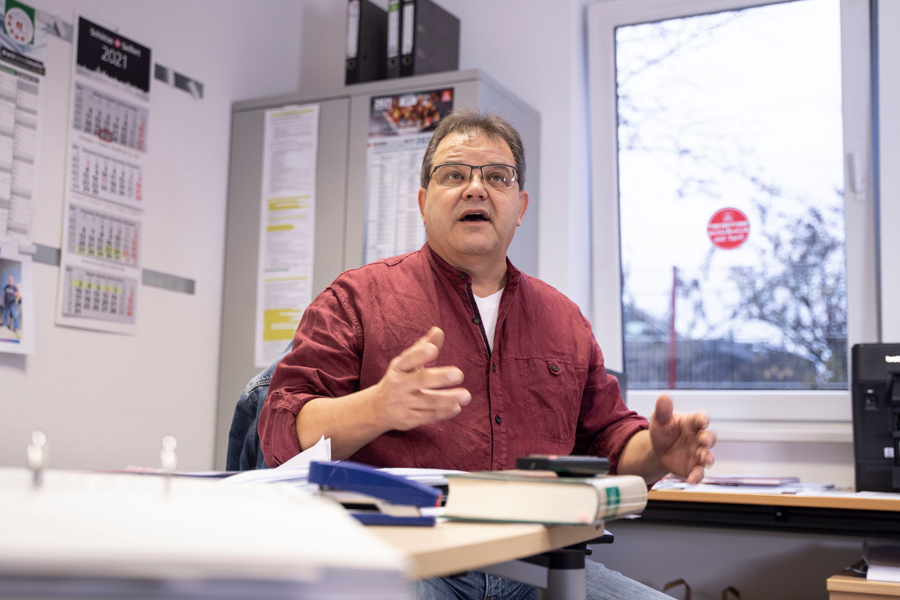
Reinhard Zachmann experienced the worst kind of workplace bullying directed at the works council. Photo: Frank Rumpenhorst
The fight continues
But the workforce refused to be intimidated. Seventy percent voted for an election committee, which consistently carried out the remaining steps leading up to the works council election. The election took place in April 2021—with a 90 percent voter turnout. A clear vote in favor of co-determination. Zachmann was elected chair of the works council.
Since the works council election, the struggle against management’s resistance has continued. Works council members face significant difficulties in obtaining time off for their work. Works council meetings are required to take place outside of working hours. Training sessions are not approved. Zachmann assumes that all of his email correspondence is being monitored by management—all of which constitutes works council harassment and violations of the Works Constitution Act.
But Reinhard Zachmann remains undeterred. “I’ve actually managed to secure quite a few things for the workforce.” These include: The Christmas bonus was paid. The apprentices, like the rest of the workforce, received a 3.5 percent pay increase. There is now a representative for employees with severe disabilities at the company. A company agreement on working hours is in the works, providing for a 25 percent overtime premium—something that didn’t exist before. Many employees have joined IG Metall. An impressive track record.
How a Workforce Defied Resistance—and Elected a Works Council