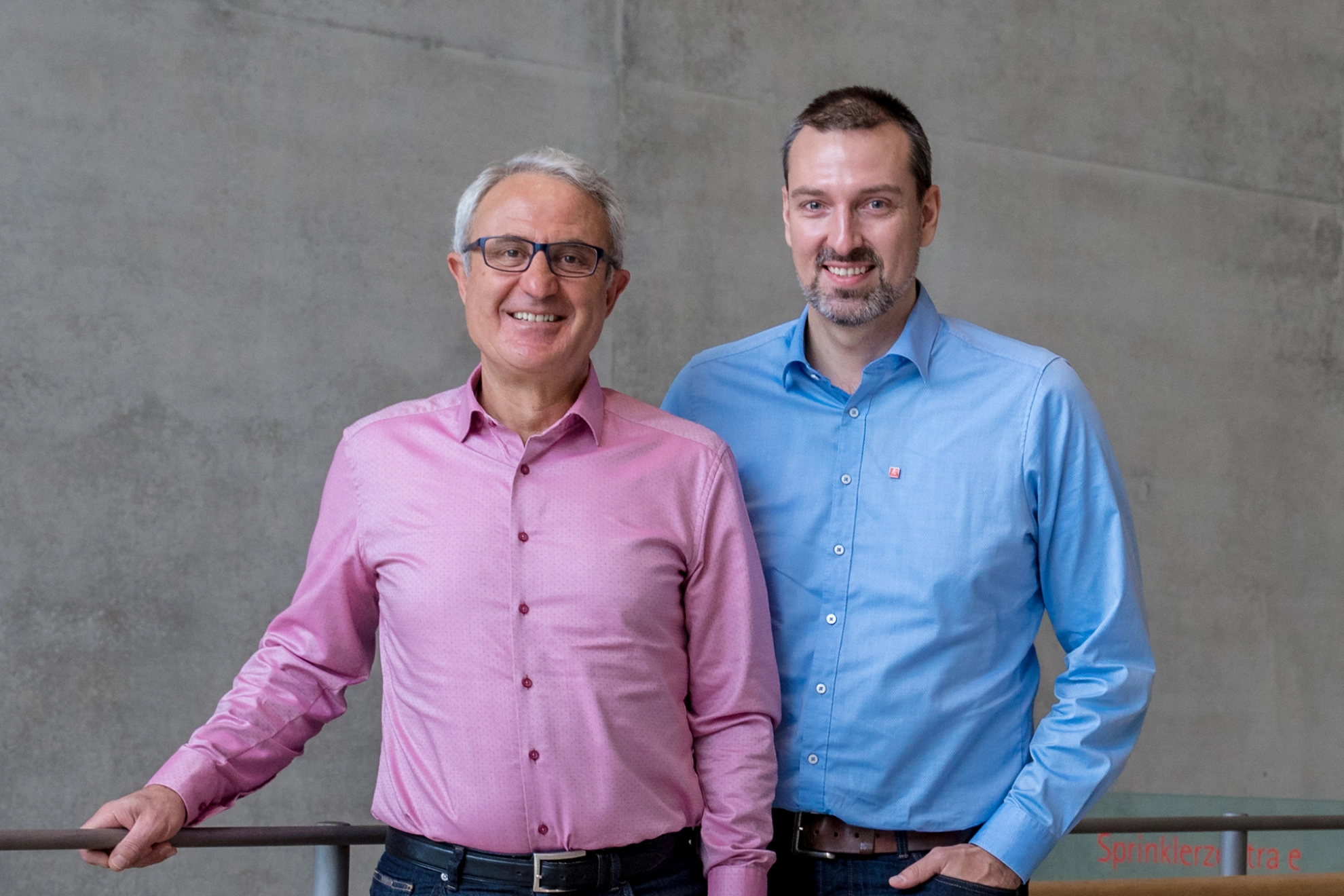
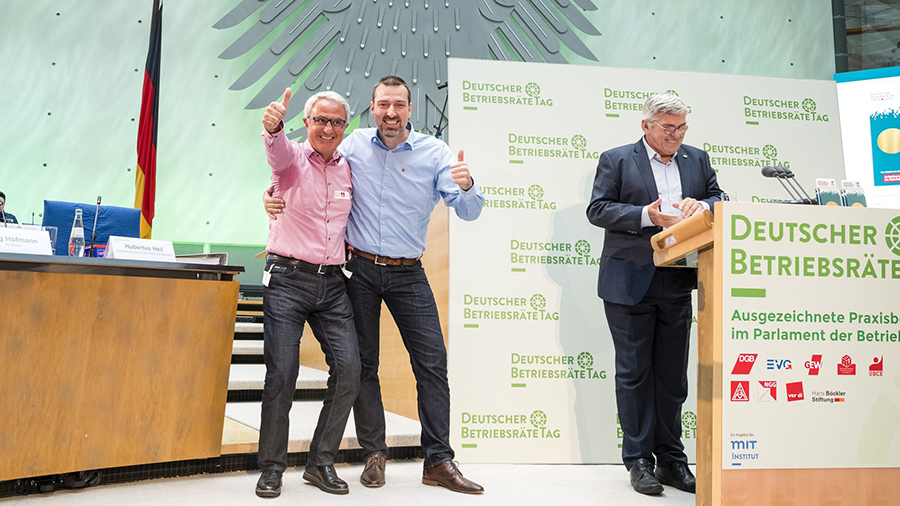
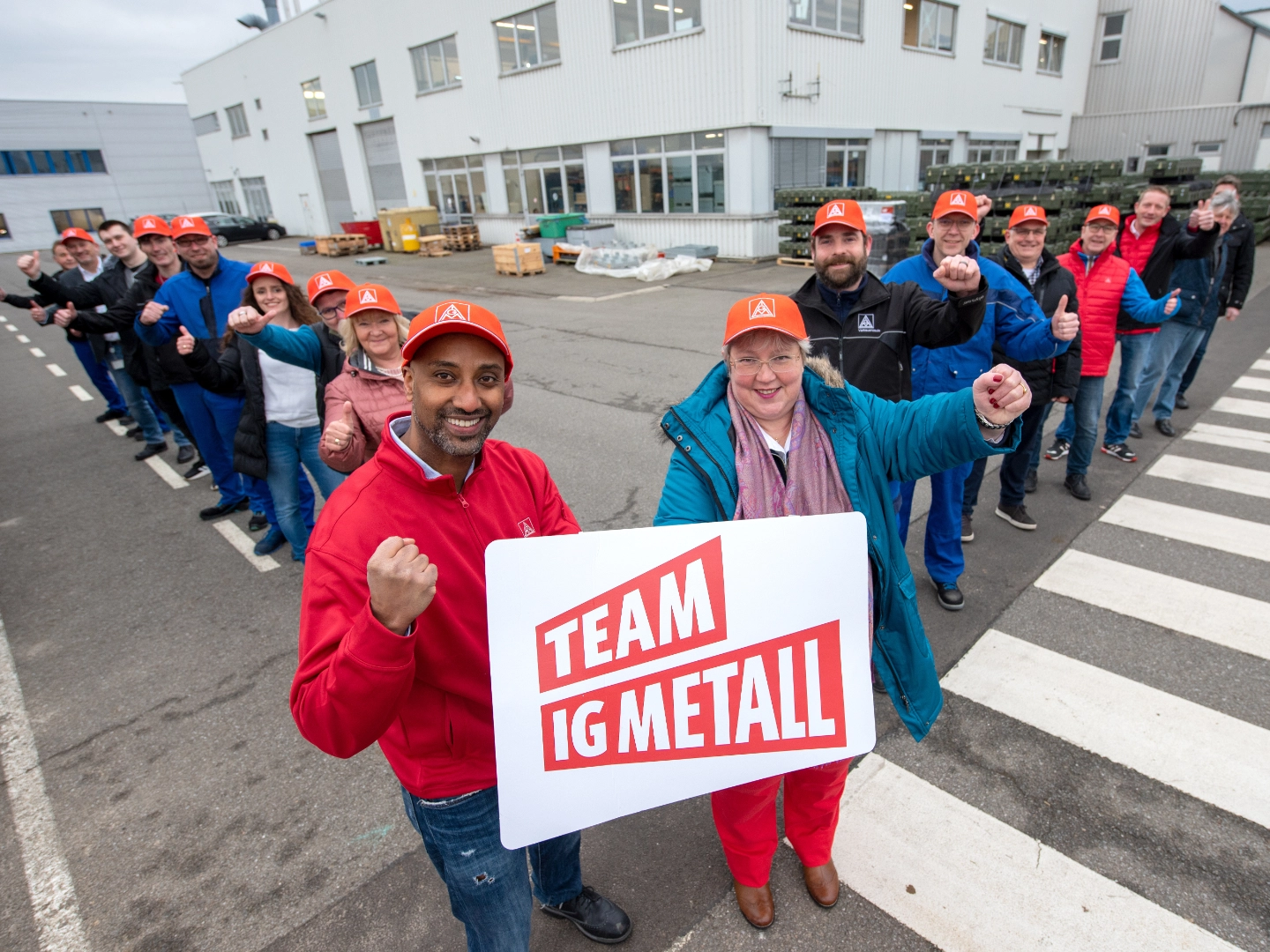
The chairman of the Siemens Tübingen works council, Ismayil Arslan (left), and Tobias Bäumler from the General Works Council during the award ceremony presided over by IG Metall Chairman Jörg Hofmann. (Photo: German Works Council Day)
Background: Siemens in Tübingen manufactures gearmotors. These are used, for example, in baggage handling conveyor belts at many airports. The shock for the approximately 500 employees came in 2017: Business was going poorly. Management announced plans to relocate assembly operations to the Czech Republic. The works council and IG Metall reacted immediately with spontaneous protests and made it unmistakably clear to management: They would not give up the site without a fight. “We knew from the start that close employee involvement would be crucial,” says works council chair Arslan.
Employees Make 80 Cost-Saving Proposals
The trained auto mechanic, together with his colleagues on the works council and the workforce, feverishly searched for ways to save the site. In workshops with the employees, ideas were gathered on how to cut costs through the use of digital technology. Within a short time, the employees in Tübingen put 80 concrete proposals on the table. The potential savings were estimated at several million euros. This impressed the management, which had initially been skeptical. The employer side was won over to participate in the “Work and Innovation” cooperation project with the European Union, the European Social Fund, and IG Metall.
Today, many of these ideas have become reality. Siemens Tübingen has made a qualitative leap into the digital age. It starts right from the training phase, where young Siemens employees learn welding in a virtual environment. In the assembly area, automated guided vehicles (AGVs) are used. They deliver missing parts to where they’re needed. They move almost silently through the assembly halls and are highly regarded by the workforce because they eliminate the need for long walks. Since the term “AGV” sounds so technical, the vehicles have been given the names “Heiner” and “Schorsch.” These digital “colleagues” are remotely controlled and guided by sensors.
Monotonous Processes Eliminated
In production, a screen in the hall displays the workload and availability of individual machines in real time. Google Glass is used in the service department. This makes it possible to provide data and instructions from anywhere in the world on how to repair a gearmotor, perform troubleshooting, and replace parts. In the offices, monotonous, repetitive processes have been eliminated through the use of algorithms, and in the assembly area through the use of robotics.
Digital technology is being used in many other areas as well—always in close coordination with the works council. This cultural shift at Siemens Tübingen is supported by a training program for employees, enabling them to keep pace with digitalization. For example, machine operators are trained to understand how the systems are programmed and to be able to suggest changes for optimization on their own. Eighty percent of employees are now receiving this training.
The Courage to Experiment
This was made possible by the Future Fund for Digitalization, which the General Works Council negotiated with the corporate group and which is endowed with 100 million euros over four years. Over one million euros has been allocated for employee training in Tübingen. “The Future Fund represents uncharted territory for everyone involved,” said Tobias Bäumler, a member of the Siemens General Works Council, at the award ceremony. “It requires the courage to just go ahead and do things and to experiment. And, most importantly, all colleagues should be included in the change process. Because structural change isn’t shaped in the ivory towers of corporate headquarters, but at the grassroots level.”
When you ask Ismayil Arslan what the efforts of the past two years have achieved, you can sense a great sense of relief. “The threat of relocating the site is off the table. That’s the result of fantastic teamwork on the works council.” The struggle was time-consuming and took a lot of energy. Winning it was so important to him that Arslan gave up his seat on the Tübingen City Council so he could focus entirely on his mission at the plant. He is convinced: “The digital transformation is well underway here and can no longer be reversed.” Siemens Tübingen is well on its way to becoming a digital model of excellence within the Siemens Group.
(The award ceremony took place as part of German Works Council Day.)