Maschinenfabrik Alfing Kessler GmbH was under massive pressure due to changes in the automotive industry, the debate over the phase-out of internal combustion engines, the consequences of the COVID-19 pandemic, disrupted supply chains, and the energy crisis. For the company, these developments had very concrete consequences. Closures of certain divisions and a workforce reduction of more than 20 to 25 percent were already being actively planned. Instead of around 1,200 employees, the long-term projection was for only about 800 to 900 jobs.
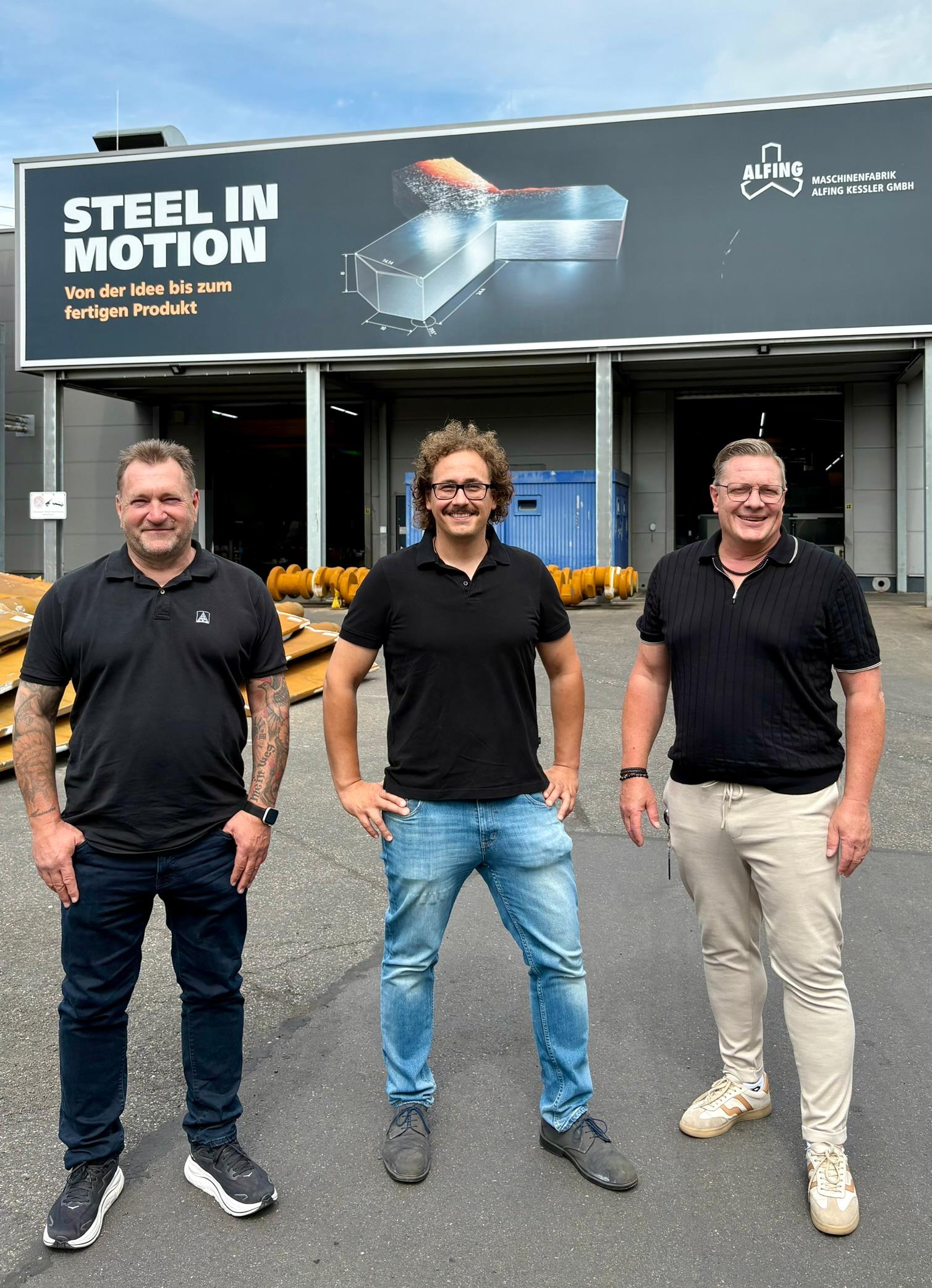
Committed to the employees: Oliver Hirsch, Klaus Vaas, Rainer Lehnert (from left).
At the same time, the company’s public image suffered: in the region, even younger people increasingly viewed the company as one without a future. This also had consequences internally. There was a great deal of uncertainty among the workforce, turnover rose, and the work atmosphere deteriorated noticeably. Departments collaborated less and less with one another and increasingly worked alongside—or even against—one another.
Waiting is not an option
It was clear to the works council early on: waiting it out is not an option. The goal was to secure jobs, create new opportunities, and ensure the long-term competitiveness of the location. Together with IG Metall, management, and with the active participation of the workforce, a change process was therefore launched that went far beyond mere product changes. The focus was on new business areas, a broader positioning of the company, greater employee involvement, and a noticeable improvement in corporate culture.
A key step was joint training. In September 2020, a series of modules was held for the works council and employee representatives. This helped establish a shared understanding of the challenges. Shortly thereafter came a decisive milestone: On September 22, 2020, a key points document was signed. It included job security through the end of 2021, the exclusion of layoffs for operational reasons, and the establishment of a transformation team that explicitly took corporate culture into account.
Another important step took place in December 2022 with the creation of a showroom featuring transformation products as part of the Christmas party. This made the transformation visible, tangible, and concrete for the employees. Starting in 2023, the project entered a new phase: moving away from the initial launch phase toward structured consolidation.
Jobs Secured
To this day, the journey is not complete. That is what makes it so special: change was not viewed as a short-term reaction, but as a long-term process of shaping the future that must continue well into the future.
And much has already been achieved: Step by step, the crankshaft manufacturer—which had been heavily dependent on the internal combustion engine—transformed into a supplier of high-precision components for various applications. Instead of facing the threat of workforce reductions of up to 25 percent, employment was not only secured but significantly expanded. At the same time, the work environment, trust within the company, and the site’s image all improved. The project demonstrates that employee participation can not only accompany transformation but also successfully shape it.