With more than 530 motions up for a vote, plus the election of the new executive board, the 2023 Union Congress has plenty of work in store for the 421 elected delegates.
IG Metall’s major congress, held every four years, has been underway since this afternoon (October 22). This time, it’s taking place in Frankfurt am Main.
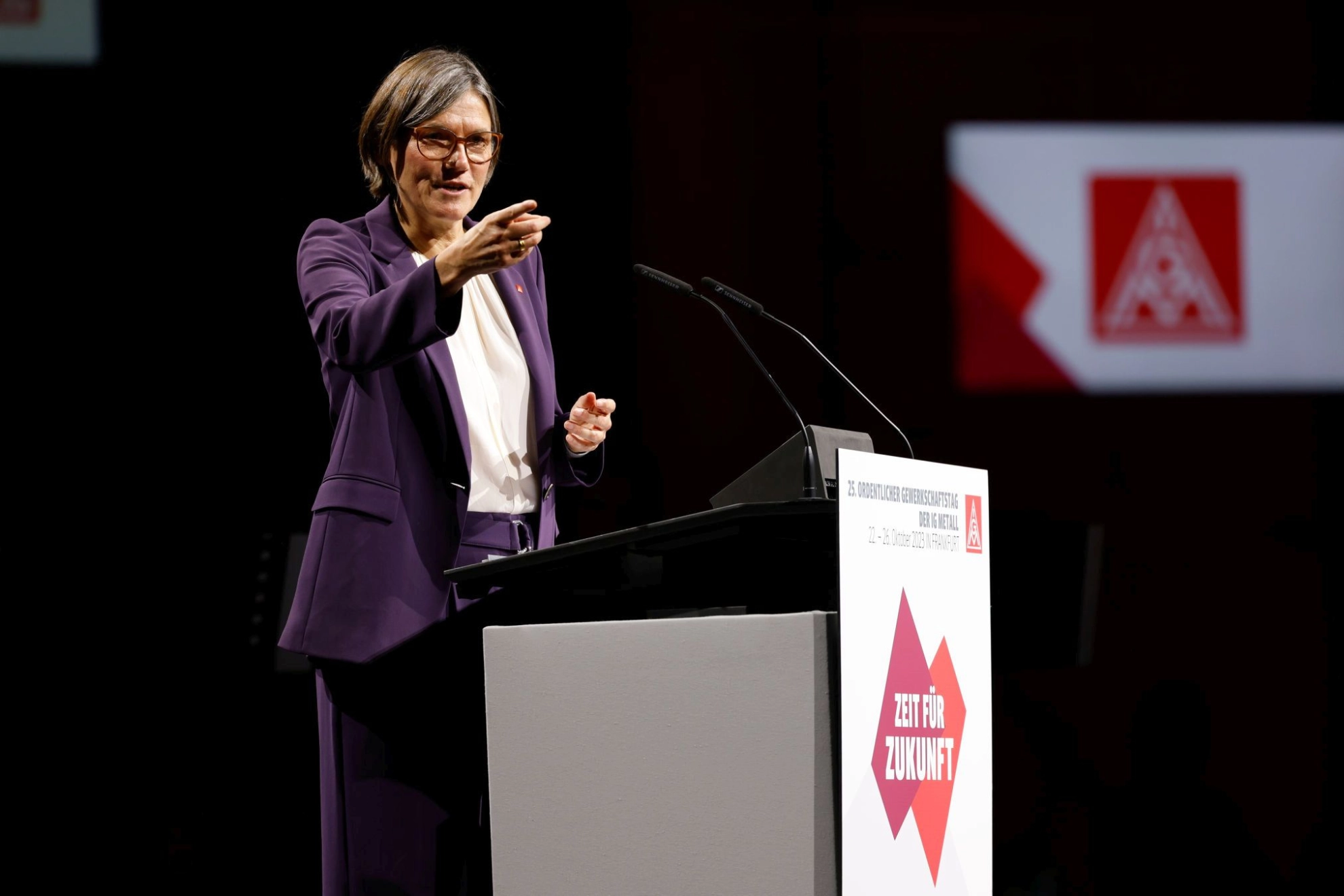
Under the motto “Time for the Future,” IG Metall will discuss and adopt its work program for the next four years. On Monday (October 23), the new leadership team led by Christiane Benner and Jürgen Kerner will also stand for election.
“All IG Metall members are represented here by you, dear colleagues,” said Christiane Benner, Second Chair of IG Metall, at the opening. She added that the union convention is thus a “symbol of democracy in action.”
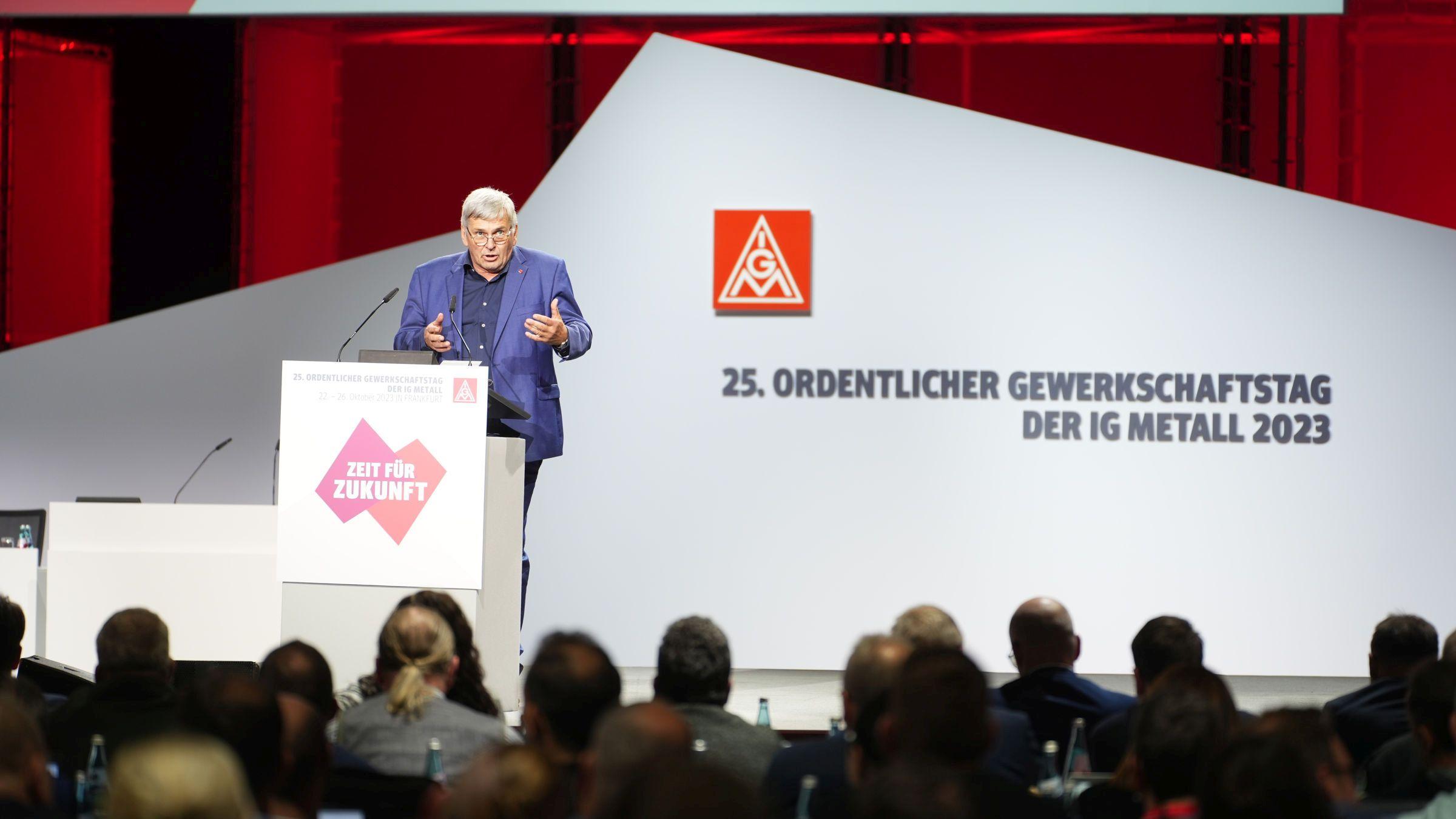
Jörg Hofmann, the outgoing First Chair of IG Metall, emphasized the importance of the 2023 union convention: “Union conventions must find answers for the here and now.” Since the last union convention, the world has changed enormously. Now, he said, the task is to “further consolidate the path toward social, ecological, and democratic transformation.”
Jörg Hofmann at the union convention in Frankfurt.
Vice Chancellor Advocates for Change
Prominent guests on opening day: DGB President Yasmin Fahimi and Federal Minister of Economics Robert Habeck (Greens).
At the opening ceremony, Habeck underscored the importance of IG Metall for the success of Germany’s industrial transformation: “We are living in challenging times. The monumental task of transformation demands that we embrace change and shape the future.” This, he said, requires a strong social partnership and strong unions that advocate for a robust, future-oriented industry and secure jobs.
Habeck called for a willingness to embrace change in German industry and in the country as a whole: “We should not side with those who bury their heads in the sand, because otherwise others will create the prosperity of the future.”
He wants to preserve industry—including sectors such as steel and aluminum—in Germany, the Minister of Economic Affairs continued. He was referring to the months-long dispute over a transitional electricity price for energy-intensive industries. Habeck supports this plan.
A Bridge to the Future
In her speech, DGB Chair Yasmin Fahimi also spoke out in favor of extending the electricity price caps with a reliable, competitive transitional electricity price for energy-intensive industries: “We want a future with a strong, climate-friendly industry. But without this bridge, we will not be able to make the transition to a sustainable economy.”
To put Germany back on the path to modernization and secure future prosperity, the government must act now. “We must follow the example of the U.S. government and make it clear: there is no government money without something in return,” said Fahimi. “Our conditions are: collectively bargained wages, commitments to maintain operations here, and investment pledges!”
IG Metall’s Highest Governing Body
The IG Metall union congress runs through Thursday, October 26. It is IG Metall’s highest decision-making body. Democratically elected delegates—the vast majority of whom are volunteer members of IG Metall—decide on the tasks, goals, and priorities for the next four years.
The motions under debate primarily concern shaping the energy and mobility transitions, securing employment and the welfare state, and issues related to collective bargaining policy and workplace co-determination.
On Monday (October 23), the election of the new Executive Board is on the agenda. This will be followed by deliberations on the motions, interrupted by the newly elected First Chairperson’s keynote address on Tuesday (October 24), a visit by Federal Chancellor Olaf Scholz, and a visit by Labor Minister Hubertus Heil on Wednesday (October 25).
 Everything about the