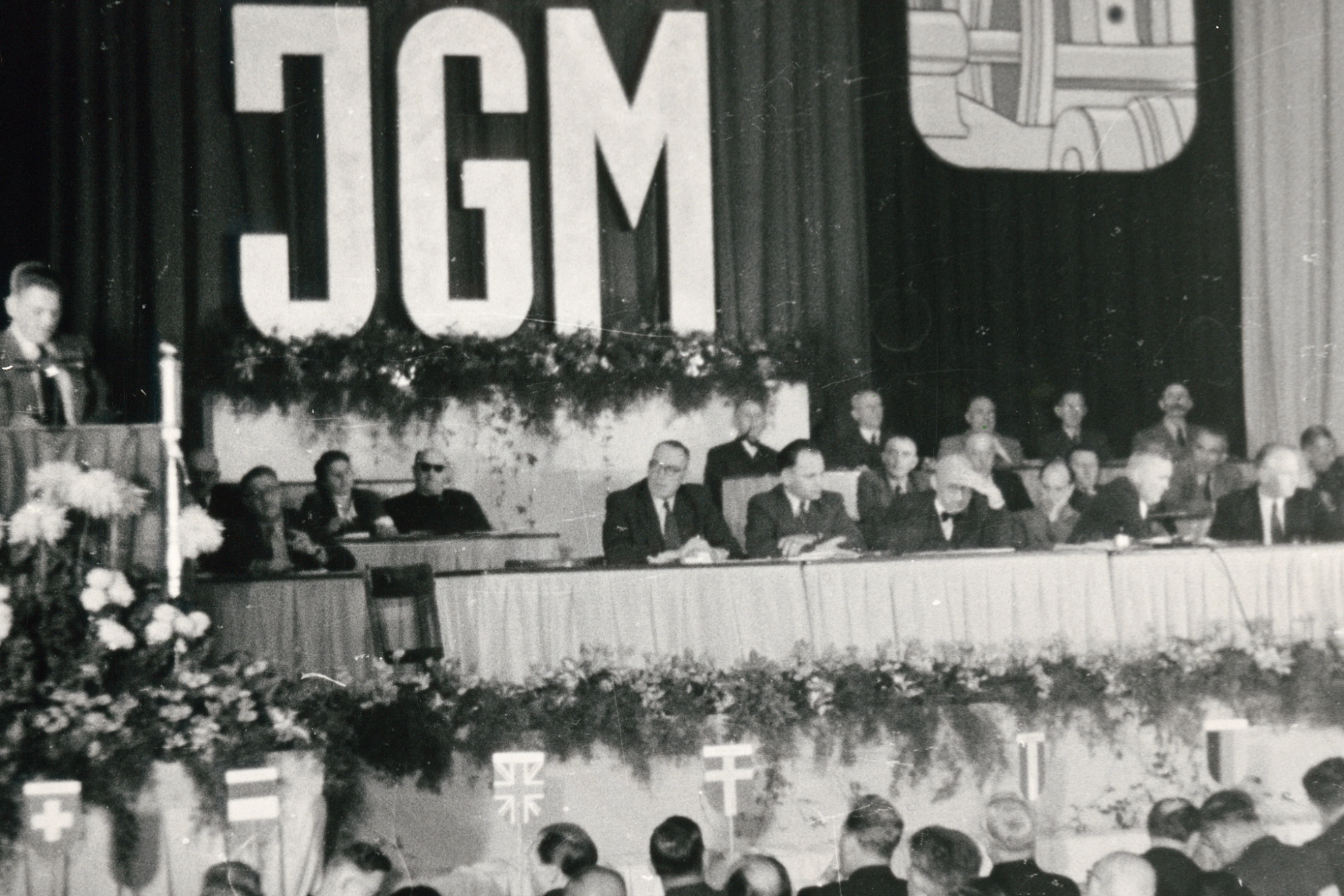
Large parts of Germany still lay in ruins when delegates gathered in Hamburg in September 1950 for IG Metall’s first regular union convention. The industrial union had been in existence for only one year across the entire federal territory, yet it had already weathered some tough struggles.
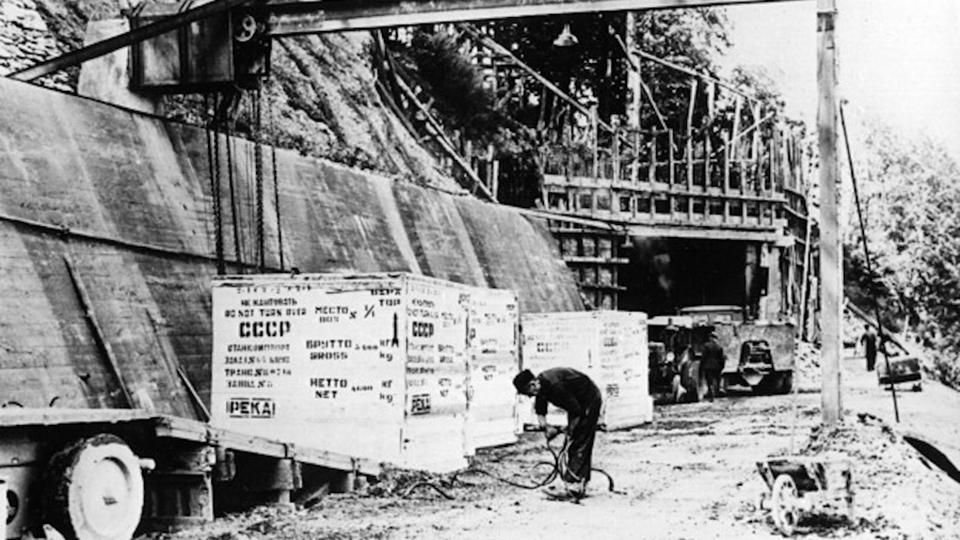
A constant source of contention in the postwar period was the dismantling of industrial facilities. IG Metall protested. After all, in many places, workers were being forced to dismantle their own workplaces. Furthermore, the dismantling hindered reconstruction efforts. However, the metalworkers were often powerless against the orders of the occupying powers.
The 1st Regular Union Congress
At the first union convention, the focus is on another, no less controversial issue: the struggle for co-determination in the mining and steel industries. IG Metall’s goal: equal co-determination in the workplaces.In November 1950, the union successfully builds pressure through a strike ballot. Since 1951, equal co-determination in the coal and steel industries has been enshrined in law.
Removal of reparations goods from the underground aircraft engine plant of Daimler-Benz in Obrigheim, January 1946
Atthe 3rd Regular Union Congress, held in Hanover in September 1954, the focus was less on fundamental questions of the economic order. The metalworkers’ motto was: “We are fighting for a higher standard of living.” In 1953, only nine percent of West German households owned a refrigerator; only one in four households had a vacuum cleaner.
“Equal Pay for Equal Work”
The fact that the profits of the “Economic Miracle” years ultimately led to rising prosperity for the population is due in no small part to IG Metall. Between 1950 and 1960, collectively bargained hourly wages in the various industries doubled. Added to this was the gradual reduction of the workweek from 48 to 44 hours with full wage compensation. And following the longest strike in the history of the Federal Republic, IG Metall secured continued pay in the event of illness.
At union conventions, delegates often see themselves as drivers of progress; sometimes they are far ahead of their time. Take, for example, the5th Regular Union Conventionin 1958. At that time, IG Metall demanded equal rights for women; the slogan was “Equal pay for equal work”—at a time when large segments of the population still clung to the ideal of the housewife and mother.
“Together for Full Employment”
Atthe 1977 union convention, current issues once again shaped the delegates’ agenda. After years of full employment, the oil price crisis hit German industry. The number of unemployed rose from around 150,000 in 1970 to nearly one million in 1978. “Together for Full Employment” was therefore the message IG Metall sent to policymakers and employers.
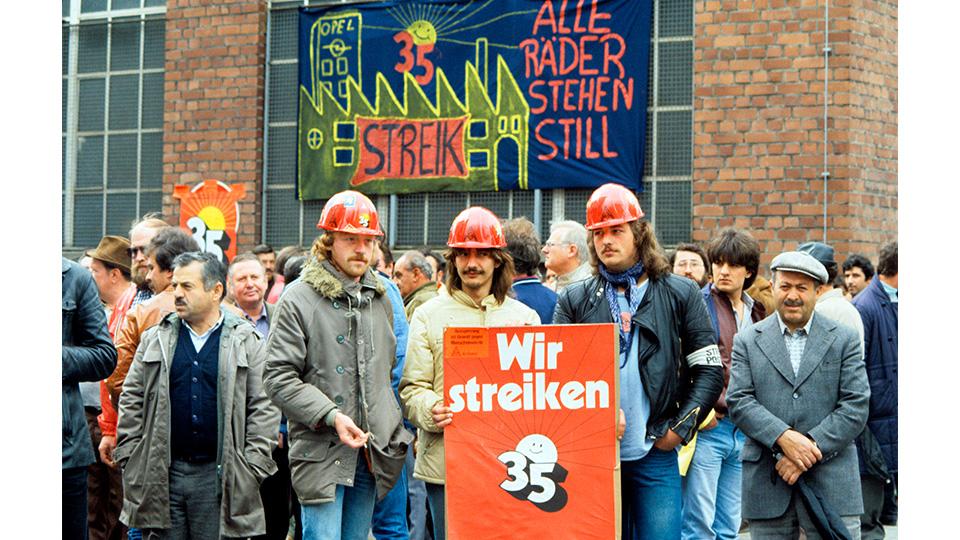
The fight for jobs continued to be a central issue for IG Metall in the years that followed. Atthe 1983 union convention, the motto was “Out of the Crisis Through Reform—Work for All.” At that time, the number of unemployed stood at over 2.2 million. IG Metall’s response: Work must be distributed more fairly. This demand led to the tough—and ultimately successful—labor struggles for the introduction of the 35-hour workweek.
Metalworkers’ strike at Opel in Rüsselsheim in 1985
First All-German Trade Union Congress
In 1992, the first all-German trade union congress took place, with around 240 delegates from the new federal states. Klaus Zwickel, then Second Chairman, described the historic moment as follows: “The people in the GDR made what was believed to be almost impossible a reality. After more than 40 years of separation, we are now united not only in one state, but in one organization—our IG Metall.”
Zwickel also addresses the dark sides of reunification: the radical dismantling of East German industry and unemployment. People in the new federal states felt “the full force of the ruthlessness of simple profit calculations.” Zwickel’s response: “Our experiences teach us that through unity and determination in action, rights and social safeguards that were once denied could be won.”
Anger Over the Neoliberal “Agenda 2010”
“A New Beginning for the New Millennium” was the title chosen by IG Metall atits 1999 union convention—and it set itself on a new course: The delegates adopted a women’s quota. It stipulated that women must be represented in IG Metall’s governing bodies and committees at least in proportion to their share of the membership.
In 2003, the social cuts of “Agenda 2010” brought a flush of anger to the faces of many delegates. The reform package of the red-green federal government was a central point of criticism in speeches and debate contributions. IG Metall’s accusation: With a neoliberal reform program, the government had committed itself to a policy that was socially irresponsible and economically nonsensical.
Atthe 2007 union conventionin Leipzig, the issue of temporary work was a defining topic alongside collective bargaining policy and the humanization of work. Atthe 2011 regular union convention, IG Metall continued its campaign for fair temporary work—and launched a new one: for a fair transition to retirement.
Working Hours: The Central Issue
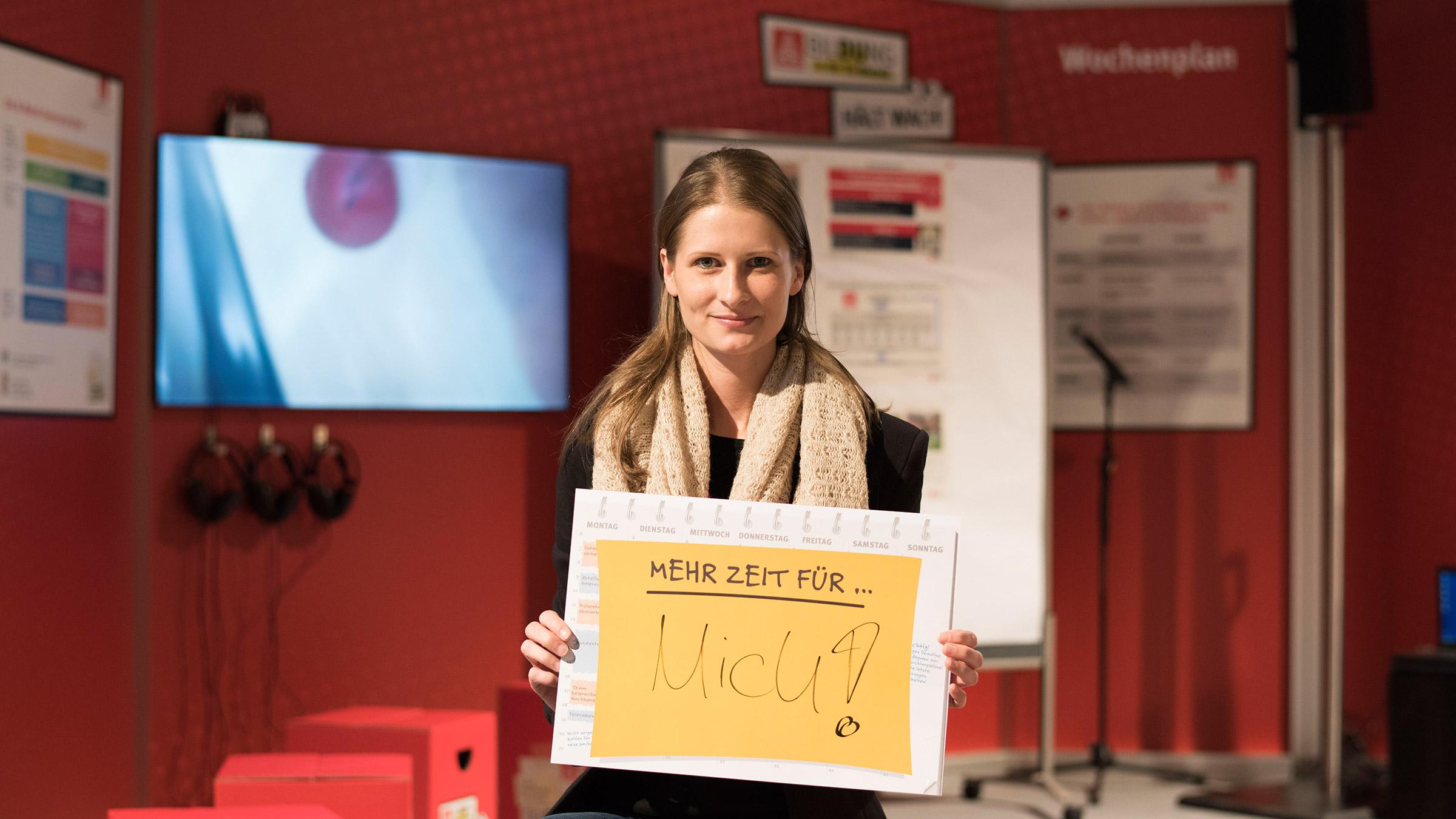
The debates at the 23rd Regular Union Convention in 2015 also reflect the major questions of our time: How do we want to live and work? What is fair? How can the pension system be structured so that it functions even in a rapidly aging society? How do we deal with the accelerating pace of working life? How can we balance family and career?
Photo campaign on the topic of working hours at the 23rd Regular Union Congress in 2015
As a result, IG Metall revisits the issue of working hours during the 2018 collective bargaining round. To push through the employees’ demands, so-called 24-hour warning strikes are used for the first time. This new labor action tool had been called for by the 23rd Regular Union Congress. Thanks in part to the high turnout for these warning strikes, the collective bargaining round proved to be a remarkable one: Shortly thereafter, employees in the metal and electrical industries gainedgreater autonomy over their working hours. From then on, they had the option to temporarily reduce their working hours to a shortened full-time schedule—down to 28 hours. Those raising children, caring for relatives, or working shifts could also take an additional eight days off per year.
IG Metall provides answers—then as now.