Automatic translation
This article has been translated automatically using computer technology. While we strive for accuracy, some wording or details may differ from those in the original article.
This translation was not manually reviewed. For important facts, quotations or legally sensitive information, please consult the German original. Individual selections, images, embedded media or technical terms may have been translated differently or incompletely.

Privacy Information Processing of Personal Member Data

On this page, we explain how we process members’ personal data.

The data controller as defined by the GDPR is
First Chairperson, Christiane Benner,
IG Metall Executive Board,
Wilhelm-Leuschner-Straße 79,
60329 Frankfurt am Main
dsgvo.verantwortlicher@igmetall.de

Questions regarding data protection at IG Metall should be directed to the Data Protection Officer
IG Metall Executive Board,
Legal Affairs/Data Protection Department,
Wilhelm-Leuschner-Str. 79,
60329 Frankfurt am Main
datenschutz@igmetall.de


This central privacy policy on igmetall.de applies to all associated subpages and subdomains ([name].igmetall.de). 

It explains what personal data is collected and processed and what rights users have. We provide a clear, consolidated summary of all data protection information. 

Protecting your privacy and your personal data is very important to us.

With this privacy notice, IG Metall (hereinafter: “we” or “us”) informs you about our processing of your personal data. Personal data refers to all information relating to you, in particular information about your identity (such as your name, contact information, gender, and date of birth), your occupation (such as occupational group, industry, length of employment, and income), and your status as a union member.


1. Categories of data, purposes for which the personal data is to be processed, and the legal basis for the processing:

a. We process the following categories of personal data:
Data we collect from you as part of the membership application, in particular

  • about you, such as your name, contact information, gender, and date of birth;
  • about your occupation, such as employer, occupational group, industry, length of employment, income, and education;
  • regarding your union membership, such as type of membership;
  • the bank account information you provided, specifically the name of the bank, IBAN, and BIC;

In the case of employer-administered membership: data we receive from your employer; data relating to a change in your employment relationship that justifies a change in your contribution payments.

b. “We”—that is, our employees in the organizational units of IG Metall and, depending on their responsibilities and duties, our volunteer officers at the workplace—process personal data for the following purposes:

We process the data we collect from you as part of your membership application

  • to administer your membership in IG Metall;
  • to conduct elections (for example, to verify eligibility to vote, and to support and oversee the conduct of elections for shop stewards, works council members, youth and apprentice representatives, and representatives for employees with severe disabilities);
  • to support the work of union officials (for example, through educational activities and oversight, in the formation of committees and working groups, and by recognizing local activities);
  • to generally manage our union activities and optimize internal processes related to the other purposes listed here;
  • to support members during strikes;
    and
  • to fulfill our other statutory duties as a union (e.g., holding meetings; registering, training, and advising shop stewards, works council members, representatives for employees with severe disabilities, and members of youth and apprentice representative bodies; monitoring the activities of local officials; overseeing collective bargaining agreements, wages, salaries, and working conditions; promoting local union activities).

In the case of workplace-based dues collection: We process the data we receive from your employer in order to collect your statutory dues directly through your employer’s payroll department.

c. We base the data processing on the following legal grounds:

The legal basis for processing your personal data relating to your person or your profession is Article 6(1)(b) of the General Data Protection Regulation (Regulation (EU) 2016/679) (“GDPR”), which permits processing for the performance of a contract. The contractual obligations are essentially specified in the IG Metall Bylaws, as currently in force.

The legal basis for processing is also Article 6(1)(f) of the GDPR, which permits processing to safeguard our legitimate interests, provided that such processing is necessary and does not override your interests or fundamental rights and freedoms. Legitimate interests in this sense exist, in particular, to the extent that we process the data in the course of performing the tasks assigned to us under the Articles of Association, such as to inform members or communicate with former members. If you would like more detailed information about our legitimate interests or the balancing of these interests against your own, please contact our Data Protection Officer (see Section 2).

All processing purposes listed in Section 3.b are additionally based on the legal basis of Article 9(2)(d) of the GDPR, which generally permits trade unions to process personal data indicating trade union membership within the scope of their lawful activities.

The legal basis for the transfer of your personal data, including information regarding union membership, to our payment service provider (in the case of payroll deduction: your employer) is Article 6(1)(a) in conjunction with Article 9(2)(a) of the GDPR, which permits processing with your consent.

2. Necessity of data processing

The provision of your personal data is not required by law; that is, you are not obligated to provide us with your data. However, if you do not provide us with the personal data we request from you as part of the membership application, we will not be able to process your membership.

The transmission of information to our payment service provider(s) that allows for inferences regarding your union membership is absolutely necessary for the payment of dues via SEPA direct debit. If you do not wish for this information to be transmitted to our payment service provider(s), you may arrange an alternative payment method with the IG Metall office responsible for you.

In the case of payroll deduction: The transmission of information regarding your union membership to your employer is absolutely necessary for your employer to collect your membership dues. If you do not wish for this information to be shared with your employer, you may use an alternative IG Metall membership application form or change-of-information form, which provides for the setup of a SEPA direct debit mandate directly from your account for the payment of membership dues.

3. Disclosure to recipients or categories of recipients of the personal data:

When setting up the SEPA direct debit, we provide our payment service provider(s) with the amount of your membership dues as well as information from which your union membership may be indirectly inferred.

In the case of payroll deduction: We will inform your employer that you are a union member.

Volunteer Officials
For the purposes of our union work, your data may be shared with volunteer officials—for example, for direct support within the company—if these officials require the information to perform the tasks assigned to them. In this context, we ensure that the principles of data protection are upheld.

Service Providers
We transfer your personal data to service providers who guarantee GDPR-compliant handling of your data even after the transfer, in order to receive support in fulfilling our statutory duties.
The majority of our service providers are based in Europe to ensure a high level of data protection and security. For contracts with service providers outside the EEA, there are contractual provisions with additional safeguards designed to guarantee the protection of personal data.

Other Third Parties
In addition, your data may also be disclosed to other third parties if this is necessary for the effective performance of our union work (associations, established entities, umbrella organizations, etc.), if you expressly request it, or if we are legally obligated to disclose it (e.g., in the context of cooperation with government authorities).  In this context, we ensure that data is transferred only on a case-by-case basis.

If you would like further information about specific recipients, please contact our Data Protection Officer (see Section 2).

4. Duration of storage/criteria for determining the duration:

The period for which personal data is stored depends on the respective purposes of processing. It is not possible to list the various retention periods individually in a reasonable format here. The criteria for determining the respective retention period in a specific case are as follows:

  • To the extent that we process the data solely for the purpose of administering the membership relationship, we store the data for the duration of your membership;
  • To the extent that we process the data in connection with anticipated legal proceedings, we store the data until the final conclusion of the legal proceedings or until the claims in question become time-barred in accordance with the relevant provisions of civil law; in the case of the standard statute of limitations, the storage period is generally three years;
  • To the extent that we require the data for accounting purposes, the retention period is governed by the statutory regulations governing the retention of records; the retention period is generally between six and ten years;
  • Data pertaining to members who have resigned will be marked as “resigned”; access to this data will be maintained for an additional 12 months to process these members’ claims as provided for in the bylaws (recreational accident insurance, death benefits, etc.).

5. Note on the use of AI

To carry out internal processes and achieve the purposes mentioned above, we use AI-based systems in addition to conventional IT systems. No automated decision-making takes place in this context. The use of such AI systems complies with applicable legal requirements.

6. Rights of the data subject:

If you have any questions regarding your rights, please feel free to contact us. You can find our contact information in Section 2 above.

Provided the legal requirements are met, you have the following rights under Articles 15 through 22 of the GDPR:

  • Right of access, i.e., the right to receive confirmation from us as to whether personal data concerning you is being processed and, if so, to receive information about such data and further details;
  • The right to have inaccurate personal data concerning you corrected;
  • The right to erasure, for example, if the personal data is no longer necessary for the purposes for which it was processed;
  • Right to restriction of processing,
  • Right to data portability, i.e., the right to receive the personal data concerning you that you have provided to us in a specific format;
  • The right to object to data processing in certain cases for reasons arising from your particular situation, or at any time in the case of direct marketing.

7. Right to withdraw your consent

You may freely revoke any consent you have given for data processing at any time. However, this does not affect the lawfulness of the processing carried out on the basis of your consent prior to revocation. If you revoke your consent or effectively object to further processing based on your consent, we will no longer process the data for these purposes.

The exercise of your rights may be limited in individual cases due to legal restrictions, particularly where processing is necessary (see Article 17(3) of the GDPR), where retention obligations exist, or where the effort involved would be disproportionately high (see Section 34(1) and (4), Section 35 of the BDSG) or in the event of an overriding public interest (see Section 36 of the BDSG).

If you have any questions regarding your rights or any restrictions on them, please contact our Data Protection Officer using the contact information provided in Section 2.

8. Right to lodge a complaint with a supervisory authority:

If you believe that the processing of your personal data is not lawful, you have the right under Article 77 of the GDPR to lodge a complaint with a competent supervisory authority, in particular in the Member State of your habitual residence, your place of work, or the place where the alleged infringement occurred. The address of the supervisory authority responsible for IG Metall is:

The Hessian Data Protection Commissioner
Gustav-Stresemann-Ring 1, 65189 Wiesbaden
Phone 0611 14 08-0

New on igmetall.de
Aktionstag bei Mercedes Benz, Daimler, in Sindelfingen gegen die Angriffe auf Beschäftigten in der Automobilindustrie.
Resistance to Attempts at Drastic Cuts Auto industry workers issue a warning
Sie wollen doch nur dein Bestes
Redistribution Making Germany more equitable: We need this tax reform now
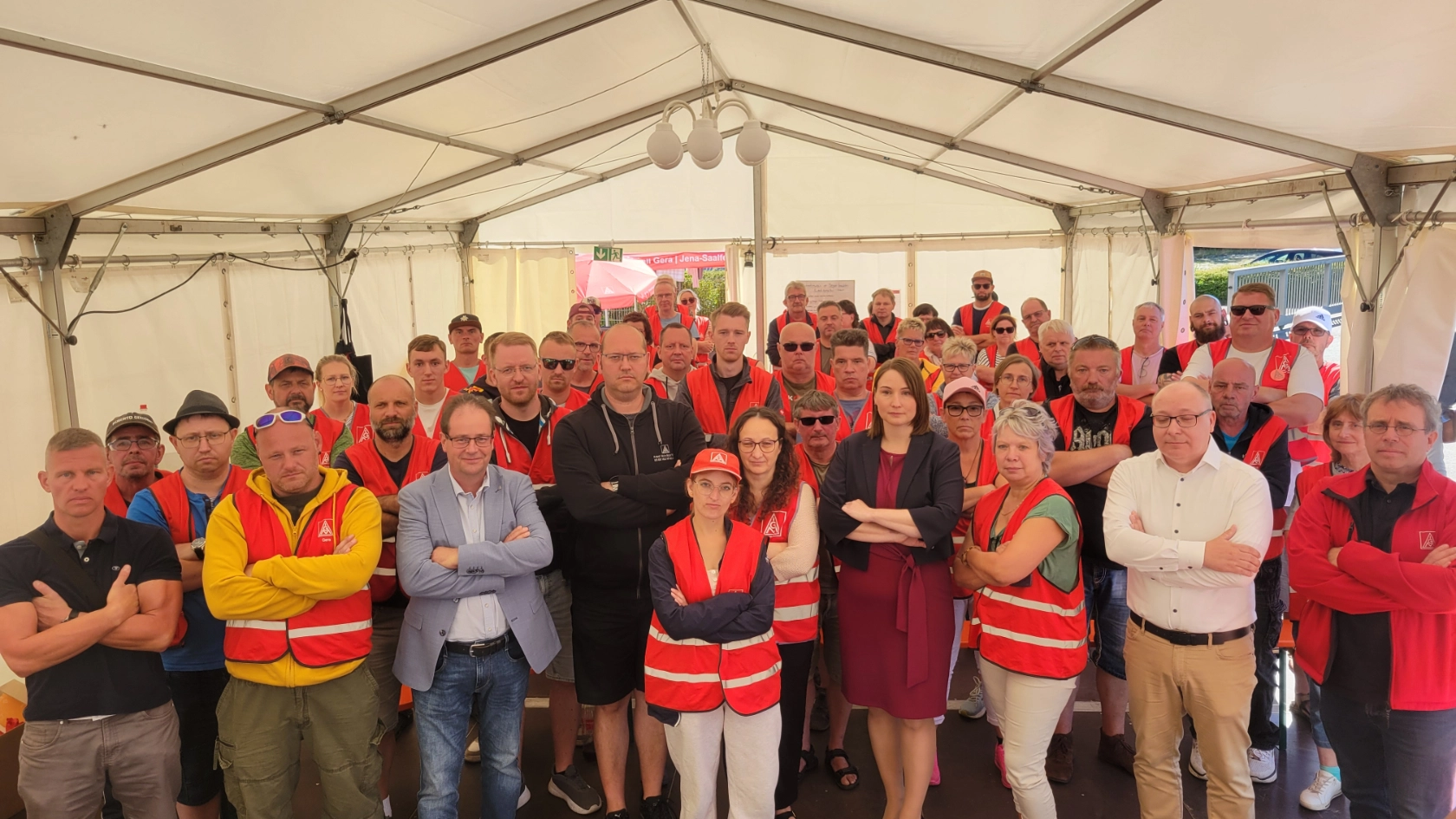
Der Streik bei Kelvion in Nobitz-Wilchwitz begann am 4. August 2026. Die Geschäftsleitung will nach Sarstedt/Niedersachsen verlagern - obwohl die Produktion in Wilchwitz profitabel und bis ins nächste Jahr ausgelastet ist.
"It’s worth fighting for!" Kelvion workers strike for a social collective bargaining agreement
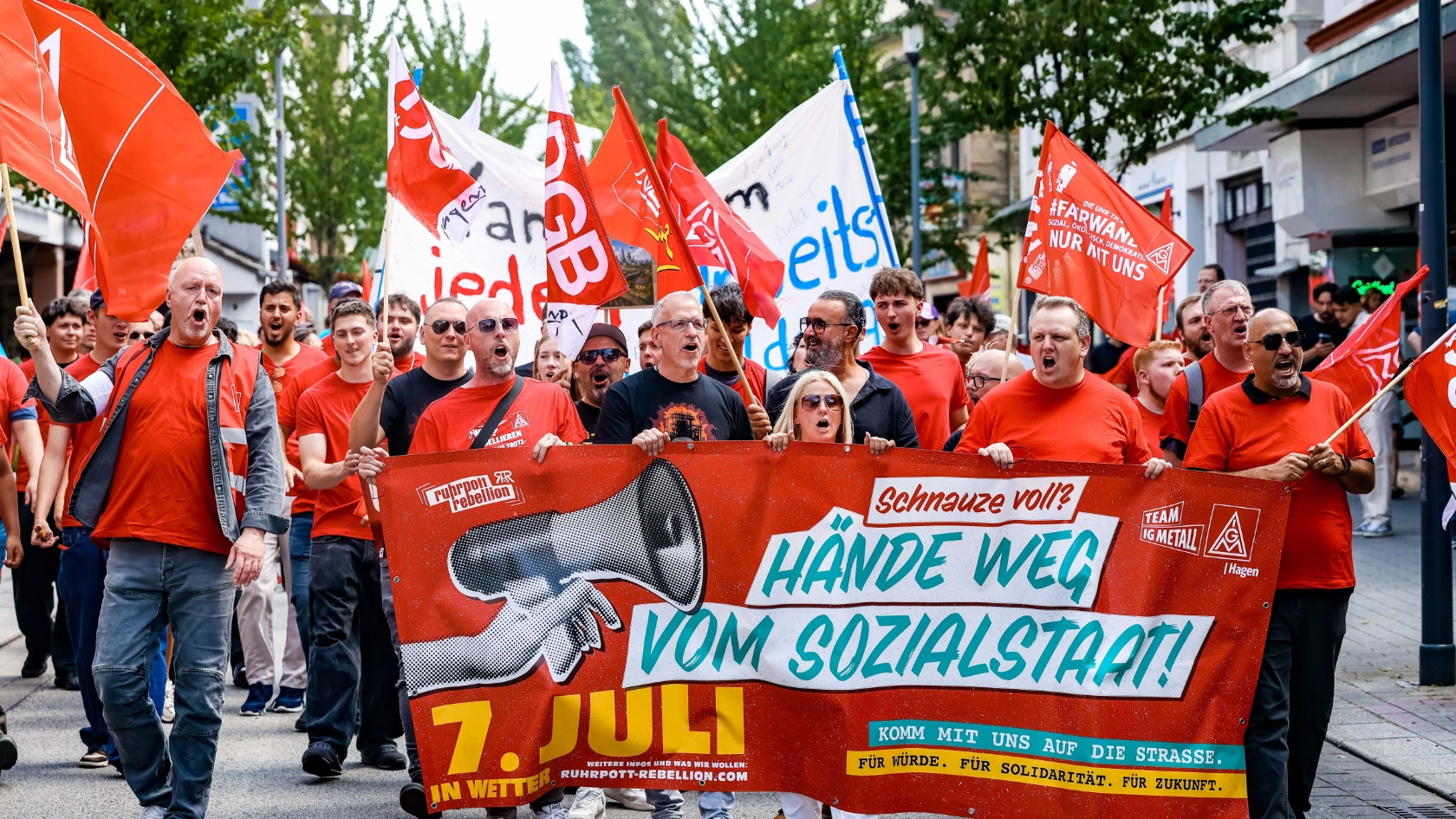
Ruhrpott Rebellion am 07.07.2026
Welfare State September 26: Nationwide Day of Action for Social Policy
Beschäftigter arbeitet an einem Getriebe in einer Fabrik
Working Hours Why working longer doesn’t help—and actually does more harm than good
Ein männlicher Land- & Baumaschinenmechatroniker prüft einen Traktor mit einem Tablet
2026 Collective Bargaining Agreement for the Metalworking and Agricultural Engineering Sectors Greater Flexibility in the Metalworking and Agricultural Engineering Sectors in Lower Saxony and Bremen
Elektronikerin prüft die Spannung an einem Schaltschrank.
2026 Collective Bargaining Round for the Electrical Trades Wage Increase in the Electrical Trades in Berlin-Brandenburg
Benjamin Heine ist Mitarbeiter der BMA in Braunschweig
2026 Collective Bargaining Round for Metal Fabrication and Precision Engineering Higher Wages in the Metal Fabrication and Precision Engineering Sectors in Southwest Germany
Metall-Arbeiter beim Schleifen
2026 Collective Bargaining Round for the Metalworking Trade Employees in the Berlin-Brandenburg metalworking sector will receive higher pay
Beschäftigte von Thyssenkrupp demonstrieren in Essen am 23. Mai 2024 gegen das Vorgehen der Geschäftsführung beim geplanten Teilverkauf des Unternehmens.
Defend the welfare state All dates for nationwide actions against cuts to social services
IGM Aktion VW Wolfsburg
On September 21, things will get loud Nationwide Day of Action: Auto Industry Workers Fight Back Against Mass Layoffs
Auszubildender in einer Schreinerei
Apprenticeship Wages Questions and Answers About Apprenticeship Wages

Subscribe to the newsletter