What is an apprenticeship stipend?
An apprenticeship stipend is the payment you receive during your apprenticeship. Colloquially, it’s also referred to as an “apprentice salary,” “apprenticeship salary,” or “apprentice wage.” Officially, however, apprentices do not receive a salary or a wage, but rather a stipend. The amount of your apprenticeship stipend varies depending on the industry, region, and year of your apprenticeship.
How much is the apprenticeship stipend?
Your apprenticeship contract specifies the amount of your apprenticeship stipend. It increases each year of your apprenticeship. The exact amount depends not only on the year of your apprenticeship but also on the region where your company is located and the industry in which you work. For many apprentices, the apprenticeship stipend is set by collective bargaining agreements. If there is no collective bargaining agreement, the stipend must still be “reasonable.” This is stipulated by the Vocational Training Act, which sets a minimum threshold based on the minimum apprenticeship stipend secured by the youth wing of the labor unions. Furthermore, an apprenticeship stipend is only considered reasonable if it amounts to at least 80 percent of the standard industry-wide collective bargaining stipend. This means: The higher the collective bargaining stipends in an industry, the better.
How much is the collective bargaining-based apprenticeship stipend?
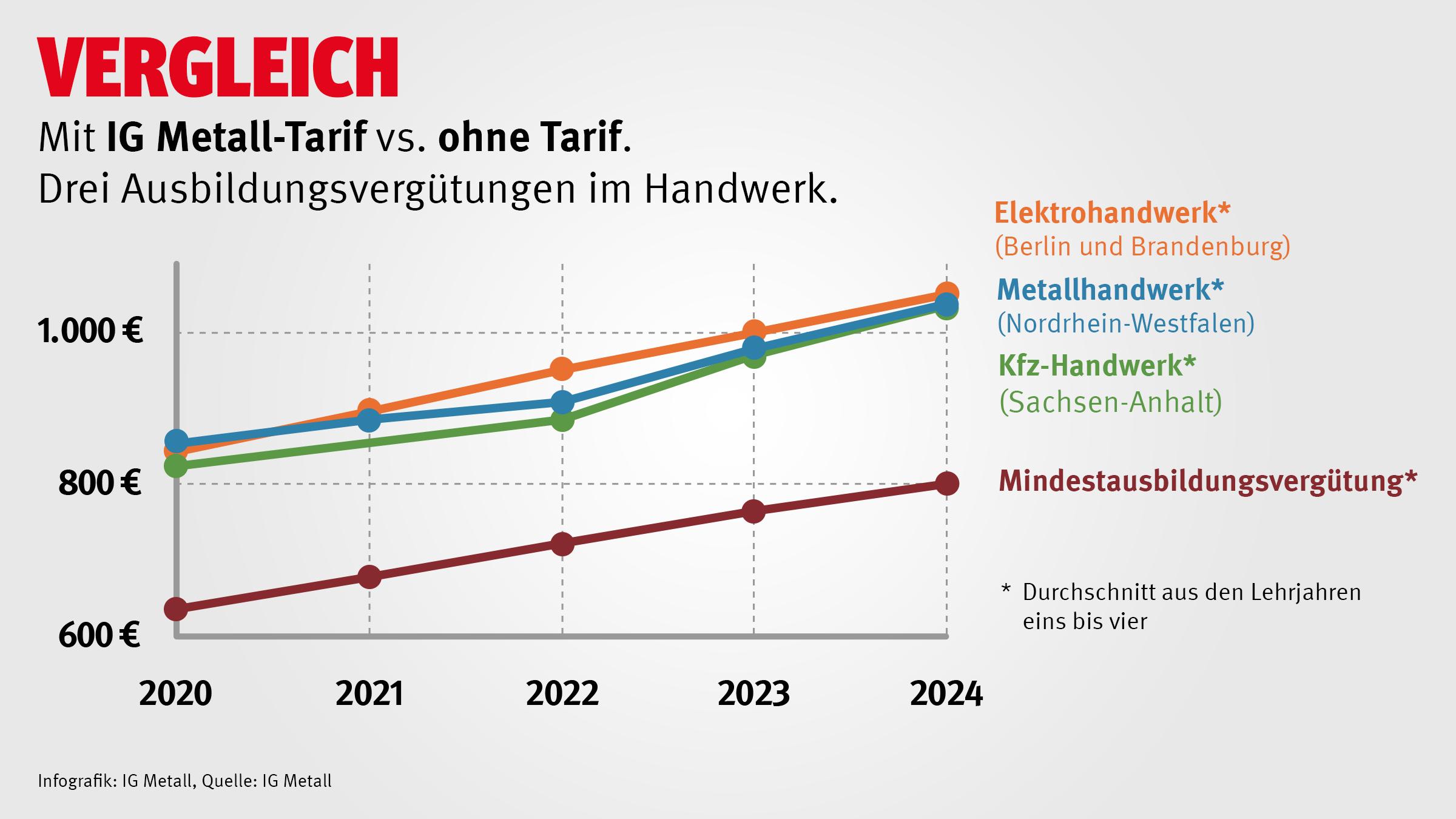
You’re in a much better position if your company has a collective bargaining agreement —because then the training stipend amount set by the collective bargaining agreement applies. Training stipends set by collective bargaining agreements are generally significantly higher than the minimum training stipend. You can find out how high the training stipends are in the respective industries and trades here in our collective bargaining tables.
The chart compares, by way of example, the development of three collective bargaining-based apprenticeship wages in the skilled trades with the minimum apprenticeship wage—that is, without a collective bargaining agreement.
However, higher apprenticeship wages are not the only benefit of a job or apprenticeship covered bya collective bargaining agreement. Vacation pay and Christmas bonuses are usually higher as well, and many industries offer additional payments. However, only ourmembersare entitled to all these benefits.
Who sets the collective bargaining-based apprenticeship wages?
IG Metall negotiates collective bargaining-based apprenticeship wages with employers’ associations or individual employers during collective bargaining rounds. In most cases, a term is also agreed upon—that is, how long the negotiated collective bargaining agreement will remain in effect. We negotiate apprenticeship wages in the industries that fall within our organizational scope. These include , among others, the metal, wood and plastics, and textile and apparel industries.
Do I have a legal right to the apprenticeship wages set by the collective bargaining agreement?
Only if you area memberof IG Metall can you legally enforce the collectively agreed-upon apprenticeship wages in the event of a dispute. If you do not belong to a union, you cannot rely on the collective bargaining agreement in a dispute.
Is there a minimum wage for apprentices?
The minimum apprenticeship stipend—commonly referred to as the “minimum wage for apprentices”—has been in effect since 2020. It is a legally mandated minimum amount that apprentices receive during their vocational training. It primarily helps apprentices who are not covered by a collective bargaining agreement and is increased annually by a set percentage. The amount of the minimum apprenticeship stipend always depends on the year in which the apprenticeship began.
If you start your training in 2026, the minimum training allowance in
- 1st year: €724
- Year 2: €854
- Year 3: €977
- 4th year: €1,014
When must the pay be deposited into your account?
The training allowance is paid monthly. It must be credited to your account by the last day of the month at the latest. It is also paid when you are on vacation. If you are sick, your allowance will continue to be paid for up to six weeks. After that, you will receive sick pay from your health insurance provider.
Gross / Net – What’s Left of My Pay?
The amount listed in your apprenticeship contract is the gross amount of your stipend. This is the total amount before taxes and social security contributions for health, long-term care, unemployment, and pension insurance are deducted. The net amount, on the other hand, is the money that is paid to you after taxes and social security contributions have been deducted and that ends up in your bank account.
Do apprentices pay taxes?
Whether you have to pay taxes depends on the amount of your apprenticeship pay and your income tax bracket. If you’re in income tax bracket I and your income falls below the basic exemption amount of 12,096 euros per year (tax year 2025), you don’t have to pay taxes. If you earn more than that, you’ll have to pay income tax and, in some cases, church tax. For the 2026 tax year, the basic exemption amount will increase to 12,348 euros.
Is the apprenticeship stipend counted toward child benefit?
Your parents receive child benefit for you if you are under 25 years old and are in vocational training. It doesn’t matter how much your training allowance is—the entitlement to child benefit remains. It may also be paid if you are between two training programs. The entitlement to child benefit applies only until you complete your first vocational training program and, at the latest, until you turn 25.
Is the apprenticeship stipend counted toward child support?
Regardless of whether you are a minor or an adult, your parents are obligated to provide you with financial support during your first vocational training program. Once you begin receiving your first training stipend, it is counted, at least in part, toward your maintenance entitlement. If both of your parents are obligated to provide maintenance, the training stipend is counted as half for each parent.
Do apprentices receive a Christmas bonus and vacation pay?
In addition to your training stipend, your training company may also pay you additional benefits. These include, among other things, vacation pay and a Christmas bonus. These additional benefits are also called annual special payments and are not regulated by law. Employers are therefore only required to pay them if they are specified in the employment contract, a company agreement, or a collective bargaining agreement.