Automatic translation
This article has been translated automatically using computer technology. While we strive for accuracy, some wording or details may differ from those in the original article.
This translation was not manually reviewed. For important facts, quotations or legally sensitive information, please consult the German original. Individual selections, images, embedded media or technical terms may have been translated differently or incompletely.
Illustration zeigt Auszubildende verschiedener IG Metall-Branchen.

Trainees
Getting Started with Your Apprenticeship

Compensation, probationary period, vocational school—we explain what you need to know before starting your apprenticeship or dual study program.


Whether you’re in an apprenticeship or a dual study program: To make sure you’re well-prepared for the challenges of this new phase of your life, we’ve put togethersome tips and information for you here. We provide concise answers to nine questions that apprentices often ask. We also address the topic of finances: What financial support is available, and what should you know about your apprenticeship stipend? And, of course, we explain how and where you can get help if you run into problems.


1/9—What documents do I need to start my apprenticeship?

The most important document is your apprenticeship contract. It should include at least the following points:

  • Length of the probationary period
  • Working hours
  • Number of vacation days
  • Amount of the apprenticeship stipend
  • Termination provisions
  • Special payments
  • Start date, duration, type, and objective of the training

You’ll also need to provide your training company with yourtax identification numberat the start of your program. If you don’t have it yet, you can request it from yourlocal tax office. You’ll also receive yoursocial security numberfrom the German Pension Insurance. The social security number is assigned once and remains valid for life. It includes, among other things, your date of birth, which is used to determine when you’ll start receiving your pension. The social security card must be treated with the same care as your ID card. Whenever you start a new job or apply for social benefits (such as unemployment benefits), you’ll need this card to verify your personal insurance number. In addition, the human resources department will need your health insurance information and your checking account details.


2/9 - How long is my probationary period?

TheVocational Training Actstipulates that the probationary period must last at least one month and no more than four months. During this time, the employer and the apprentice are supposed to get to know each other. This allows you to determine whether you’ve chosen the right career for you. During the probationary period, both you as the apprentice and the company can terminate the apprenticeship agreement from one day to the next without providing a reason. Notice of termination must be given in writing.

3/9 - Do I have to attend vocational school?

Yes, classes at the vocational school are an important part of your on-the-job training. As a rule, they are mandatory for all apprentices. They take place either in intensive blocks or on a part-time basis. Your employer must grant you paid time off for this period. In addition, all training materials required for your vocational training and for taking interim and final exams must be provided to you free of charge. You can find out exactly how school attendance is regulated inthe Vocational School Guide.


Apprenticeship & Dual Study Program


4/9 - Do I have to complete every task I’m assigned?

It often happens that apprentices are assigned tasks that do not correspond to the training content of their profession. These “tasks” are referred to as activities unrelated to the apprenticeship. However, it is not always possible to define exactly which activities fall into this category. For example, in commercial training, filing and photocopying are also part of the training. However, if these tasks dominate or are even performed exclusively by the trainee, they no longer serve the purpose of the training and can be classified as non-training-related activities. They are prohibited, as trainees should not be exploited as cheap labor.

The specific tasks required are outlined in the respective training framework plan—but washing the boss’s car or constantly running errands definitely do not fall under this category. You can find training framework plans for all occupations on the website of the Federal Institute for Vocational Education and Training.

5/9 - How can I tell if an apprenticeship position is a good one?

Your training at the company should be well-structured in terms of both time and content. To this end, the trainer draws up a training plan, which you’ll receive at the beginning of your training. It ensures that you learn all the content and tasks that are necessary and important for your profession. If you’re constantly being saddled with tasks unrelated to your training, that’s not allowed. In this case, you should contact yourYouth and Apprentice Representative Committee (JAV)at the company or your works council. Overtime that does not serve the purpose of your training—and that may not even be compensated or offset with time off—is also prohibited. Here, too, you should contact the JAV, the works council, or your local IG Metall chapter to discuss further steps. You can find more criteria for a good apprenticeship in the Apprenticeship Quality Checklist.

6/9 - What about overtime?

Don’t agree to work overtime during your apprenticeship. Anyone undergoing an apprenticeship is employed solely for the purpose of learning a trade. The daily training hours are entirely sufficient for this. If the employer requires overtime, it must always serve the purpose of the apprenticeship. This means a trainer must be present and training must take place. The employer must pay overtime at an overtime rate or compensate for it with an equivalent amount of time off.


Beratung und Kontakt
We’re here to help
Advice & Help
Mitglied werden
Become a Member
Without you, there is no “we”

7/9 - How much vacation time am I entitled to?

The apprenticeship contract specifies how many vacation days you are entitled to per year. With a few exceptions, our collective bargaining agreements provide for30 days of vacation. Annual vacation must be taken during the current calendar year, and your employer must grant you at least two consecutive weeks of it. We recommend submitting yourvacation requestin writing well in advance. Your employer must respond to this request within one month.

8/9 - Will I be hired after my apprenticeship?

Since 2012, apprentices who are members of IG Metall have, in principle, a collective bargaining right topermanent employment upon successful completion of their apprenticeship. We have secured this right in the metal and electrical sectors, the iron and steel industry, the wood and plastics sectors, and in many skilled trades. Here, the works council must work with the employer to determine staffing needs and plan how many graduates will be hired on a permanent basis. If, based on this staffing plan, it is determined that permanent employment is possible, the graduate is entitled to it. Even if the company trains more apprentices than it needs, graduates are entitled to be employed for at least one year—unless the works council and the employer have agreed otherwise.

9/9 - My trainer is sending me home because there’s no more work at the company. What happens now with me and my apprenticeship?

If the training company sends you home, it is forgoing your training contributions or your labor. In this case, deducting hours is not lawful. Thetraining stipendmust continue to be paid if the training is canceled for reasons beyond your control, even though you would be available to work.


For Students

Housing assistance, student loans, and more: Here we answer questions that dual-track students often ask. And we explain who you can turn to if you encounter problems.

Learn more
We’re your union

We stand up for fair pay, good jobs, future prospects, and equal opportunities. In solidarity and with determination.

Illustration zum Thema Besser mit Tarif für Auszubildende und dual Studierende

More money and time

Our collective bargaining agreements make things easier for you.
Illustration zum Thema Rechtsschutz für Auszubildende und dual Studierende

Legal protection

At work and with exam-related matters.
Check von Arbeits- und Ausbildungszeugni

Fair evaluation

We review your transcripts and employment contracts
Illustration zum Thema Seminare für Auszubildende

Seminars and internships

Stay up to date with us on both theory and practice.
Streikrecht für Auszubildende und dual Studierende erklärt

Strike support

We’re your safety net—especially in an emergency!
Illustration zum Thema „mit der IG Metall zum Stipendium“

Scholarship

Study with a scholarship from the Hans Böckler Foundation.
Illustration zur Solidar-Gemeinschaft IG Metall

Solidarity

We’ve got your back!
Clever sparen mit der ISIC-Card

ISIC Card for Budget-Conscious Students

Discounts and perks—worldwide.
Illustration zur Freizeitunfallversicherung für Auszubildende und dual Studierende

Recreational Accident Insurance

With us, you’re covered even in your free time.
Bücher gestapelt in einem Regal
Glossary
Education from A to Z

Your guide to vocational training and dual study programs

Our news straight to your smartphone

IG Metall App for Android and iOS

With our IG Metall app, we keep you informed about collective bargaining agreements and pay raises. We report on politics and news from the workplace. Also popular: the shift scheduler, our guides on all aspects of working life, and our various services.

IG Metall App
new on igmetall.de
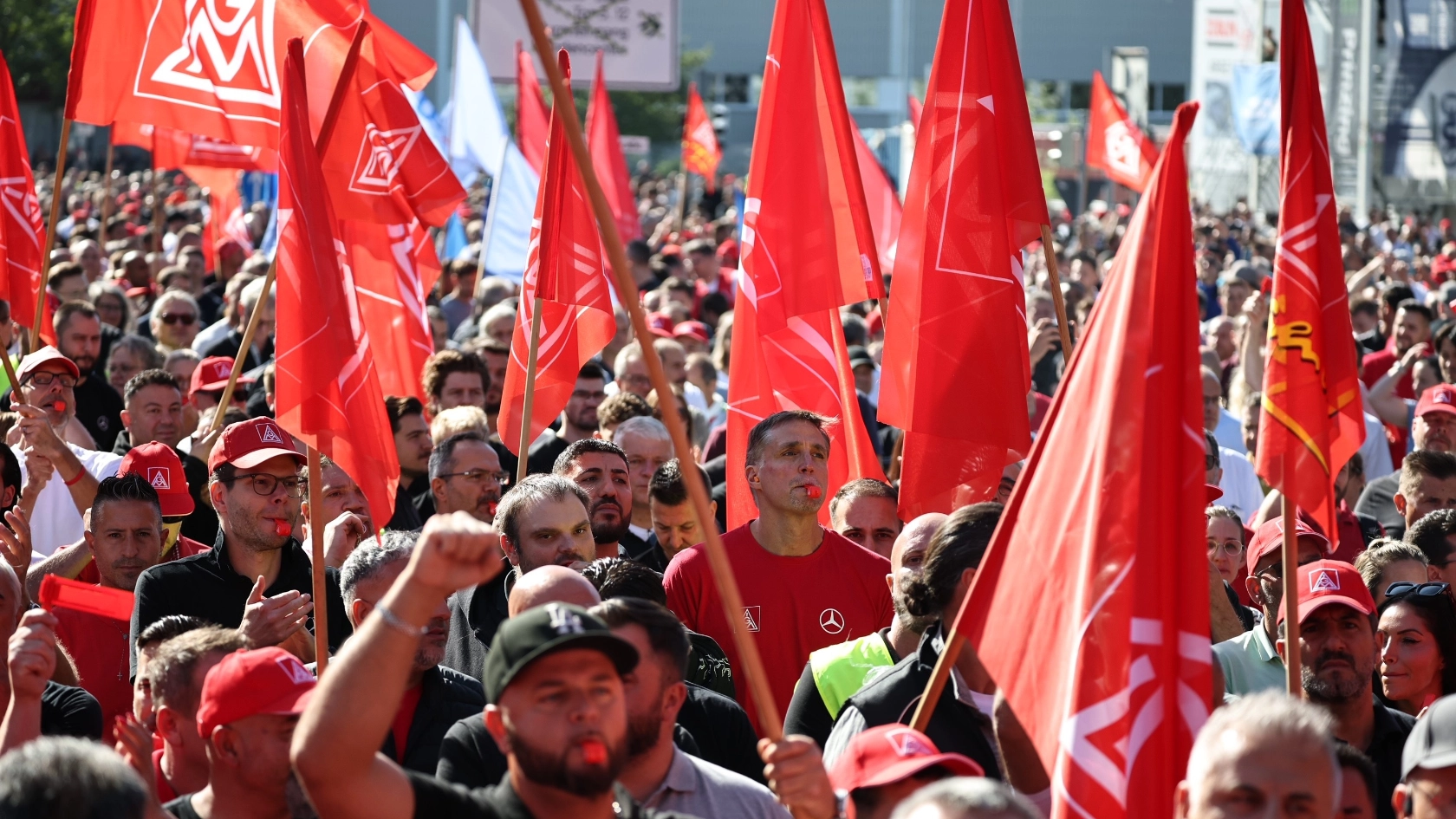
Aktionstag bei Mercedes Benz, Daimler, in Sindelfingen gegen die Angriffe auf Beschäftigten in der Automobilindustrie.
Resistance to Attempts at Drastic Cuts Auto industry workers issue a warning

Employees at VW, Mercedes-Benz, and other automakers and suppliers are giving their corporate bosses a rough fall. They will no longer allow themselves to be made scapegoats when management mistakes are the cause of the crisis. A nationwide day of action is scheduled for September 21.

Sie wollen doch nur dein Bestes
Redistribution Making Germany more equitable: We need this tax reform now

Is Germany a fair country? Many people say: no! Tax policy is the key lever for greater social justice. We should use this lever—and we should do so quickly and in several areas.

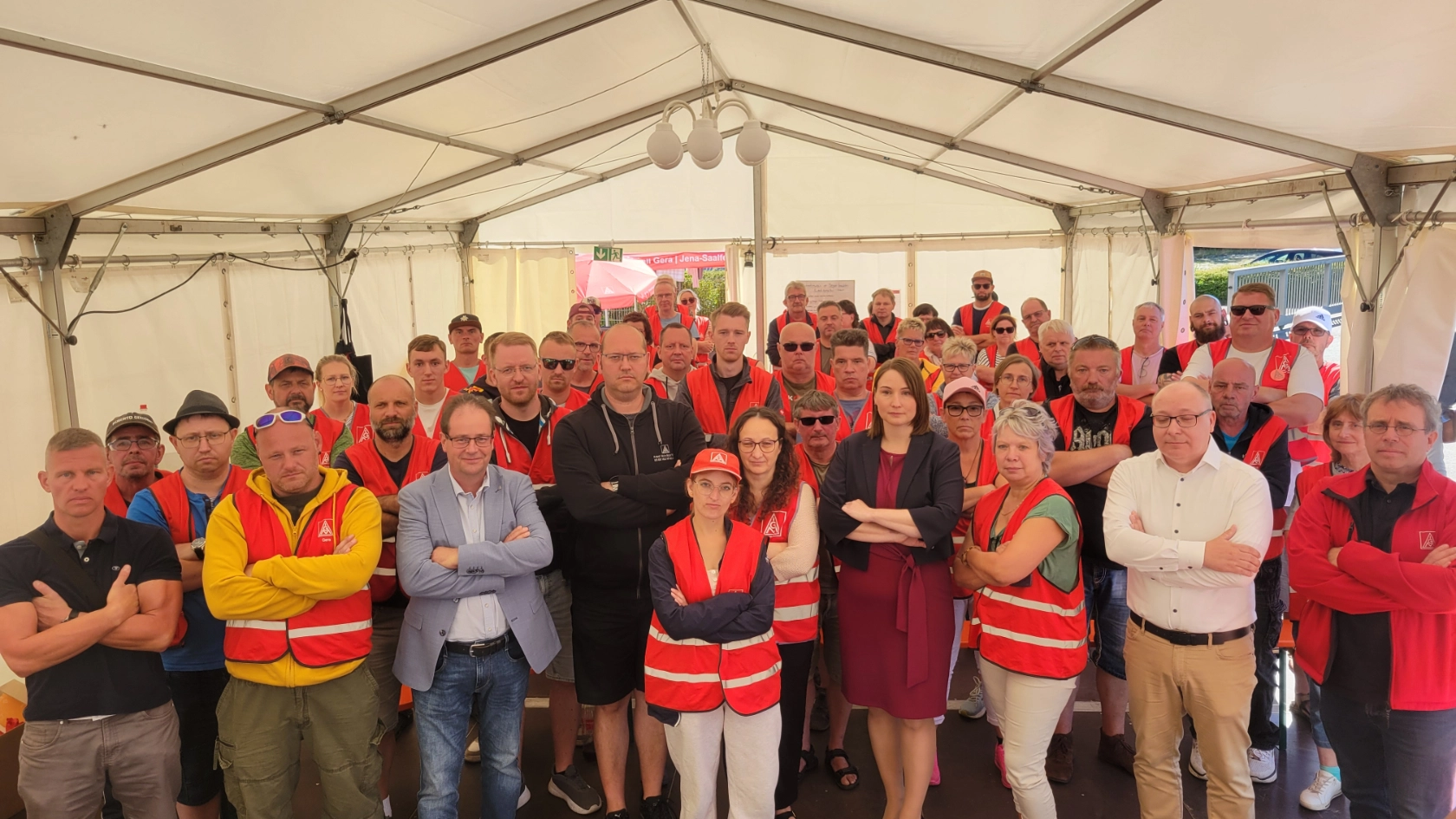
Der Streik bei Kelvion in Nobitz-Wilchwitz begann am 4. August 2026. Die Geschäftsleitung will nach Sarstedt/Niedersachsen verlagern - obwohl die Produktion in Wilchwitz profitabel und bis ins nächste Jahr ausgelastet ist.
"It’s worth fighting for!" Kelvion workers strike for a social collective bargaining agreement

Kelvion plans to relocate its profitable heat exchanger production in Wilchwitz (Thuringia) to the west. After nearly four weeks on strike, employees and IG Metall have reached a collective bargaining agreement that includes generous severance packages. A new investor intends to take over at least part of the operation.

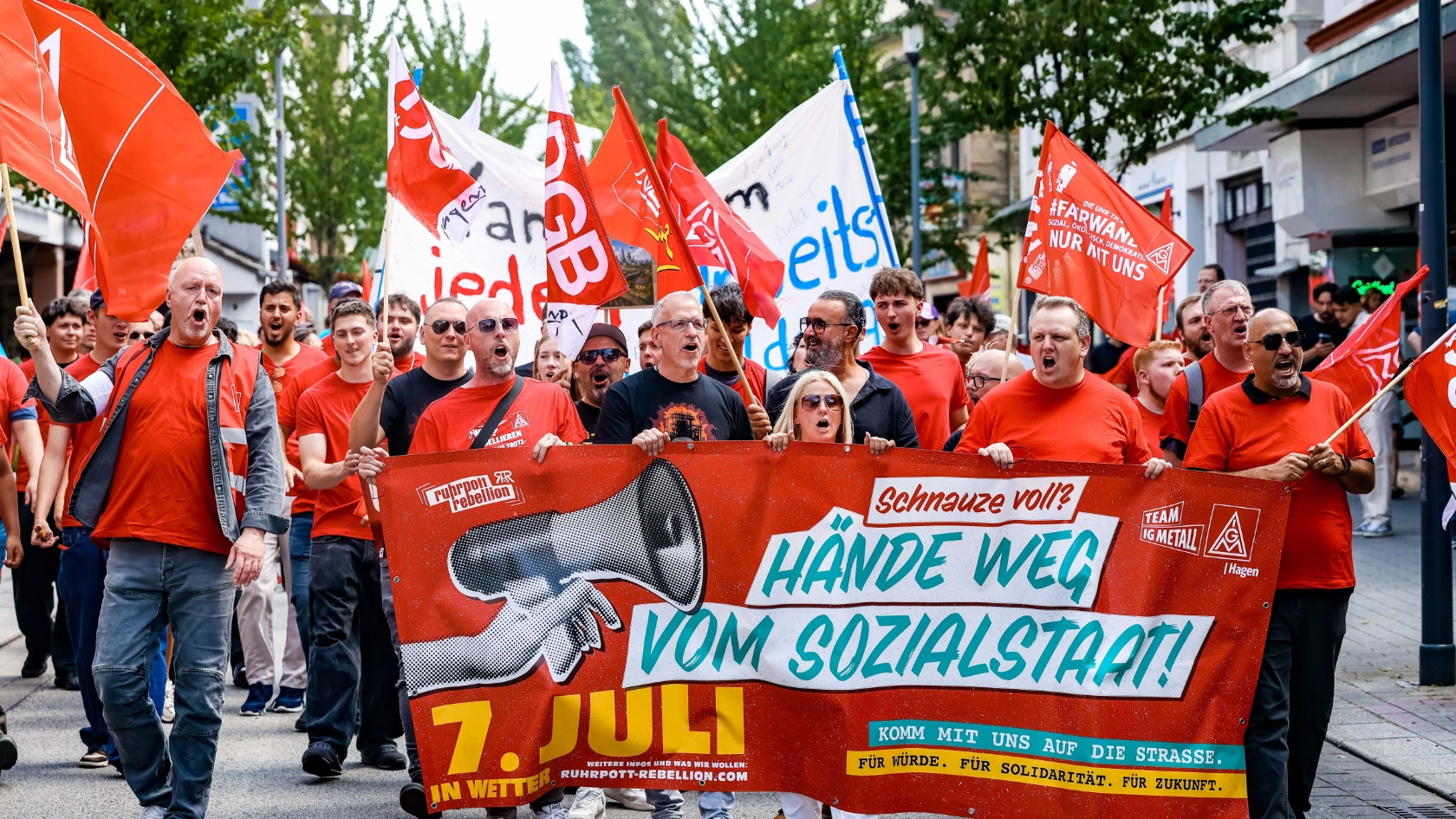
Ruhrpott Rebellion am 07.07.2026
Welfare State September 26: Nationwide Day of Action for Social Policy

Working longer, smaller pensions, cuts to long-term care: The attack on the welfare state is growing ever more intense. On September 26, metalworkers will stand up against it. As part of the “Hart verdient” day of action, they will take to the streets in 15 German cities.

Beschäftigter arbeitet an einem Getriebe in einer Fabrik
Working Hours Why working longer doesn’t help—and actually does more harm than good

The German metal and electrical industry is in crisis and cutting jobs. Employers are demanding that we work longer hours again—preferably without pay—and that the 35-hour workweek be abolished, claiming that this would solve everything. But will that really make a difference?

Ein männlicher Land- & Baumaschinenmechatroniker prüft einen Traktor mit einem Tablet
2026 Collective Bargaining Agreement for the Metalworking and Agricultural Engineering Sectors Greater Flexibility in the Metalworking and Agricultural Engineering Sectors in Lower Saxony and Bremen

Workers in the metalworking and agricultural machinery sectors in Lower Saxony and Bremen can look forward to a 2.5 percent pay raise and the option to convert pay into time off.

Elektronikerin prüft die Spannung an einem Schaltschrank.
2026 Collective Bargaining Round for the Electrical Trades Wage Increase in the Electrical Trades in Berlin-Brandenburg

Collective Bargaining Agreement for the Electrical Trades in Berlin-Brandenburg: Wages will increase in two stages starting January 1, 2027. Apprentice wages will also be raised in two stages.

Benjamin Heine ist Mitarbeiter der BMA in Braunschweig
2026 Collective Bargaining Round for Metal Fabrication and Precision Engineering Higher Wages in the Metal Fabrication and Precision Engineering Sectors in Southwest Germany

The collective bargaining agreement provides the approximately 30,000 employees in Baden-Württemberg with a compensation bonus and a pay increase reflected in the pay scale, effective February 2027.

Metall-Arbeiter beim Schleifen
2026 Collective Bargaining Round for the Metalworking Trade Employees in the Berlin-Brandenburg metalworking sector will receive higher pay

Collective bargaining agreement in the Berlin-Brandenburg metalworking sector: Wages and apprenticeship stipends will increase starting in July. In addition, employees will receive a one-time payment and a new annual recreation allowance.

Beschäftigte von Thyssenkrupp demonstrieren in Essen am 23. Mai 2024 gegen das Vorgehen der Geschäftsführung beim geplanten Teilverkauf des Unternehmens.
Defend the welfare state All dates for nationwide actions against cuts to social services

The federal government’s reform plans will mean cuts for many workers. It’s time to actively defend the welfare state.

IGM Aktion VW Wolfsburg
On September 21, things will get loud Nationwide Day of Action: Auto Industry Workers Fight Back Against Mass Layoffs

Automotive industry workers are resisting their corporate bosses’ fantasies of cost-cutting and offshoring. During the nationwide day of action, they will send a clear message: Competitiveness is not achieved through cost-cutting, but through investment.

Junge Auszubildende in der technischen Berufsausbildung werden von älteren Trainer auf CNC-Drehmaschinen Maschinen unterrichtet
Entry into the Workforce The Apprenticeship Market Put to the Test: Five Theses on the Start of the 2026 Apprenticeship Cycle

Vocational training is considered a model of success. Yet a decline in apprenticeship openings, financial worries among many apprentices, and millions of young people without vocational qualifications show that not everything is running smoothly in the apprenticeship market. Five theses on the start of the 2026 apprenticeship cycle.

Subscribe to the newsletter