Automatic translation
This article has been translated automatically using computer technology. While we strive for accuracy, some wording or details may differ from those in the original article.
This translation was not manually reviewed. For important facts, quotations or legally sensitive information, please consult the German original. Individual selections, images, embedded media or technical terms may have been translated differently or incompletely.

When money isn’t enough How to finance your vocational training or college education

Apprentices and dual-track students can receive various forms of financial assistance. We provide tips on the vocational training allowance (BAB), BAföG, housing allowance, and child support—and we explain what you should keep in mind when working a part-time job.

Auszubildender in einer Schreinerei

18 August 2026 18 August 2026


There are a variety of resources and a wide range of support options available. Some, such as the Vocational Training Allowance (BAB), depend on whether or not you live in your own apartment during your training. Other forms of support, such as BAföG, are available if your training cannot be financed by your own income and assets or by the income of your spouse and parents.

Below, we’ll describe in detail which requirements must be met for each type of financial aid—but let’s start by addressing how you can supplement your own income during your apprenticeship or dual study program.

To be specific: Are trainees allowed to have a part-time job in their free time? And if so, what are the most important things to keep in mind?
 

Supplementing Income with a Part-Time Job

First of all: It is not illegal to have multiple employment contracts. However, employment or apprenticeship contracts typically stipulate that side jobs require the employer’s consent. This does not mean, however, that the employer can simply decide whether or not to give consent. While the employer must be informed, they generally cannot refuse. If they object to the side job, they must provide a valid reason.

What’s crucial for you to know, however, is that even as an apprentice, you must comply with the Working Hours Act. This means you may not work more than 8 hours per workday (including Saturdays—that is, 48 hours per week). For 16- to 18-year-olds, the Youth Labor Protection Act also limits weekly working hours to 40 hours. In addition, there must be rest periods of 11 hours between work shifts.

Now, one more important question: Can you take a part-time job with a competitor?

While you are employed or in an apprenticeship , it is generally prohibited to engage in any activity that competes with your employer. You may neither run a competing business yourself nor work for a competitor if that activity involves competitive practices, such as brokering policies for another insurance agency. This also applies to apprentices.
 

Comply with the Working Hours Act

However, if the activity itself does not constitute a competitive act—such as working as a bricklayer at another construction company or as a sales clerk at another supermarket—it is not prohibited.

And what are the consequences if the employer has not given consent and the situation is discovered?

After the probationary period, the apprenticeship contract can only be terminated without notice. This means there must be such a serious breach of contractual obligations that it would be unreasonable to expect the employer to even wait out the notice period. Simply failing to disclose a side job despite an existing contractual requirement for consent will generally not justify termination without notice.

However, if the job conflicts with the apprenticeship and jeopardizes it, termination may be justified.

That covers the question of what you need to keep in mind if you want to supplement your income with a part-time job. There are also a number of other ways to obtain financial support.
 

Here are the most important forms of support for apprentices.
 

1.) Vocational Training Allowance (BAB)

As a general rule, minors who cannot live at home during their apprenticeship because the workplace is too far from their parents’ home are eligible for financial support. This is known as the Vocational Training Allowance (BAB) and must be applied for through the Federal Employment Agency.


Vocational Training Allowance

Apprentices who are of legal age or married can receive financial support if they do not live at home. They are also eligible for the allowance even if they live near their parents. Currently, the Federal Employment Agency pays a maximum of 822 euros for living expenses and rent. The actual amount of rent does not matter. Eligibility is calculated based on the income of the parents or the partner.

If trainees must relocate for their training, they can also receive a mobility allowance from the Employment Agencies during their first year of training to cover two monthly trips home (to visit family). To qualify , they must contact the Employment Agency’s career counseling service before signing the training contract.


Eligibility Requirements for BAB

  • You are in vocational training or participating in a vocational preparation program.
  • You have an apprenticeship contract for on-the-job (not just school-based) vocational training.
  • You cannot live with your parents during your training because the workplace is too far away. This is the case, for example, if the round trip from your parents’ home to the training workplace takes more than two hours in total.
  • Or you are over 18 years old and/or married and/or have a child and live near your parents.
  • You are not yet receiving a benefit comparable to the BAB.
  • The Employment Agency verifies and confirms that you need the money.


Submit Your Application Early

If your application is approved, you will receive BAB during the prescribed training period or for as long as you are participating in a vocational preparation program. Apply for BAB as early as possible, preferably before your training begins. You will receive the allowance retroactively only starting from the month in which the application was submitted. You must submit the application to the Employment Agency in the city where you reside.

You can use the Employment Agency’s (BA) BAB calculator to estimate how much vocational training allowance you’re likely to receive. Further information on the vocational training allowance is available from the BA. Here you can find the responsible authority in your city.


Citizen’s Income for Trainees?

By the way: If you’re in a company-based apprenticeship or a vocational preparation program, you should primarily apply for vocational training allowance (BAB) or training allowance. Training allowance is a benefit provided by the Employment Agency for people with disabilities. As an apprentice, you are generally not entitled to living expenses assistance.

However: If you are a student at a secondary general education school, a technical or vocational school, an apprentice, or a participant in a vocational preparation program and live with your parents, this exclusion rule does not apply.

However, if you have needs unrelated to your training (supplementary allowances and one-time grants), you may be eligible for social assistance. In cases of particular hardship, the social services office may also grant you living expenses assistance under Section 27 of SGB II as a grant or loan while you are in training.

Students Are Also Affected

Students are generally not eligible for Bürgergeld either, as they can primarily receive BAföG. However, there are some exceptions. For example, if you live with your parents, you may be eligible for a supplement to your BAföG under certain conditions.

Whether you’re an apprentice or a student, the local Job Center is your point of contact for social assistance.

 

2.) BAföG / Scholarships / Education Loans 

There are a wide range of funding opportunities available for apprentices and dual-track students. You just need to know about them. We’ll introduce them here.


Upgrading Scholarship

The federal government has established a scholarship specifically for professionally qualified individuals without a high school diploma. It’s calledthe “Aufstiegsstipendium”and is aimed at particularly talented prospective students (or current students) with professional experience. The requirements for applying are a completed vocational training program or advanced vocational training, at least two years of professional experience prior to the start of studies, and proof of exceptional academic achievement. These include:

  • very good final grades (at least a 1.9 or 87 points) or
  • particularly successful participation in a nationwide vocational skills competition, or
  • a substantiated recommendation from your employer

Those already enrolled in a program must not have completed their second academic semester yet. There is no age limit. For full-time study, the grant amounts to 853 euros per month, plus 80 euros for books. A flat-rate childcare allowance is provided for children under the age of ten. Scholarship recipients in part-time degree programs receive 2,700 euros annually.

More information is available on the website of the Federal Ministry of Education and Research.

Continuing Education Scholarship

Particularly talented apprentices have the opportunity to receive a continuing education scholarship. To apply, they must submit an application to the chamber responsible for their apprenticeship. However, the eligibility criteria here are also quite demanding:

An above-average completion of an apprenticeship in a recognized dual vocational training program. This means:

  • A final exam score of at least 87 points (1.9 grade point average) or a top-three finish in a national vocational skills competition, or a substantiated recommendation from your employer or vocational school based on specific examples
  • Under 25 years of age. Exception: Voluntary service and/or maternity and parental leave must be verifiable. In that case, the maximum age increases to 28 years
  • Not a full-time student or a college graduate

Funding is granted for a maximum of three years. A total of up to 8,100 euros is paid out. Ten percent of the costs per program must be covered by the recipient. Eligible for funding are advanced training programs that are typically completed while working. These include:

  • Subject-specific vocational qualifications,
  • preparatory courses for advanced vocational training exams (Master Craftsman/woman, Technician, Business Administrator, Specialist),
  • interdisciplinary skills such as foreign languages, computer skills, and public speaking

Under certain circumstances, part-time degree programs may also be eligible for funding. However, these programs must not be full-time, must not have already begun, and must build upon the applicant’s vocational training.

Starting College for First-Year Students

A $1,000 “study start-up grant” is intended to make it easier for young people from low-income households receiving social benefits to begin their studies. The grant is meant to help cover initial expenses such as a laptop, course materials, or a security deposit for their first apartment. This one-time payment is considered a grant and does not need to be repaid. Applications for this benefit can be submitted starting in September.

BAfÖG

The Federal Training Assistance Act —BAföG for short—enables students and apprentices from financially disadvantaged families to participate in further educational programs. Since this is a government program, there is a legal entitlement to it provided the relevant requirements are met.

In general, BAföG funding is available for education and training at general and vocational schools, colleges, academies, and universities (including related mandatory internships). Stays abroad may also be funded. Applications for these should be submitted at least six months before the planned stay.

People without a German passport can also receive BAföG. The specific terms depend on the individual’s status (EU citizen, refugee, etc.). Funding is available up to age 30 (based on the start date of the eligible educational program); for master’s degree programs, funding is available up to age 35. Exceptions apply to graduates of adult education programs and to parents with children under the age of ten.

Whether an individual is eligible for BAföG can only be determined on a case-by-case basis. The same applies to the amount of the benefit . Both depend on the type of education and the individual’s personal and family circumstances.

The following factors are decisive:

  • Type of training
  • Housing situation
  • Subsidy for health and long-term care insurance
  • Parents’ obligation to provide financial support
  • Location of training/studies


Financial aid is granted for the standard duration of the educational program. It may be extended under special circumstances, such as pregnancy, raising children, serving on committees, advocacy work, or a disability.

Parent-Independent BAföG

To receive parent-independent BAföG, at least one of the following requirements must be met:

  • Obtaining the general university entrance qualification (Abitur) through adult education, e.g., evening high school or preparatory college
  • Commencement of training after turning 30 and significant reasons for doing so
  • At least five years of gainful employment after turning 18 prior to the start of training
  • Three years of vocational training leading to a professional qualification, followed by three years of gainful employment
  • Orphan; parents’ place of residence unknown, or parents living abroad and legally prevented from making child support payments


Student Financial Aid

Students at universities, colleges, universities of applied sciences, and academies currently receive—provided they are generally eligible—a maximum of 992 euros per month. This is the so-called maximum funding rate. If there are children under the age of ten to care for, there is an additional entitlement to a child care supplement of 160 euros per month as a full grant.

Half of the funding consists of a grant, and the other half of an interest-free government loan. Therefore, 50 percent must be repaid—but never more than 10,000 euros. However, anyone who has made 77 monthly payments is permanently debt-free going forward, regardless of how high their loan originally was. The repayment obligation begins five years after the end of the maximum funding period.

Detailed information, fact sheets, and application forms for BAföG

Upward Mobility BAföG

The Aufstiegs-BAföG establishes an individual legal entitlement to funding for continuing education aimed at career advancement. The form of continuing education is irrelevant. Funding is subject to certain personal, qualitative, and time-related requirements.

Funding is available for all qualification certificates above the level of skilled worker, journeyman, assistant, or vocational school diploma; however, it does not extend beyond the master craftsman level. A minimum of 400 instructional hours must be completed. Eligible programs include, among others, vocational training programs such as master craftsman, technician, and business administrator.

To apply for funding, applicants must provide proof of having completed and received recognition for their initial vocational training. Full-time and part-time programs are eligible, as are distance learning courses. The grant is awarded regardless of income. For full-time programs, a contribution toward living expenses may be provided, depending on income and assets.

Course and examination fees are subsidized up to 15,000 euros. However, only 40 percentof this amount is a non-repayable grant. The remainder consists of a low-interest loan. Examination fees are subsidized up to half of the necessary costs, but only up to a maximum of 2,000 euros—also in the form of a low-interest loan.

Contributions toward living expenses for full-time programs depend on the applicant’s income and assets. The loan is provided by the Kreditanstalt für Wiederaufbau (KfW). It is interest-free during the training program and for a certain period thereafter—up to a total of six years. Afterward, it must be repaid within ten years in monthly installments of at least 128 euros. Upon successful completion of the final exam, an application may be submitted to reduce the repayment amount. Up to 40 percent of the debt may be forgiven.

Scholarship from the Hans Böckler Foundation

The Hans Böckler Foundation (HBS) is a major foundation with close ties to labor unions. It specifically supports people from financially disadvantaged families, from non-academic backgrounds, and those active in labor unions. With over 2,500 scholarship recipients, it is the second-largest student aid organization in Germany. For IG Metall members, the HBS is an excellent resource when it comes to support for continuing education and professional development.

The following individuals are eligible to apply:

  • Students actively involved in labor unions and/or social and political causes
  • Committed individuals pursuing adult education
  • High school graduates from educationally disadvantaged groups
  • Doctoral candidates

More information on the application process and deadlines

Master Craftsman Bonus (in Bavaria)

The Master Craftsman Bonus is a bonus payment from the Free State of Bavaria. Every successful graduate of a continuing education program leading to certification as a master craftsman, business specialist, business administrator, or business economist receives a bonus of 2,000 euros from the Free State of Bavaria. The prerequisite is that the applicant’s primary residence or place of employment is in Bavaria. Additionally, the exam must have been taken in Bavaria. You do not need to apply separately for the Master Craftsman Bonus. The Würzburg Chamber of Industry and Commerce (IHK) identifies eligible recipients and pays out the bonus on two fixed dates each year.

More about the Master Craftsman Bonus


3.) Housing Allowance

First of all: Housing assistance is a subsidy toward housing costs for families, single parents, retirees, and students who do not receive BAföG. It helps many people cope with the significant rise in housing costs. Anyone with a low income should have their eligibility for housing assistance assessed.

In principle, students can also receive housing assistance. However, students are only eligible for housing assistance if they are not entitled to BAföG or if the entire household is not, in principle, entitled to BAföG. This is the case, for example, when a student parent lives with their child.
It may therefore be necessary to submit a certificate from the BAföG authority when applying for housing assistance. Exceptions may also apply, for example, if the age limit for BAföG eligibility has been exceeded or if the BAföG is received exclusively as a bank loan.


4.) Child Allowance

In Germany, legal guardians receive child benefit for all children up to age 18—as well as for apprentices and students under age 25. Families with low or moderate incomes may also be eligible for a child supplement.


Child Allowance

Who is eligible for child benefit?

Parents receive child benefit until their children reach the age of majority. After the child’s 18th birthday, child benefit is paid only under certain conditions.

Parents can receive child benefituntil the child’s21st birthday if the child

  • Unemployed and registered as a job seeker.

Parents can receive child benefituntil thechild’s25th birthdayif the child

  • are pursuing an educational program (including high school and college) or
  • is in a four-month transition period, or
  • cannot find an apprenticeship and therefore cannot begin or continue their vocational training, or
  • is performingrecognized volunteer service.


How much is the child benefit?

Since 2026, parents have received 259 euros per month for each child. There are no longer different amounts based on the number of children for whom child benefit is paid.


What is the application process?

The application for child benefit must be submitted in writing to the appropriatefamily benefits officeof the Federal Employment Agency—usually the one in the district where you live. The family benefits office pays child benefit monthly. Parents are entitled to it for every month in which they meet all the requirements on at least one day. For example, if a child was born on May 25, parents receive the full child benefit for the month of May.


Can child benefit be claimed retroactively?

Yes. Child benefit can be paid retroactively for up to 6 months. The prerequisite is that parents were entitled to the child benefit but did not receive it—for example, because they did not submit an application.


What is the child supplement?

The child supplement (KiZ) is a financial allowance paid in addition to child benefit. It is intended to prevent children from growing up in poverty. Families and single parents are eligible for the KiZ if their income is sufficient to cover their own living expenses but they need financial support to provide for the entire family’s living expenses.

In addition to child benefit, these families not only receive the KiZ, but they are also exempt from daycare fees and are eligible for benefits such as the school supplies package.
 

How much is the child supplement?

Since January 2025, the maximum amount has been 297 euros per child per month. Combined with the child benefit of 259 euros per month, this results in a total benefit of 556 euros per child. If the parents’ income exceeds a certain threshold, a portion of their income is taken into account, meaning the 297 euros is reduced. Parents with low incomes therefore receive the full maximum amount of 297 euros. As income rises, the payment amount decreases and gradually phases out. The German Trade Union Federation has provided a sample calculation on itswebsite.


Who is eligible for the child supplement?

Parents are eligible for the child supplement

  • for whom you also receive child benefit and
  • who lives in the parents’ household and
  • is under 25 years of age and
  • is unmarried.

Whether parents are eligible for the child supplement depends primarily on their income. Their income must exceed a legally prescribed minimum of 600 euros gross for single individuals and 900 euros gross for couples. Eligibility also depends on the amount of housing costs and the number of people in the household.

You can use theKiZ-Lotsen toolon the Federal Ministry for Family Affairs’ website to check whether it’s worth applying for the child supplement. The whole process takes less than 10 minutes.


More Money Through a Collective Bargaining Agreement

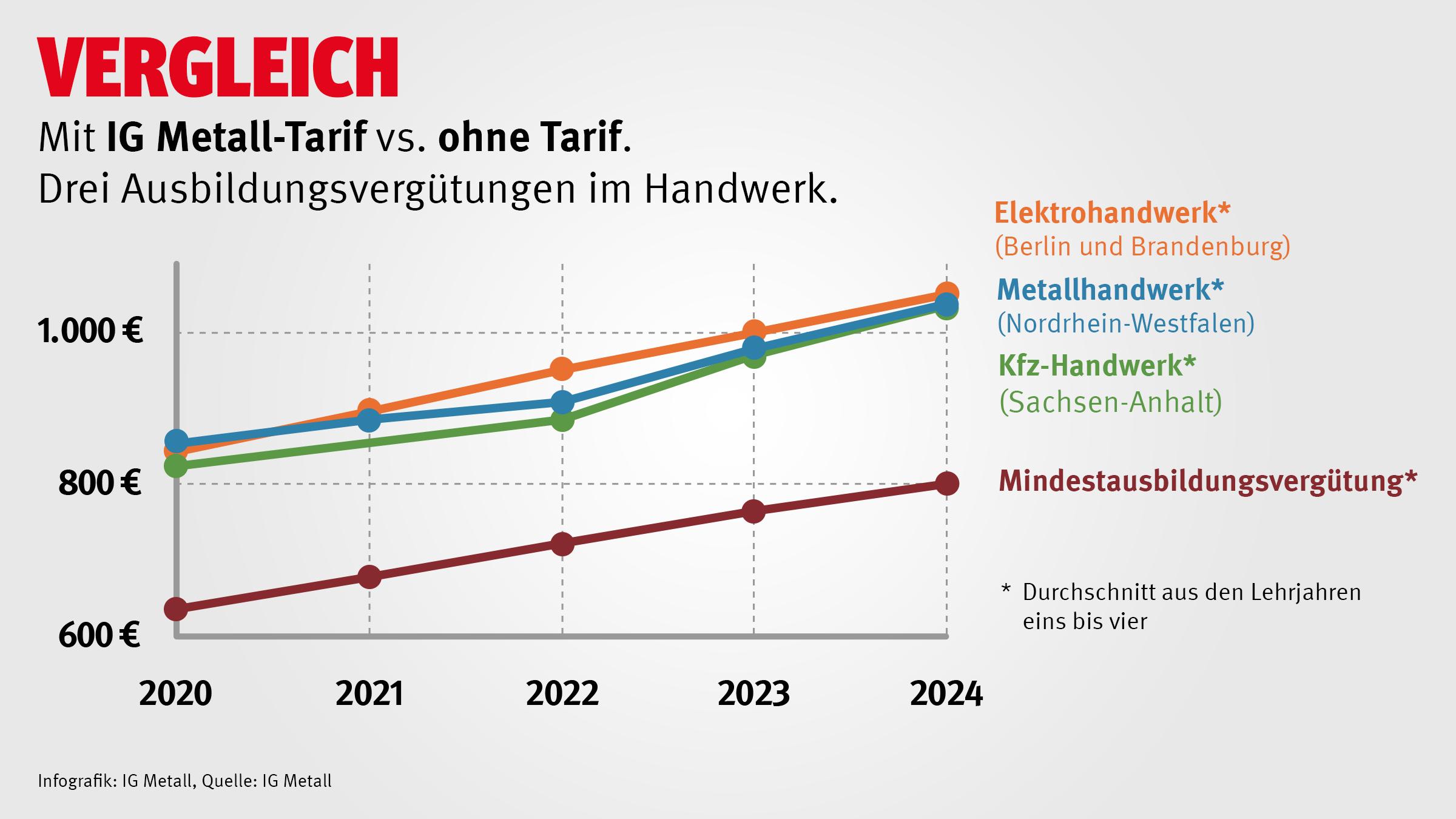
Those who work at a company covered by a collective bargaining agreement usually receive a significantly higher apprenticeship stipend than “apprentices not covered by a collective bargaining agreement.” The chart (below) illustrates this using three examples of apprenticeship stipends in the skilled trades.


Im Vergleich: Ausbildungsvergütungen mit und ohne Tarif

However, higher apprenticeship wages aren’t the only benefit of a job or apprenticeship covered by a collective bargaining agreement. Vacation pay and Christmas bonuses are usually higher as well, and many industries offer additional payments. However, only our members are entitled to all these benefits.

Not to mention: The prospect of being hired after completing their apprenticeship gives many apprentices peace of mind. In the metal and electrical industries and in the steel sector, permanent employment is guaranteed by collective bargaining agreements, provided there is a company-specific procedure in place. If no such procedure exists, a 12-month employment contract is offered.

During collective bargaining, IG Metall has repeatedly secured special provisions for apprentices: for example, coverage of travel expenses to vocational school, above-average increases in apprenticeship wages, or days off before exams. You can learn more about us and membership in IG Metall here, among other places.

Beratung und Kontakt
We’re Here for You
Advice & Help
Mitglied werden
Become a Member
We Can’t Do It Without You
We are your union

We stand up for fair pay, good jobs, future prospects, and equal opportunities. In solidarity and with determination.

Illustration zum Thema Besser mit Tarif für Auszubildende und dual Studierende

More money and time

Our collective bargaining agreements make things easier for you.
Illustration zum Thema Rechtsschutz für Auszubildende und dual Studierende

Legal Protection

At work and with exam-related matters.
Check von Arbeits- und Ausbildungszeugni

Fair Evaluation

We review your transcripts and employment contracts
Illustration zum Thema Seminare für Auszubildende

Seminars and Internships

Stay up to date with us in theory and practice.
Streikrecht für Auszubildende und dual Studierende erklärt

Strike Support

We’re your safety net—especially in an emergency!
Illustration zum Thema „mit der IG Metall zum Stipendium“

Scholarship

Study with a scholarship from the Hans Böckler Foundation.
Illustration zur Solidar-Gemeinschaft IG Metall

Solidarity

We’ve got your back!
Clever sparen mit der ISIC-Card

ISIC Card for Budget-Conscious Students

Discounts and perks—worldwide.
Illustration zur Freizeitunfallversicherung für Auszubildende und dual Studierende

Leisure Accident Insurance

With us, you’re covered even in your free time.

Our news straight to your smartphone

IG Metall app for Android and iOS

With our IG Metall app, we keep you informed about collective bargaining agreements and pay raises. We report on political developments and news from the workplace. Also popular: the shift scheduler, our guides on all aspects of working life, and our various services.

IG Metall App

Apprenticeships & Dual Degree Programs

New on igmetall.de
Aktionstag bei Mercedes Benz, Daimler, in Sindelfingen gegen die Angriffe auf Beschäftigten in der Automobilindustrie.
Resistance to Attempts at Drastic Cuts Auto industry workers issue a warning
Sie wollen doch nur dein Bestes
Redistribution Making Germany more equitable: We need this tax reform now
Der Streik bei Kelvion in Nobitz-Wilchwitz begann am 4. August 2026. Die Geschäftsleitung will nach Sarstedt/Niedersachsen verlagern - obwohl die Produktion in Wilchwitz profitabel und bis ins nächste Jahr ausgelastet ist.
"It’s worth fighting for!" Kelvion workers strike for a social collective bargaining agreement
Ruhrpott Rebellion am 07.07.2026
Welfare State September 26: Nationwide Day of Action for Social Policy
Beschäftigter arbeitet an einem Getriebe in einer Fabrik
Working Hours Why working longer doesn’t help—and actually does more harm than good
Ein männlicher Land- & Baumaschinenmechatroniker prüft einen Traktor mit einem Tablet
2026 Collective Bargaining Agreement for the Metalworking and Agricultural Engineering Sectors Greater Flexibility in the Metalworking and Agricultural Engineering Sectors in Lower Saxony and Bremen
Elektronikerin prüft die Spannung an einem Schaltschrank.
2026 Collective Bargaining Round for the Electrical Trades Wage Increase in the Electrical Trades in Berlin-Brandenburg
Benjamin Heine ist Mitarbeiter der BMA in Braunschweig
2026 Collective Bargaining Round for Metal Fabrication and Precision Engineering Higher Wages in the Metal Fabrication and Precision Engineering Sectors in Southwest Germany
Metall-Arbeiter beim Schleifen
2026 Collective Bargaining Round for the Metalworking Trade Employees in the Berlin-Brandenburg metalworking sector will receive higher pay
Beschäftigte von Thyssenkrupp demonstrieren in Essen am 23. Mai 2024 gegen das Vorgehen der Geschäftsführung beim geplanten Teilverkauf des Unternehmens.
Defend the welfare state All dates for nationwide actions against cuts to social services
IGM Aktion VW Wolfsburg
On September 21, things will get loud Nationwide Day of Action: Auto Industry Workers Fight Back Against Mass Layoffs
Junge Auszubildende in der technischen Berufsausbildung werden von älteren Trainer auf CNC-Drehmaschinen Maschinen unterrichtet
Entry into the Workforce The Apprenticeship Market Put to the Test: Five Theses on the Start of the 2026 Apprenticeship Cycle

Subscribe to the newsletter