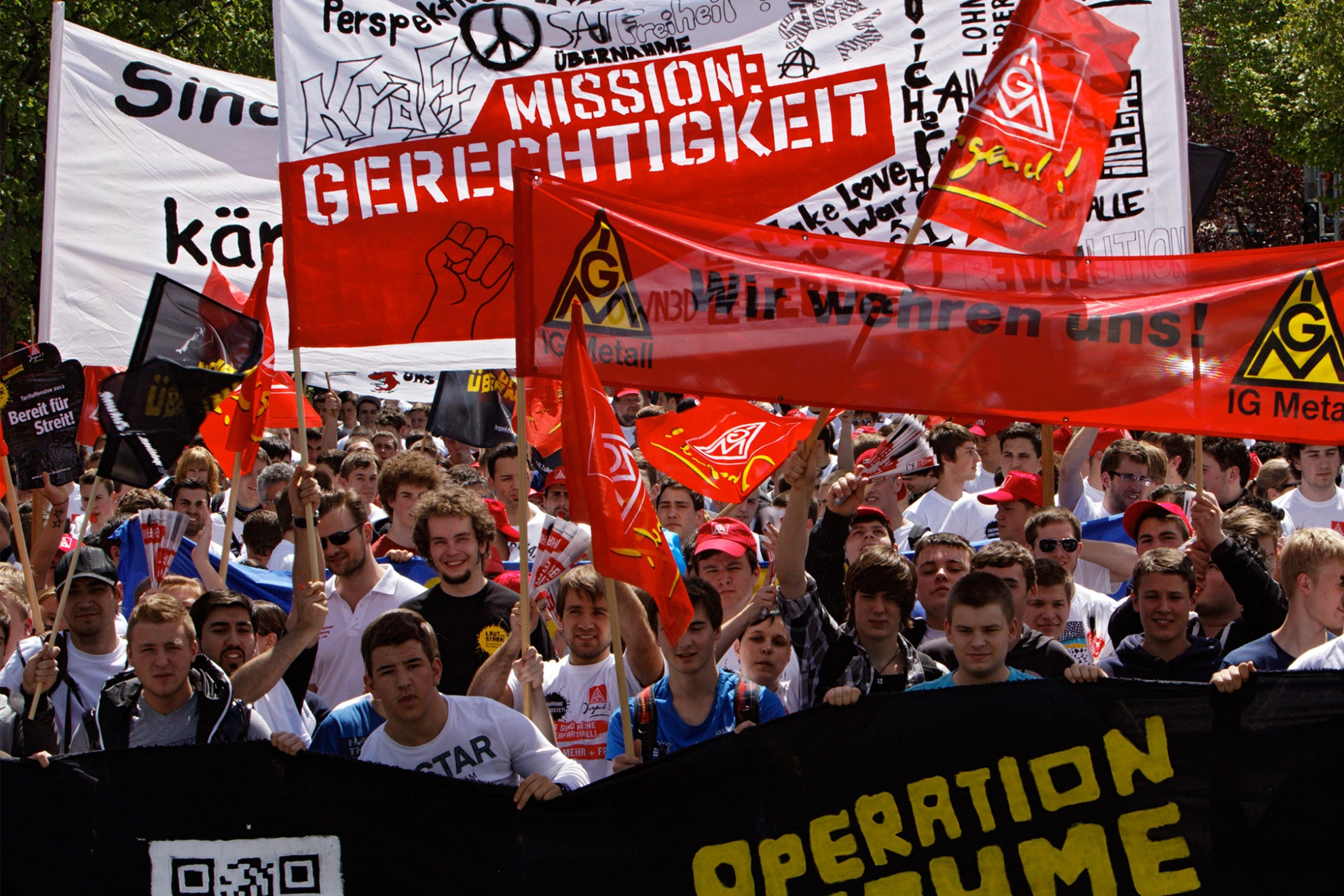
Cancelled classes, inadequate exam preparation, poor technical equipment—with their “BBS ohne Stress” campaign, the IG Metall Youth of Lower Saxony and Saxony-Anhalt is drawing attention to shortcomings at vocational schools (BBS). The fact that they’ve struck a raw nerve is evident from the 13,000 signatures collected from supporters. They’re making their stance clear: We stand behind IG Metall’s demands, and we want politicians to finally take action.
In late November, around 150 young people marched to the Ministry of Education and Cultural Affairs in Hanover as part of a campaign organized by the IG Metall Youth of Lower Saxony and Saxony-Anhalt to present the petition to State Secretary Erika Huxhold. The ministry is currently reviewing the demands—and has promised a written response.
“While the dual vocational training system is admired internationally, the quality of the school-based component of vocational training is being severely neglected here at home. The investment backlog affects not only the lack of technical equipment at vocational schools; the staffing situation is also alarmingly strained in some cases,” says Hartmut Meine, IG Metall regional director for Lower Saxony and Saxony-Anhalt.
And IG Metall Regional Youth Secretary Nina Zach criticizes: “In the age of Industry 4.0, we cannot afford poor vocational schools, because if you want well-trained skilled workers, you cannot skimp on their education.”
Surveys show: Quality must be improved
Unfortunately, the opposite has been the case so far. Whether it’s restroom facilities, computers, machinery, or teaching materials: it’s long been no secret that conditions at German vocational schools leave much to be desired. The latest DGB training report also shows that only 56 percent of students nationwide are satisfied with the academic quality of their vocational school instruction.
This alarming picture is also confirmed by a survey conducted by IG Metall Youth in Lower Saxony and Saxony-Anhalt among more than 2,000 apprentices. Its findings form the basis of the campaign:
Teacher shortage: More than half of the apprentices surveyed report that classes are regularly canceled—on average, three to four hours per month. More than two-thirds also say that their individual level of knowledge is not taken into account.
Insufficient coordination between vocational schools and companies: Only 63 percent feel adequately prepared for exams. Regular coordination between vocational schools and companies occurs in only 34 percent of cases. Particularly in industrial trades, the alignment of practical and theoretical content is in dire need of improvement.
Costs for teaching materials: One in two trainees surveyed has to pay for the materials used in class out of their own pocket—neither the company nor the vocational school covers these costs.
Student Participation: While class representatives and student councils are elected almost everywhere, students lack knowledge about opportunities for participation and their right to have a say at vocational schools. About two-thirds do not know whether their vocational school has a student council, and half do not know whether there are faculty advisors.
“IG Metall Youth in Lower Saxony and Saxony-Anhalt now wants to do something about this,” said IG Metall District Youth Secretary Nina Zach.
The demands are clear:
- More money for education!
- Quality through innovative and inclusive learning!
- More democracy and co-determination at our vocational schools!
You can read more about the campaign by IG Metall Youth Lower Saxony and Saxony-Anhalt and their demands here.