The figures are alarming: The Federal Statistical Office recently reported that in 2020—the year of the COVID-19 pandemic—not even half a million young people began an apprenticeship —the lowest figure on record and a 9.3 percent decline from the previous year. By comparison: Before the 2008 financial crisis, well over 600,000 new apprenticeship contracts were signed. And the trend continues: For the upcoming apprenticeship year, employers have offered 14,000 fewer apprenticeship positions than in the crisis year of 2020, according to the Federal Employment Agency.
The consequences are clear. “A lack of apprenticeship positions today means a shortage of skilled workers in the future. We at IG Metall Youth and DGB Youth therefore call for a pay-as-you-go-funded apprenticeship guarantee,” Cosima Steltner makes clear. She represents IG Metall Youth on the DGB Federal Youth Committee, where she developed the concept together with the sister unions. “Long before the pandemic, fewer and fewer new apprenticeship contracts were being signed. This must come to an end—companies must finally be held more accountable by contributing to a nationwide apprenticeship guarantee through a pay-as-you-go system.”
Study Confirms: Apprenticeship Guarantee Prevents Skilled Labor Shortages
A study commissioned by the Bertelsmann Foundation recently reinforced the call for an apprenticeship guarantee. According to the study, this could bring up to 20,000 additional skilled workers into the German labor market each year—with positive consequences for the economy and the government. Gross domestic product, as well as revenue from taxes and social security contributions, would rise in the long term, while unemployment would fall.
According to the study, graduates of vocational training programs benefit in any case: Their lifetime earnings would increase by 580,000 euros with a completed vocational training program compared to a career path without vocational training.
Pay-as-you-go training guarantee: How it’s supposed to work
A pay-as-you-go training guarantee is intended to operate in three stages.
The first stage: A young person finds a suitable apprenticeship at a company—the traditional and preferred path, according to the youth organizations of IG Metall and the DGB.
Second stage: Small and medium-sized companies that have not previously offered apprenticeships due to a lack of capacity should be able to utilize the joint training model. Specifically, this could mean that if a company, for example, does not have certain machines, it can send its apprentices to off-site or inter-company training facilities where the necessary machines or training resources are available. These facilities are to receive special funding. This creates further incentives for companies to offer apprenticeship positions.
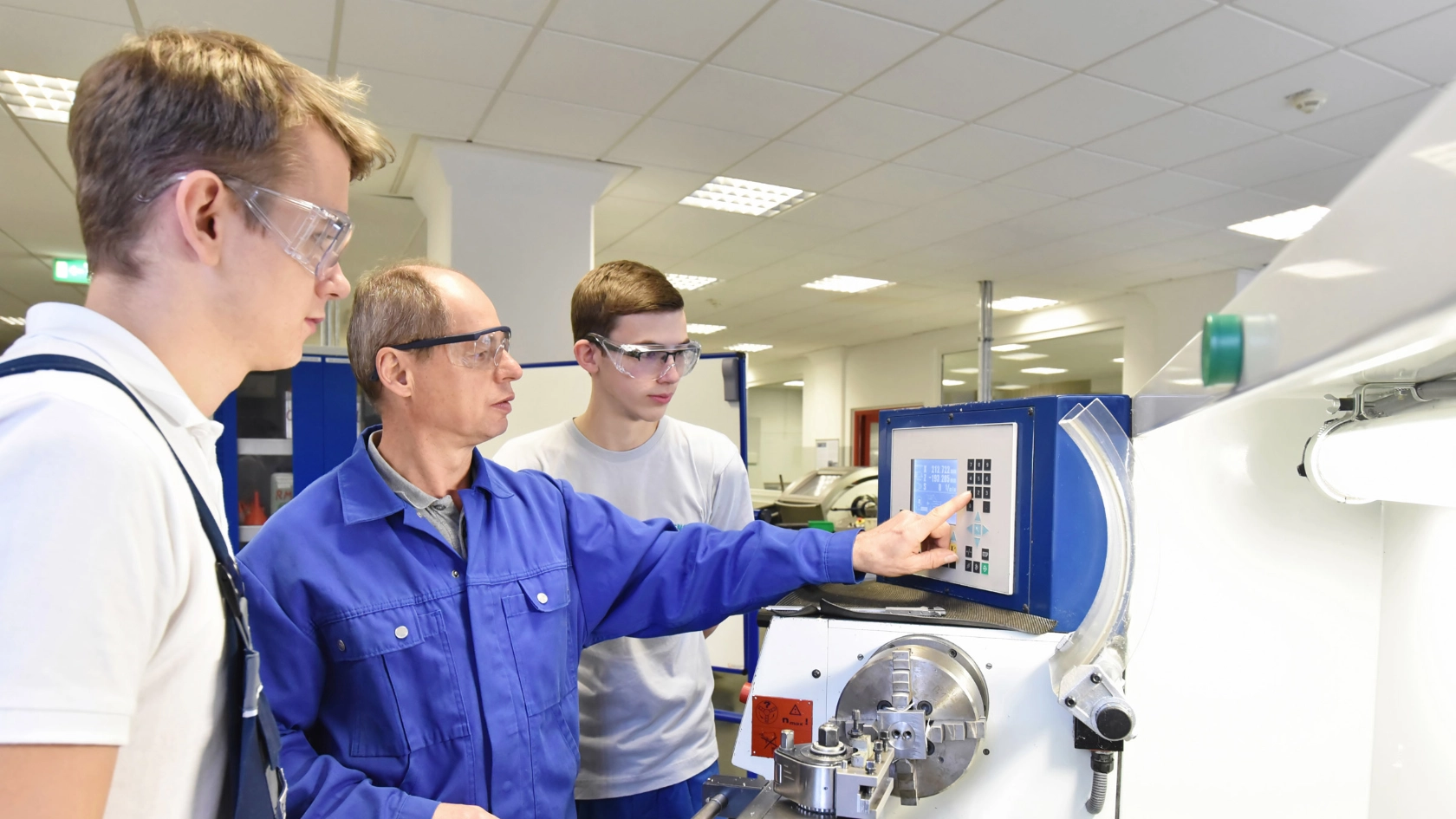
Third and final stage: If young people cannot find a suitable in-company apprenticeship position, they have the option of beginning their training at an off-site facility. The training provider cooperates with local companies where the apprentices complete practical training phases. In addition, the apprentices attend a vocational school, where they learn alongside in-company apprentices.
The goal here is to place the trainees in a company as quickly as possible so they can continue their training there. “The aim is to avoid gaps in their educational history and to show them future prospects,” says Cosima Steltner. “The uncertainty that some young people feel after finishing school can carry over into the rest of their lives. This makes it all the more important to provide a sense of stability right from the start through a guaranteed apprenticeship.”
Companies Should Contribute to a Future Fund
One thing is clear: A training guarantee must be well-funded. That is why the DGB youth organizations want a “Future Fund” to be established, into which all companies will contribute. Companies that provide apprenticeships will receive financial support for training costs from the fund. The remaining contributions will be used to finance the creation of additional apprenticeship positions—that is, to cover costs incurred by external training providers and their partners.
“For us, the training guarantee is only conceivable in conjunction with pay-as-you-go financing through a Future Fund,” emphasizes Stefanie Holtz, Federal Youth Secretary of IG Metall. “This fund should be used to support training in small and medium-sized enterprises. Pay-as-you-go financing offers companies an additional incentive to increase the number of apprenticeship positions.”
Through a pay-as-you-go Future Fund, all companies could finally be held accountable—especially those that have so far been unwilling to provide apprenticeships. Reality shows that this works: In some industries, such as construction, a pay-as-you-go industry fund has already been introduced. The youth organizations of IG Metall and the DGB are now pushing for a cross-industry solution.