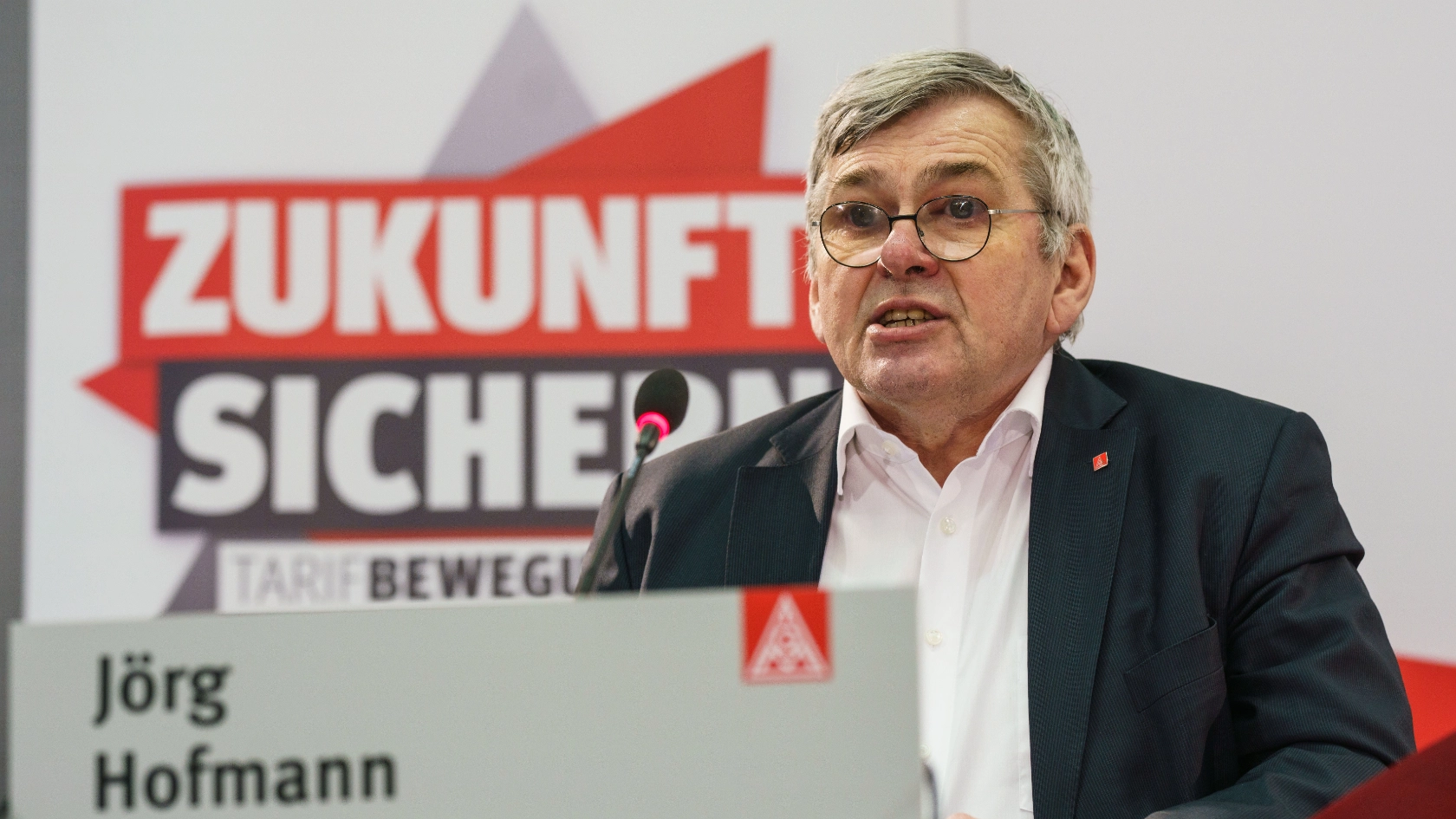
Frankfurt am Main ― The COVID-19 pandemic also posed immense challenges for IG Metall and its sectors in 2020. In an already tense period of upheaval, this created additional pressure, as Jörg Hofmann, First Chairman of IG Metall, made clear today at the annual press conference.
This made answers and prospects for workers all the more urgent, as Hofmann explained: “Whenever and wherever the pandemic situation allowed, we prioritized an on-site presence. Social distancing, masks, and labor disputes have shaped our actions in numerous workplace conflicts over the past few months. In Berlin, too, we have been actively involved from the outset on behalf of workers. Occupational safety and health, regulations for short-time work, and relief for parents are just a few key issues. We have wisely supplemented this political and legal framework at the collective bargaining level.”
Job security for workers and clear prospects for the future are also at the forefront of the union’s ongoing collective bargaining rounds. “Securing jobs, shaping the future, and strengthening incomes—these are the goals we are pursuing in these collective bargaining rounds. With this package of demands, we are taking into account the varying situations of companies across the sectors,” explained Jörg Hofmann.
In addition to the collective bargaining rounds, the super election year is also shaping the union’s goals for 2021: “We will get involved to win majorities for a fair transformation. Because the fact is: The COVID-19 pandemic has given new momentum to the driving forces of transformation, but it has also opened up new opportunities. We demand and are committed to decent work for all. Here, the unions have a central role and responsibility to exert influence and help shape the future,” Hofmann elaborated.
“The pandemic has impressively demonstrated, without any ifs or buts, how important a reliable welfare state is. That is why we must take a stand against all those who want to pay off debts by cutting social benefits. Because in doing so, they are shifting the burden of the crisis onto the general population.”
The importance of union action is also evident in membership trends. In 2020, the year of the COVID-19 crisis, IG Metall did not experience a significant drop in membership. At the end of 2020, IG Metall had exactly 2,214,662 members. That is 47,909 fewer members than in the previous year. “We are an organization that draws its strength from direct dialogue with workers,” said Jörg Hofmann, First Chairman of IG Metall. “Since we nevertheless managed to gain over 87,500 members in 2020, we remain confident overall. Our members’ commitment has actually increased, in part due to their consistent involvement in shaping our political priorities.”
Strengthening Co-determination and Clearly Regulating Remote Work
Christiane Benner, Second Chair of IG Metall, made it clear that the COVID-19 pandemic must not continue to have a negative impact on the future prospects of young people and those just starting their careers. “We must prevent a ‘COVID generation’ at all costs!”
Clear regulations are needed for remote work, which is currently still being improvised in many places: “Above all, there is a lack of works council co-determination rights regarding the introduction of working from home. In this regard, the Federal Ministry of Labor’s current draft of the Works Council Strengthening Act falls short.”
The transformation and the COVID-19 crisis clearly demonstrate how important the work of works councils and workplace co-determination is—and where action is needed, Benner continued. IG Metall has therefore adopted the “Co-determination Initiative” as a central focus of its political work in 2021. Key components of this initiative include a comprehensive right of initiative for works councils regarding training, co-determination in economic matters and strategic decisions, and the abolition of the double voting rights of supervisory board chairs.
Christiane Benner underscored the importance of reforms to works constitution and corporate co-determination for shaping the transformation: “In the coming years, the focus will be on substantially preserving industry, production, and research and development. Many companies still face transformation and digitalization without a clear direction or plan, and more than half of employees feel their employers lack a strategy in this regard.”
IG Metall Is Financially Well-Positioned
“Even in this challenging situation, IG Metall stands on a solid financial footing,” emphasized Jürgen Kerner, IG Metall’s chief treasurer. Members paid 591 million euros in dues—7 million less than in 2019, but 5.5 million more than in 2018. The largest portion of membership dues revenue—216 million euros—went to the local offices in 2020 as well; these offices serve as the point of contact for members, organize union activities in the workplaces, and coordinate actions during collective bargaining rounds. 89 million euros went into reserves and provisions; 31 million were invested in educational programs; and IG Metall used 25 million to support its members through benefits provided for in the bylaws, such as strike pay and legal protection. “IG Metall is always ready to act; financially, we are well-positioned. No political action, no strike will fail due to a lack of funds,” Jürgen Kerner made clear.
Kerner, who is responsible for IG Metall’s sector coordination, emphasized the urgent need for action in the steel and aviation industries. “The situation is critical for both of these key sectors.” He noted that the government’s action plan for the steel industry is sound, but it must now be implemented quickly. For the aviation industry, liquidity support and short-time work remain necessary, and industry and policymakers must tackle the ecological transformation. Hydrogen will become essential for steel and aircraft, as well as for ships, rail, and commercial vehicles. “We support the federal government’s hydrogen strategy. But here, too, results must be delivered,” Jürgen Kerner emphasized. “We appeal to the government and the Bundestag: Don’t push this into the new legislative term! Delays cost jobs!”
Statement by Jörg Hofmann (PDF, 9 pages)
To the statement by Christiane Benner (PDF, 5 pages)
To the statement by Jürgen Kerner (PDF, 4 pages)
To the presentation slides (PDF, 11 pages)
Jürgen Kerner’s background information on the 2021 Annual Press Conference (PDF, 5 pages)
To the discussion paper “Co-determination Initiative” (PDF, 9 pages)
Press release (PDF, 4 pages)
To load this video, you must enable YouTube cookies and thereby agree to the YouTube privacy policy.