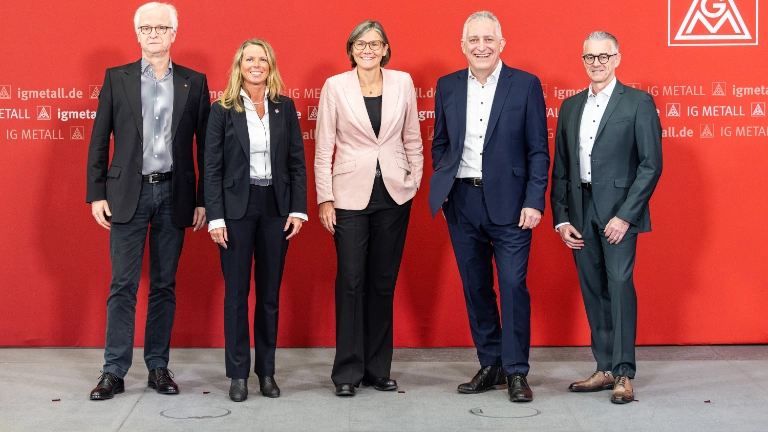
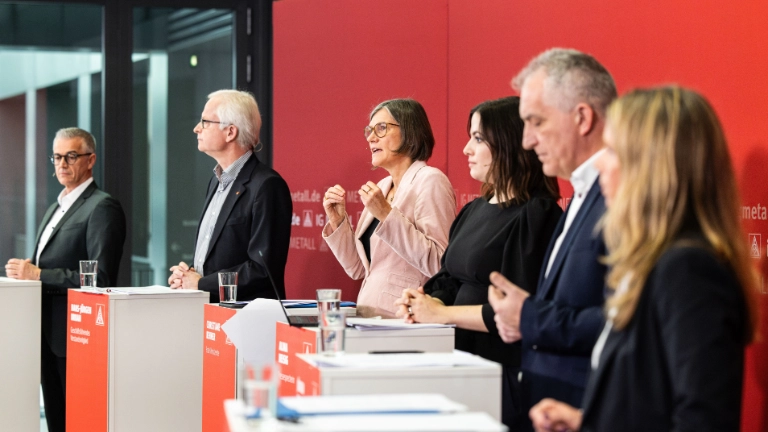
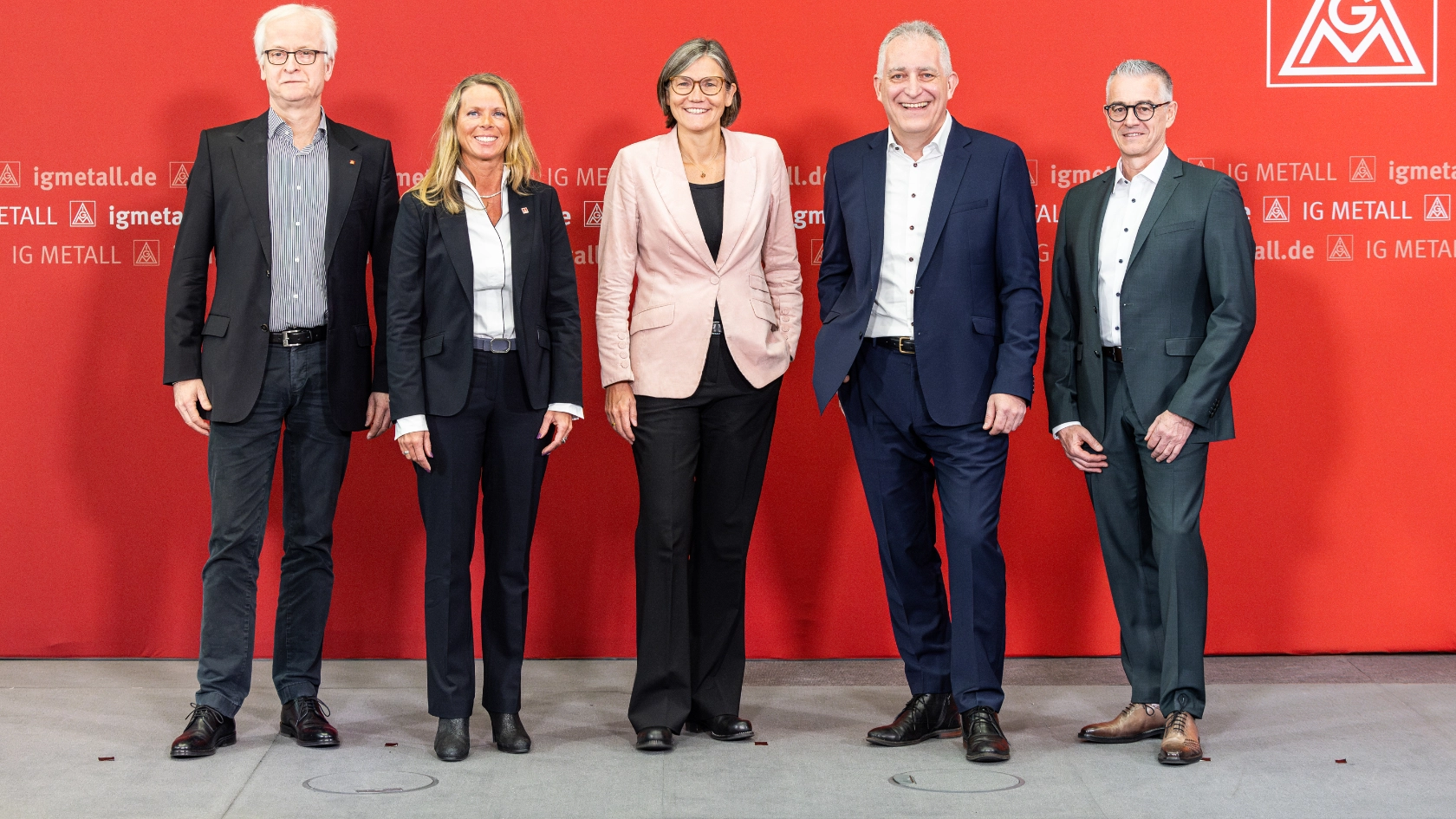
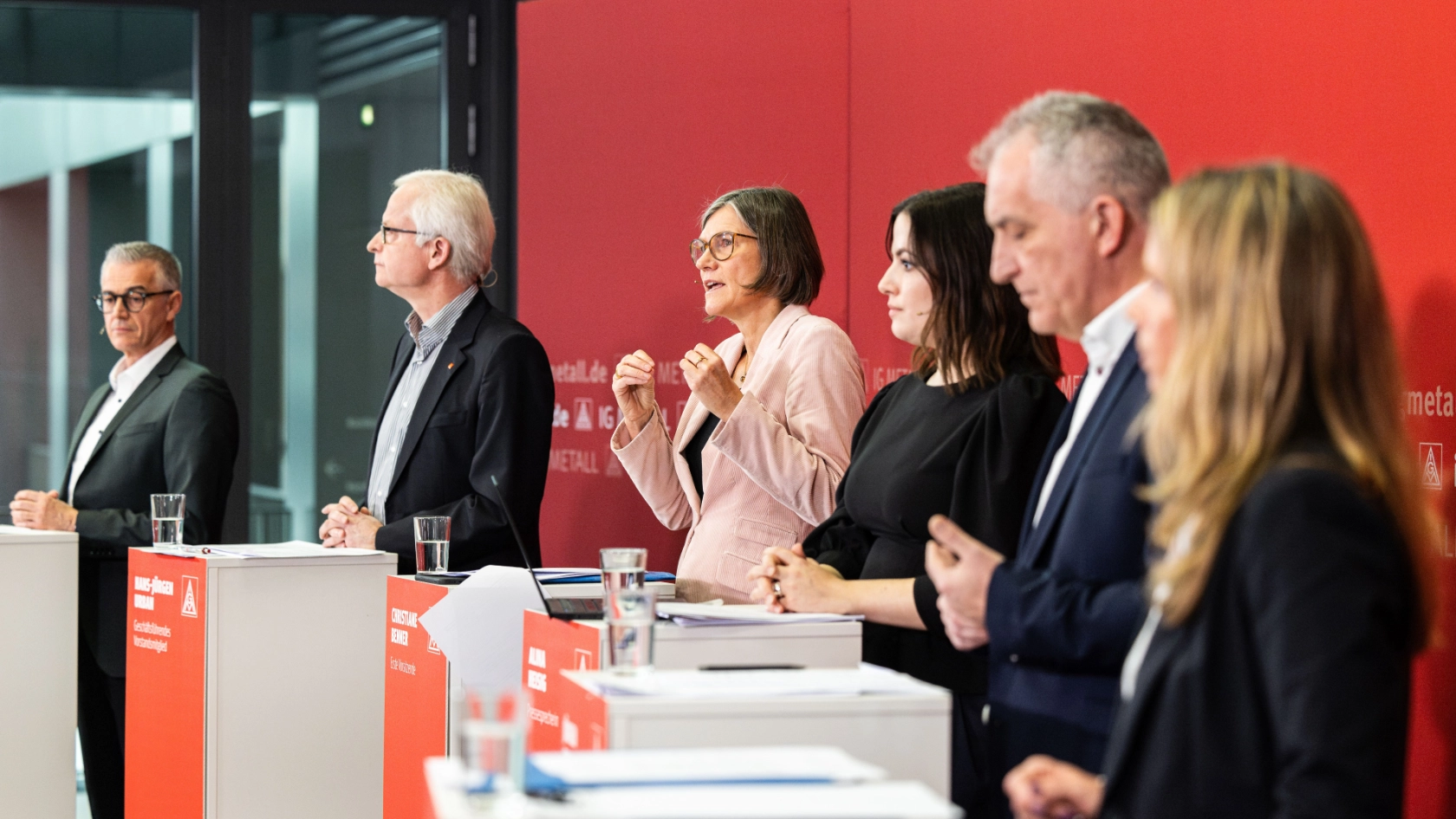
Frankfurt am Main – IG Metall is calling on companies and policymakers to take responsibility for consistently making industry climate-neutral, thereby strengthening good jobs in Germany for the future. “We now need a clear commitment from all sides to preserve and socially and ecologically transform Germany as an industrial hub—through actions, not just words,” says Christiane Benner, First Chair of IG Metall, at the union’s annual press conference. “Companies must now go all out and invest in future technologies here in Germany. The traffic-light coalition must abandon its piecemeal, sometimes dogmatic approach. We are convinced that the federal government can do better! It must prove this this year and finally take the big leap.”
Looking at the current state of transformation in Germany, the President paints a mixed picture: On the one hand, there are important new industrial investments, such as in battery manufacturing or semiconductor production. At the same time, site closures and relocations are on the rise, affecting entire regions.
Security Amid Change Is the Best Protection Against Political Disenchantment
“Deindustrialization threatens social cohesion in the country and, with it, our democracy,” warns Benner. “Workers demand a clear vision for the future. Security amid change—that is the best protection against political disillusionment.”
Specifically, IG Metall is calling for government investments totaling approximately 500 billion euros over a ten-year period. These investments are necessary to ensure that Germany remains a viable business location for the future.
Call for a Transformation Commission
To ensure that the climate-neutral restructuring of industry progresses faster and more effectively, a new transformation commission should be established. Representatives from the federal and state governments, companies, IG Metall, and experts should work together to develop a concrete program without delay. “We now need a task force for transformation that will outline by September exactly how we can achieve our climate goals while simultaneously strengthening industry and jobs in Germany,” explains Jürgen Kerner, Second Chairman of IG Metall.
The new commission is tasked with identifying the private and public investments needed to achieve the climate goals, clarifying the government framework and market-based incentives to trigger private investment, and designing a suitable, reliable, and legally sound financing instrument for public investments.
“Workers need an active industrial policy now. The situation is too serious for partisan political games,” Kerner emphasizes. “Clear, forward-looking decisions are necessary: The debt brake must be abolished; at the very least, it must be reformed so that it no longer acts as a brake on the future and jeopardizes jobs. We will not accept the deindustrialization of Germany.”
More Democracy in the Workplace
Furthermore, from IG Metall’s perspective, a massive skills development and training initiative is needed so that both industries undergoing transformation and newly emerging sectors can offer a future to as many workers as possible. In addition, IG Metall expects policymakers to expand worker participation in workplaces and companies and to strengthen collective bargaining coverage. “Workers need to feel that they are not at the mercy of change, but can help shape it. This is only possible with more democracy in the workplace,” said Christiane Benner.
Record Number of New Members and Revenue
IG Metall itself considers itself well-positioned to meet future challenges. With 129,348 new members, the union once again surpassed last year’s record for new members—an increase of 10 percent. Only in 2018, before the outbreak of the pandemic, were there more new members. The departures—largely due to demographic factors—were almost completely offset. With approximately 2.14 million members as of December 31, 2023, membership trends remain largely stable.
The influx of new members is also strengthening the union’s finances: Membership dues revenue reached a record high of 620 million euros in 2023. The lion’s share of this goes to the 148 regional offices nationwide to support their work in local workplaces and industries.
“The influx of members in the workplaces ensures that our strike fund is well-stocked,” states Nadine Boguslawski, chief treasurer of IG Metall.
Collective bargaining agreements are anchors of stability in times of upheaval
Looking ahead to the upcoming round of collective bargaining in the metal and electrical industries this fall, Boguslawski says: “IG Metall is entering the 2024 collective bargaining negotiations with a constructive mindset and a willingness to take a stand. Our fight for collective bargaining coverage is a fight to shape the transformation. Especially in times of economic and political turmoil, collective bargaining agreements serve as an anchor of stability for democracy and provide security amid change. Our members’ participation in shaping our demands—on behalf of the 3.9 million workers in the metal and electrical industries—serves as a model for transformation across workplaces as a whole.”
For social security and solidarity, against hate and incitement
Hans-Jürgen Urban, Executive Board Member, emphasizes the importance of social security, especially in times of upheaval: “Right now, curbing the welfare state and debates over cuts—such as those regarding the citizen’s income—are the wrong approach. In times of upheaval, we need social security, not further uncertainty. A stable welfare state is worth more than it costs. Ecological transformation is only possible with sufficient social investment. Support for people is only possible with social security. Our welfare state therefore requires solidarity-based financing so that it can decisively cushion economic cycles and structural change.”
Ralf Reinstädtler, Executive Board Member, clearly rejects exclusion and attempts to sow division: “Fantasy scenarios of upheaval, hatred, and incitement are not answers to change, but rather a fight against constructive, union-led engagement. We offer concerned workers a home based on solidarity for dialogue and action. We resolutely educate and combat those who hate humanity in workplaces and parliaments. With 90,000 participants annually, IG Metall is one of the largest educational providers in Germany. We want to train advocates for democracy and human rights in the workplace. Workers need the practical and political tools to shape the transformation in a social, just, and democratic way.”
Background Information on the 2024 Annual Press Conference(Membership and Finances)