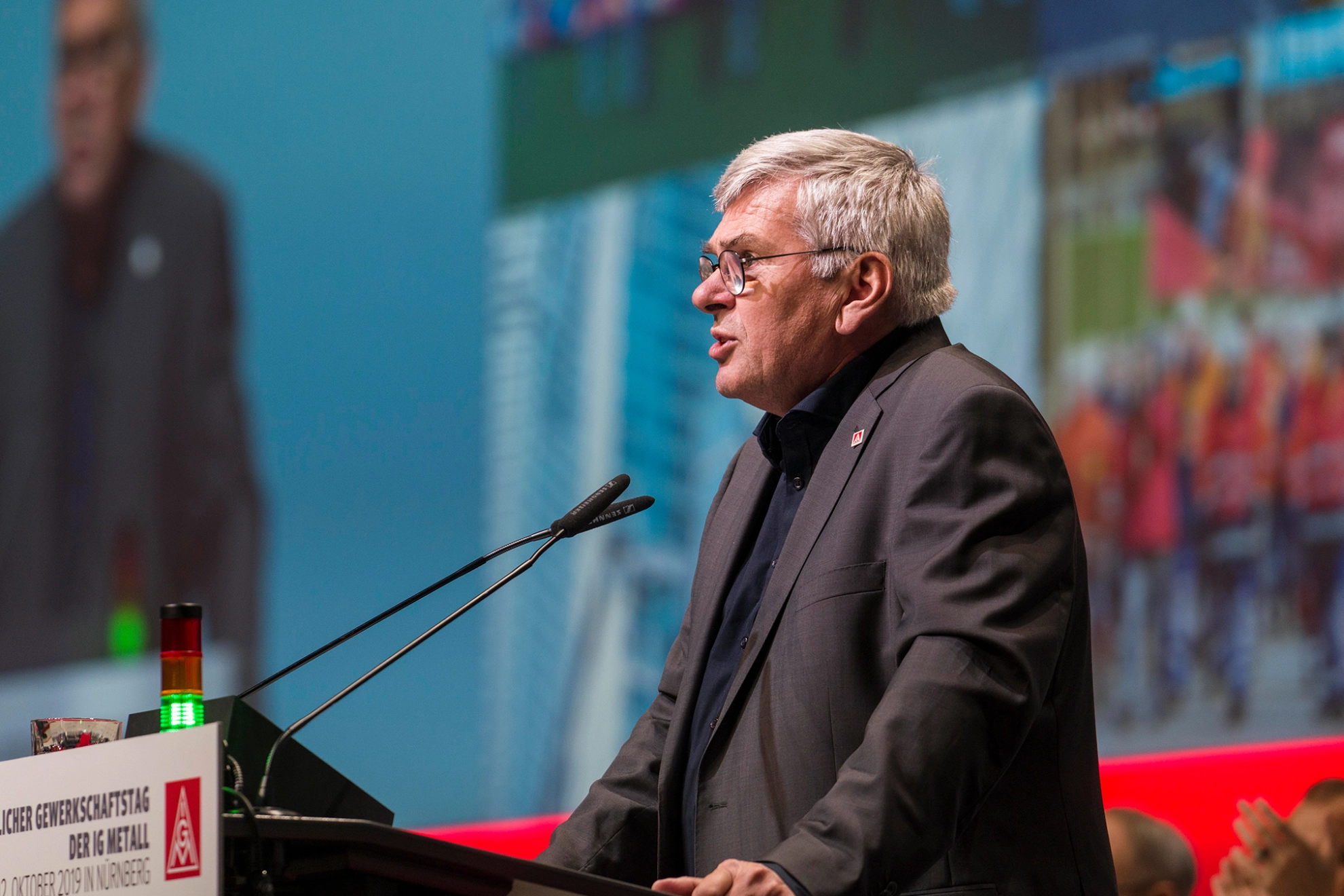
Frankfurt am Main – The COVID-19 pandemic has the economy in its grip: Many businesses are losing liquidity day by day, and small and medium-sized enterprises in particular are at risk of insolvency. All forecasts indicate that gross domestic product will decline significantly. “We are currently experiencing the deepest recession in postwar history worldwide. Beyond the support measures taken so far, it is therefore now essential to provide a strong, short-term stimulus to demand in order to get the economy back on track while simultaneously driving forward the digital and ecological transformation of our industries in the long term,” said Jörg Hofmann, President of IG Metall, on Friday in Frankfurt.
IG Metall has presented corresponding proposals for an economic stimulus package. To be effective, the stimulus package should amount to at least 3 percent of economic output. That is well over 100 billion euros. “To quickly and effectively boost demand, it makes sense now to go big rather than small, before the recession eats even deeper into our economy and unemployment rises sharply,” said Hofmann.
Hofmann sees no room for tax cuts or the complete abolition of the solidarity surcharge. “That would enormously limit the scope for public investment and have only a minor impact on private demand.”
In the short term, the priority is to maintain purchasing power and safeguard employment. “This requires an economic stimulus package that covers all sectors and strengthens demand.”
One way to achieve this could be to support families and low-income earners through consumption vouchers, which would have an immediate impact on demand. Families should receive these time-limited consumption vouchers in the amount of at least 300 euros per child.
Furthermore, in light of the sharp decline in local governments’ trade tax revenues, public investment must be safeguarded by supporting municipal budgets. “Municipal investment activity provides important stimulus to the skilled trades and local service and commercial enterprises; this must not be allowed to disappear,” said Hofmann.
In addition to protecting companies and employees from the threat of insolvency in the sectors of the economy that have been particularly hard hit, “a sustainable path out of the recession will depend on how successfully we can put German industry back on a growth trajectory,” said Hofmann.
Special depreciation allowances—for example, for investments in energy-efficient technologies and processes—are an appropriate means of strengthening private investment. Given its great importance to the entire industrial sector, this also includes support for the automotive industry. Hofmann: “The automotive industry is a key industry in Germany. If demand collapses here, it affects entire regions and other sectors—from machine tool manufacturing to the steel industry.” One in every four euros of industrial value added in Germany depends on the automotive industry. Ultimately, this also helps tradespeople, retailers, and restaurants.
That is why a purchase incentive in the form of an environmental bonus would be the right approach. Such a bonus must meet three conditions: First, it must contribute to a significant reduction in CO2 emissions. Second: The incentive must support employment and lead to a reduction in short-time work. Therefore, it must be technology-neutral and should also promote vehicles with low-emission internal combustion engines, as 90 percent of employees at manufacturers and suppliers work on these. Third: It may only be implemented if manufacturers also make a substantial contribution.
To create the framework for the desired mobility transition, measures to further develop and expand private and public charging infrastructure must also be included in an economic stimulus package that takes effect in the short term. The electricity from charging stations should come from renewable energy sources. This is another reason why the energy and heating transition must be accelerated.
Hofmann expects employers to commit to their social responsibility. “As many employees as possible should be retained in their companies using the existing tools of short-time work and flexible working hours. Financial support from public funds must be tied to such commitments. No layoffs in exchange for government aid.”
IG Metall’s proposals for an economic stimulus package can be found at www.igmetall.de/vorschlaege-konjunkturpaket
Further information and press photos of Jörg Hofmann